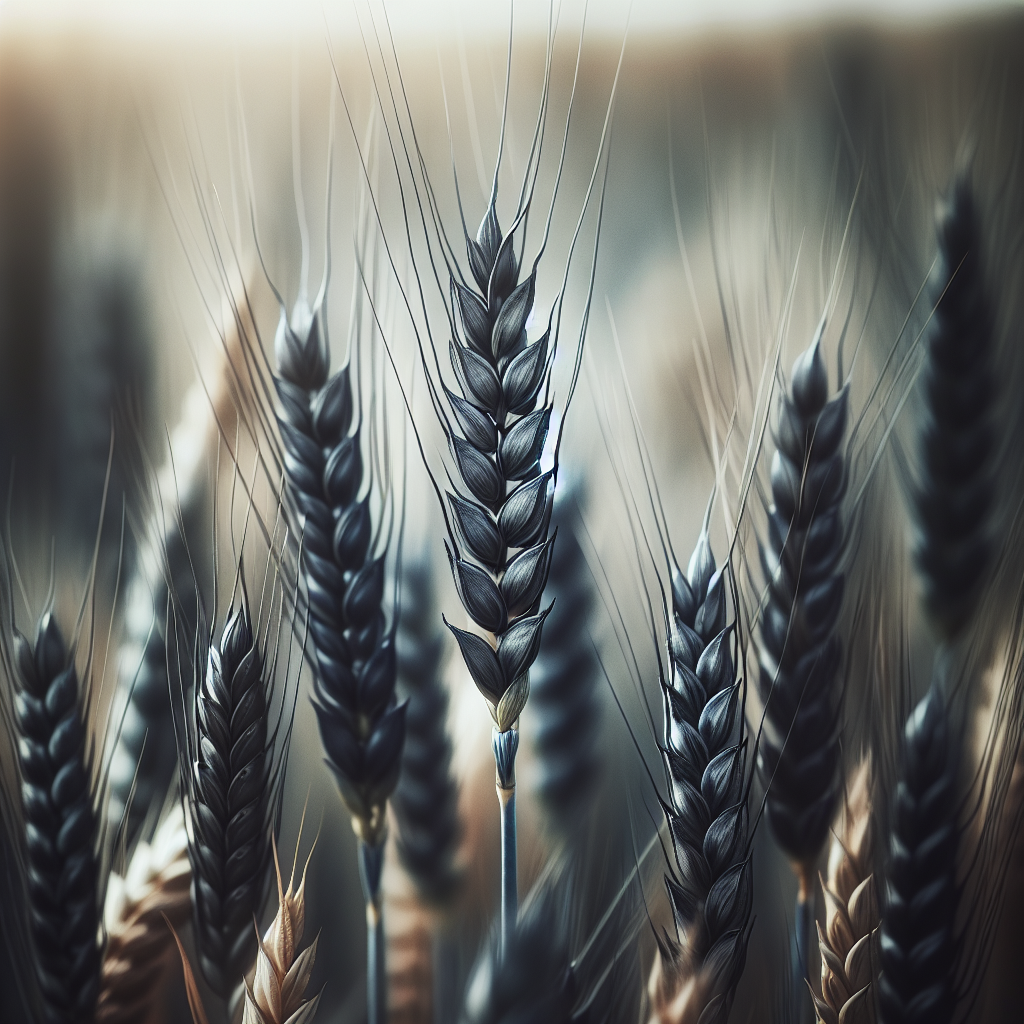
Introduction to Black Emmer
An ancient hulled wheat with roots in some of the earliest grain-growing civilizations, this crop belongs to the emmer group and is closely tied to the development of dryland agriculture across the Fertile Crescent, Mediterranean basin, and parts of Central Europe. Black forms are especially prized for their dramatic dark glumes or grain appearance, artisan baking quality, and adaptability to lower-fertility land where modern wheats often lose consistency.
For practical growers, its main advantages are hardiness, tolerance of cool-season conditions, good competitiveness against weeds once established, and reliable performance in low-input systems. Its main limitations are equally important to understand: the kernels remain tightly enclosed in hulls after harvest, so threshing alone does not produce clean grain. A dehulling step is usually required before milling or food use.
Compared with modern bread wheat, Black Emmer generally produces taller plants, more fibrous straw, and lower but more stable yields under stress. The grain is usually high in minerals and often appreciated for dense, aromatic flour, porridge, pilaf, whole-kernel salads, and traditional breads. If you already know Wheat, think of Black Emmer as a more primitive, more resilient, but less mechanically convenient cereal.
Its deep coloration can come from dark glumes, pigmented bran layers, or landrace selection rather than a single uniform commercial standard. Because seed sources vary, it is wise to trial a small block first and record days to maturity, plant height, disease tolerance, and lodging resistance under your own conditions.
Botanical Profile of Black Emmer
This crop is a tetraploid wheat in the species complex Triticum turgidum, subsp. dicoccum. It is a hulled wheat, meaning the caryopsis adheres firmly to the lemma and palea at maturity. That one trait has major management implications: harvest timing, post-harvest cleaning, market planning, and processing equipment all differ from common free-threshing wheat.
Key botanical traits include:
- Growth habit: annual cool-season grass
- Plant height: commonly 90-150 cm, depending on fertility, moisture, and strain
- Rooting: fibrous but often vigorous and relatively efficient in structured soils
- Tillering: moderate to strong under lower plant populations
- Spike type: two-rowed spikelets typical of emmer architecture
- Awns: many lines are awned, which can improve bird deterrence and aid photosynthesis in dry environments
- Grain form: elongated kernels enclosed in tough hulls
- Grain color: black or very dark expression may appear in hulls, grain bran, or both depending on the population
Black Emmer usually develops a strong upright juvenile habit, then elongates rapidly once vernalization and spring temperatures trigger stem extension. It tends to be less responsive to very high nitrogen than modern semi-dwarf wheats, and excessive fertility can actually increase lodging risk without proportionate grain gain.
Physiologically, this is a crop better adapted to moderate stress than luxury conditions. In rich soils with heavy irrigation, vegetative growth can become excessive. Under balanced nutrition and moderate rainfall, the crop often produces denser, more resilient stands and better grain quality.
Most seed lots are winter or facultative types, though spring forms exist. Winter types typically require exposure to cold to initiate reproductive development and are sown in autumn for harvest the following late spring or summer. Always confirm your seed source before planting, because sowing a winter line in warm spring conditions can result in delayed or failed heading.
Soil, pH, and Climate Requirements for Black Emmer
This crop is best suited to temperate and Mediterranean-like climates with cool establishment periods, moderate spring growth, and a relatively dry ripening window. It is notably more forgiving of thin, stony, calcareous, or moderately low-fertility soils than modern wheat, but it still performs best when drainage, structure, and mineral balance are managed well.
Ideal soil texture ranges from silt loam to clay loam, though well-structured sandy loams can also work if moisture is conserved. Heavy clays are acceptable only if drainage is good and winter waterlogging is limited. Standing water for more than 48-72 hours in the seedling phase can sharply reduce plant stand through crown rot, poor rooting, and oxygen deprivation.
The preferred soil pH is approximately 6.0-7.8, with an optimum around 6.5-7.3. It tolerates mild alkalinity better than many modern cereals, especially where calcium is sufficient and micronutrients remain available. Below pH 5.8, watch for reduced root vigor, manganese toxicity risk, and poorer phosphorus uptake. In alkaline soils above pH 8.0, zinc deficiency can show up as pale striping on younger leaves and reduced tillering.
Target soil organic matter should ideally exceed 2.5% in arable fields and be higher in dryland systems where water-holding capacity is critical. Black Emmer benefits enormously from biologically active soil with good aggregation. If your soil crusts after rain, emergence can be uneven, especially from deeper sowing.
Climate targets:
- Germination: 4-20°C, with fastest emergence around 12-18°C
- Vegetative growth: 10-20°C
- Grain filling: 18-26°C is acceptable, but prolonged heat above 30°C shortens fill and reduces kernel size
- Frost tolerance: winter types tolerate substantial cold once established and hardened off
- Rainfall: roughly 350-700 mm seasonal moisture, depending on soil type and evaporative demand
The crop prefers moderate moisture through tillering and stem elongation, then drier conditions from late dough to harvest. Persistent humidity during heading and flowering can encourage foliar disease and Fusarium risk. By contrast, intense drought at boot stage can reduce head emergence and grain number.
A useful field target is to maintain soil moisture in the active root zone at roughly 60-80% of field capacity from emergence through early grain fill in irrigated systems. If it drops below about 45-50% during tillering, expect reduced tiller survival. If it remains saturated near field capacity without air exchange in heavier soils, roots become shallow and disease pressure rises.
If you are building fertility for heritage grains, the principles in soil health strategies apply especially well to this crop because stable aggregation and balanced nutrient release matter more than sheer nitrogen abundance.
Step-by-Step Planting & Propagation
This crop is propagated by seed. There is no vegetative propagation in commercial practice, and farm-saved seed can be used successfully if it is clean, true to type, disease-free, and stored properly.
Select the right seed lot. Choose a winter or spring type suited to your climate. Seed should be plump, fully mature, and free from musty odor, smut contamination, and obvious insect feeding. Hulled seed can still be viable for sowing, depending on source and equipment; confirm whether your seed is in spikelets or fully dehulled planting seed before calibrating drills.
Prepare the seedbed. Aim for a firm, fine, moist seedbed with good seed-to-soil contact. Large clods reduce emergence uniformity, but over-pulverized soil can crust after rain. In no-till systems, successful establishment is possible after legumes or broadleaf crops if residue distribution is even and slug pressure is low.
Time sowing carefully. For winter Black Emmer, sow 2-4 weeks before the average first hard freeze, allowing enough time for root establishment and 2-4 leaves before deep winter. In mild winter climates, later autumn sowing helps reduce aphid and viral pressure. Spring forms should be planted as early as workable soil conditions allow.
Determine seeding rate. Because Black Emmer tillers reasonably well, avoid excessive rates. A common target is 250-350 viable seeds per square meter under average conditions. Increase to 350-400 seeds per square meter in late sowing, colder sites, heavy weed pressure, or lower germination lots. In row agriculture, 15-20 cm spacing is standard; wider spacing can work in organic systems where inter-row cultivation is planned.
Set planting depth. Sow 2.5-5 cm deep. Use 2.5-3.5 cm in heavier or moist soils, and 4-5 cm in lighter soils or dry autumn conditions. Deeper than 5 cm can delay emergence and weaken seedlings, particularly in crusting soils.
Fertility at planting. Apply phosphorus and potassium according to soil test. Avoid large soluble nitrogen applications at sowing unless soils are very poor. A modest available nitrogen level supports establishment, but too much early nitrogen encourages lush growth and lodging later.
Roll or firm if needed. In dry soils, rolling after sowing can improve seed-soil contact and conserve moisture. Do not roll sticky clay soils likely to seal over.
Monitor emergence. Uniform emergence usually occurs in 7-14 days under favorable conditions. Patchy emergence often points to poor depth control, seed predation, slug feeding, crusting, or seedborne issues.
For organic growers, a stale seedbed can be highly effective. Prepare the bed early, allow the first flush of weeds to germinate, then lightly cultivate before drilling. This gives Black Emmer a crucial head start.
Care & Maintenance regimes for Black Emmer
Management should be conservative, balanced, and responsive to growth stage. This is not a crop that rewards aggressive feeding and frequent irrigation in the way some modern cereals do.
Water management is most important from establishment through flowering. After emergence, the top 5-8 cm of soil should remain slightly moist but never sticky for extended periods. In practical terms, if you squeeze soil from the root zone and it forms a weak ball that breaks apart with light pressure, moisture is usually acceptable. If the soil smears, smells sour, or footprints remain water-sheened, conditions are too wet.
In rainfed systems, the goal is moisture conservation rather than irrigation frequency. In irrigated production, typical scheduling might include:
- Establishment irrigation if rainfall is insufficient to wet the top 10-15 cm
- A second irrigation at active tillering if soil moisture falls below about 55% of field capacity
- A critical irrigation at stem elongation to boot stage
- A final irrigation at early milk stage only if severe dryness threatens grain fill
Avoid irrigating late once grain reaches hard dough. Late water increases lodging, delays dry-down, and may reduce grain quality.
Signs of underwatering include bluish-gray cast to leaves, reduced tillering, rolled leaf margins during midday, shortened stems, and uneven head emergence. Signs of overwatering include yellow lower leaves despite adequate fertility, shallow roots, soft lush growth, lodging after wind, and increased crown disease.
Nutrient management should prioritize moderation. Total nitrogen needs often range around 40-90 kg/ha in lower-input systems, depending on soil reserves, preceding crop, and yield target. Following a legume such as Clover or Fava Bean (Broad Bean), additional nitrogen may need to be reduced substantially. Excess nitrogen produces rank canopies, softer straw, delayed maturity, and weaker grain filling. Split applications are safer than one heavy dose: a small amount at planting and the rest near tillering or early stem extension.
Phosphorus supports rooting and winter survival, while potassium improves stem strength, water regulation, and disease tolerance. Sulfur can be important on sandy or low-organic-matter soils. Micronutrient problems are less common but zinc, copper, and manganese should be checked where pH or soil history suggests risk.
Weed management depends heavily on early establishment. Once tillered, Black Emmer can suppress weeds reasonably well thanks to height and canopy architecture. The vulnerable period is from sowing to early tillering. Effective tactics include clean seed, rotation, stale seedbeds, narrow row spacing, and avoiding sparse stands. In small plots, tine weeding at the white-thread weed stage can be useful, but timing must avoid uprooting young cereal seedlings.
Lodging prevention is critical. To reduce lodging:
- Keep nitrogen moderate
- Avoid over-irrigation after stem elongation
- Do not sow overly dense stands in fertile soils
- Maintain potassium sufficiency
- Select fields sheltered from extreme wind if possible
In mixed farming systems, Black Emmer straw has real value as bedding, mulch, or thatch material due to its length and toughness.
Pests, Diseases & Organic Management
This crop is generally resilient, but it is not immune. Disease and pest risk depends heavily on rotation, humidity, seed quality, residue management, and fertility balance.
Common diseases include rusts, powdery mildew, Septoria-type leaf blotches, smuts, bunts, take-all, and Fusarium head blight in wet flowering periods. Black Emmer may show useful tolerance to some local diseases compared with modern wheat, but landrace variability means resistance should never be assumed.
rusts appear as orange, yellow, or brown pustules on leaves and stems. They spread quickly in humid weather and dense stands. powdery mildew shows as white dusty growth on leaf surfaces, especially in shaded, lush canopies. Fusarium risk is greatest when rain or heavy dew coincides with flowering; bleached spikelets and lightweight kernels are warning signs.
Organic disease management starts before sowing:
- Rotate away from cereals for at least 2 years when possible
- Avoid planting after heavily diseased wheat or barley residues
- Use clean seed and hot-water or approved biological seed treatment where practical
- Favor good airflow and moderate fertility rather than dense, nitrogen-rich canopies
- Choose fields with morning sun and lower dew persistence
For seedborne smuts and bunts, strict seed sanitation matters more than rescue treatment. Do not save seed from infected fields unless it is professionally cleaned and treated.
Insect pests may include aphids, cereal leaf beetle, wireworms, armyworms, and occasional grasshoppers or bird pressure. aphids are important not only for feeding damage but also for transmitting barley yellow dwarf virus. Late summer volunteer cereals and early autumn green bridges should be destroyed before sowing to reduce virus carryover.
Birds can feed on newly sown seed or maturing heads, though awned emmer often suffers less than soft-headed cereals. Rodents may damage both field margins and stored grain.
Organic pest management priorities:
- Encourage beneficial habitat near, but not within, production zones with Yarrow or insectary strips
- Sow into warm enough conditions for quick emergence
- Destroy volunteer cereals 2-3 weeks before planting
- Use row and field sanitation to reduce pest carryover
- Scout weekly from emergence to milk stage
Threshold-based intervention is better than routine spraying. For small plots, spot treatment with insecticidal soap is rarely practical on cereals; ecological prevention and timing are more effective.
Harvesting, Curing & Optimal Storage
Harvest timing is different from vegetable crops and slightly more nuanced than with free-threshing wheat because the hull remains attached. The goal is to cut when grain is fully mature, dry enough for safe harvest, but not so brittle that shattering and field loss increase.
Typical indicators of maturity include:
- Whole plant turns from green to golden-buff or bronzed, depending on line
- Heads bend less and lose green tint
- Kernels in hulls are firm and cannot be dented with a thumbnail at full maturity
- Straw below the head is dry
- Grain moisture ideally approaches 12-14% for direct combining, though some harvest slightly higher and dry down artificially
In small-scale systems, plants can be cut with a sickle or scythe and bundled. Cure sheaves upright in a dry, airy place protected from rain until stems are crisp. In mechanized systems, combine settings often need adjustment to reduce damage to hulled spikelets and minimize unthreshed losses.
Remember that harvested material is usually spikelets, not naked grain. After threshing, a dehuller or abrasive hulling system is required to remove the adhering hulls. Plan this before planting if the crop is intended for food sale.
Post-harvest handling steps:
- Clean out chaff, broken straw, and weed seeds.
- Dry to safe storage moisture. For long-term storage, dehulled grain should be at or below 12%, and preferably near 10-11% in warm climates. Hulled spikelets store somewhat more safely but still require dryness.
- Cool the grain quickly if possible. Stored grain pests multiply much faster above 15°C.
- Use rodent-proof, moisture-proof containers or bins.
- Monitor monthly for condensation, off odors, caking, or insect activity.
Signs of poor storage include a sweet-fermented smell, heating, damp clumps, dust from insect feeding, or webbing from moth larvae. Once grain temperature rises in storage, quality drops fast. Heritage grains also lose flavor if stored warm for long periods.
For seed storage, choose the cleanest, most uniform lot from disease-free sections of the field. Dry gently, avoid overheating, and store cool and dark. Label year, field, source, and performance notes because on-farm selection is one of the best ways to adapt Black Emmer to local conditions.
Companion Planting for Black Emmer
In broadacre cereal production, companion planting usually means border plantings, strip intercropping, undersowing, or rotational companionship rather than mixing many species directly in the row. The best companions are those that support fertility, beneficial insects, pollination ecology around the field, or weed suppression without overwhelming the grain.
Clover is one of the best partners, especially as a frost-seeded or undersown living cover in lower-rainfall systems with careful management. It protects soil, adds nitrogen over time, improves traffic resilience, and suppresses some weeds after grain harvest. Keep the stand light while the cereal is actively filling grain to avoid moisture competition.
Fava Bean (Broad Bean) works well in rotation or in wider-row experimental strip systems. It contributes biologically fixed nitrogen, breaks cereal disease cycles, and leaves behind a favorable soil structure for the following grain crop.
Yarrow is useful along margins rather than within the crop. It supports parasitoid wasps and predatory insects that help regulate aphids and other small pests. It also tolerates dry field edges and perennial border management.
Thyme is another margin or pollinator-strip companion rather than a field intercrop. It attracts beneficial insects, remains low-growing, and fits well near pathways, plot edges, or heritage grain demonstration plantings.
Avoid aggressive companions inside dense grain stands, especially tall broadleaf species that compete for light and moisture during stem elongation and grain fill. In most practical systems, rotational companionship is more effective than direct interplanting. A sequence such as legume year, Black Emmer year, then a smother or root crop often gives better long-term results than forcing multiple species into the same cereal stand.