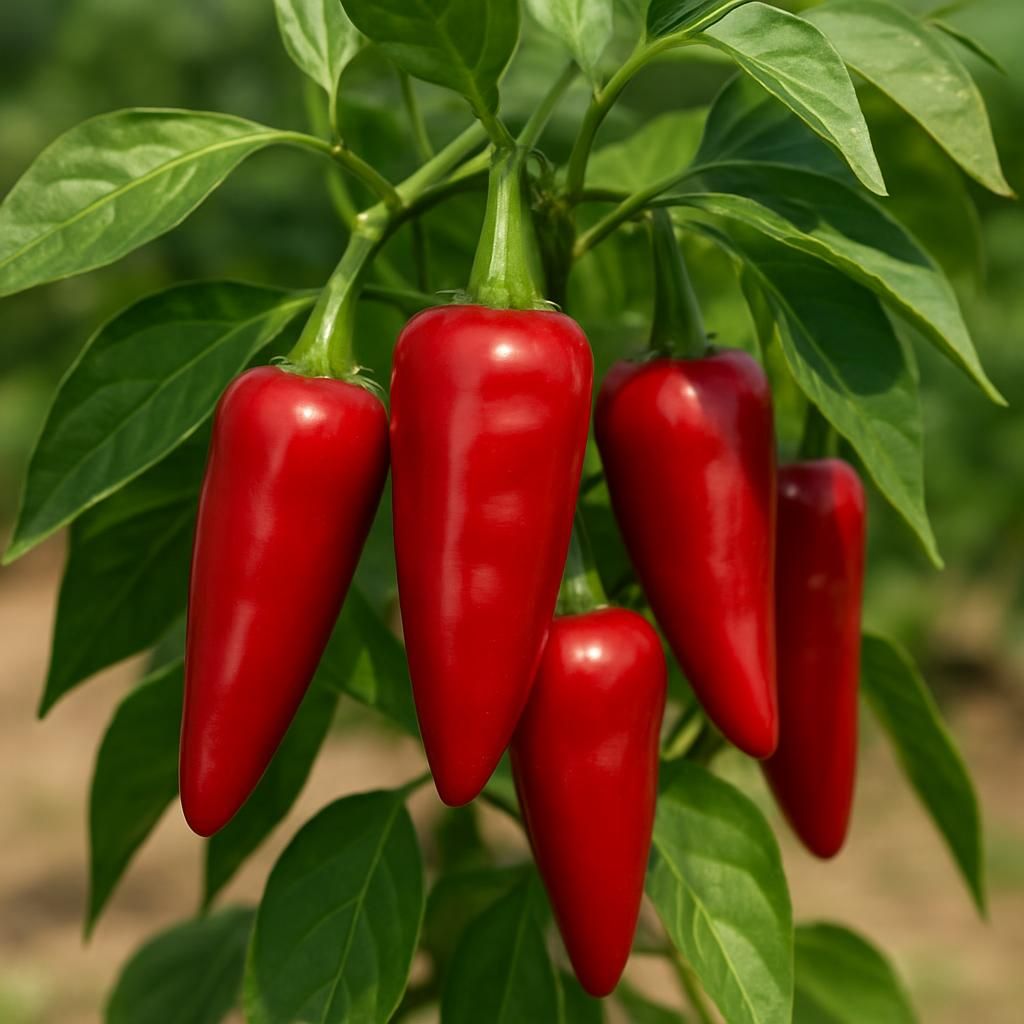
Introduction to Bhavnagari Chili
Bhavnagari Chili is a traditional variety originating from the Bhavnagar region of Gujarat, India. Farmers prize it for its thick pericarp, deep red pods, and moderate pungency (30,000–50,000 Scoville Heat Units). The variety commands premium prices in both domestic spice markets and export channels for whole dried chilies and powder. Its robust plant architecture and tolerance to heat make it suitable for smallholder and commercial operations alike.
Botanical Profile of Bhavnagari Chili
Bhavnagari Chili belongs to the species Capsicum annuum. Plants are compact, 60–90 cm tall, with dark-green, lanceolate leaves and a determinate growth habit. Flowers are white with purple anthers; fruits are elongated (6–9 cm), slightly curved, and turn from green to glossy red at maturity. The variety shows moderate branching and sets fruit continuously for 90–120 days after transplanting.
Soil, pH, and Climate Requirements for Bhavnagari Chili
Successful cultivation begins with well-drained sandy loam to clay loam soils rich in organic matter. The crop prefers a slightly acidic to neutral pH and warm temperatures with moderate humidity.
| Parameter | Ideal Range | Notes |
|---|---|---|
| Soil Type | Sandy loam to clay loam | Good drainage prevents root rot |
| Soil pH | 6.0–7.0 | Adjust with lime or sulfur as needed |
| Temperature (Day) | 25–35 °C | Optimal fruit set occurs in this range |
| Temperature (Night) | 18–22 °C | Below 15 °C slows growth |
| Relative Humidity | 60–75 % | Higher humidity increases disease risk |
| Annual Rainfall | 600–900 mm | Supplemental irrigation required |
| Altitude | 0–800 m | Performs well in coastal plains |
Step-by-Step Planting & Propagation
- Raise seedlings in 98-cell pro-trays using sterilized cocopeat and vermicompost mix. Sow seeds 0.5 cm deep; germination occurs in 7–10 days at 28 °C.
- Harden seedlings for 7 days before transplanting when they reach 4–5 true leaves (25–30 days old).
- Prepare raised beds 90 cm wide with 45 cm furrows. Incorporate 10–15 t ha⁻¹ well-rotted FYM.
- Transplant seedlings at 45 × 45 cm spacing during evening hours. Water immediately after planting.
- Apply a light irrigation on the third day to settle roots.
Care & Maintenance regimes for Bhavnagari Chili
Consistent moisture and balanced nutrition are critical during flowering and fruiting. Use drip irrigation and fertigation for precision.
| Growth Stage | Water Schedule | Fertilizer (NPK kg ha⁻¹) | Pruning & Training |
|---|---|---|---|
| Seedling (0–30 d) | Light daily misting | 20-10-10 basal | Remove lower leaves at 15 cm height |
| Vegetative (30–60 d) | 4–5 L plant⁻¹ every 3 days | 40-20-20 + 10 kg ZnSO₄ | Pinch terminal bud at 30 cm |
| Flowering (60–90 d) | 6–7 L plant⁻¹ every 2 days | 30-10-30 + 5 kg Borax | Remove basal suckers weekly |
| Fruiting (90–150 d) | 8 L plant⁻¹ every 2 days | 20-0-40 split every 15 days | Remove diseased fruits immediately |
Pests, Diseases & Organic Management
Major threats include Aphids, Thrips, Spider Mites, fruit borers, Powdery mildew, Anthracnose, and Chili leaf curl disease. Monitor weekly with yellow sticky traps. Release predatory mites and ladybird beetles for biological control. Spray neem oil (5 ml L⁻¹) or spinosad (0.5 ml L⁻¹) at economic threshold levels. For fungal issues, apply copper hydroxide or Bacillus subtilis formulations. Remove and destroy infected plant debris after harvest.
Harvesting, Curing & Optimal Storage
Harvest green chilies 55–60 days after transplanting for fresh markets; wait until full red color for drying. Pick every 7–10 days during peak season. Sun-dry pods on clean tarpaulins for 5–7 days to 10–12 % moisture. Store in jute bags with silica-gel sachets at 10–12 °C and 60 % RH. Properly cured produce retains color and pungency for 12 months.
Companion Planting for Bhavnagari Chili
Intercrop with Marigold to repel nematodes and whiteflies. Basil and Thai Basil improve flavor and deter pests. Sow rows of Onion or Garlic as border crops to reduce aphid pressure. Avoid planting near Eggplant and Tomato to limit shared viral vectors. Rotate with legumes every third season to restore soil nitrogen.