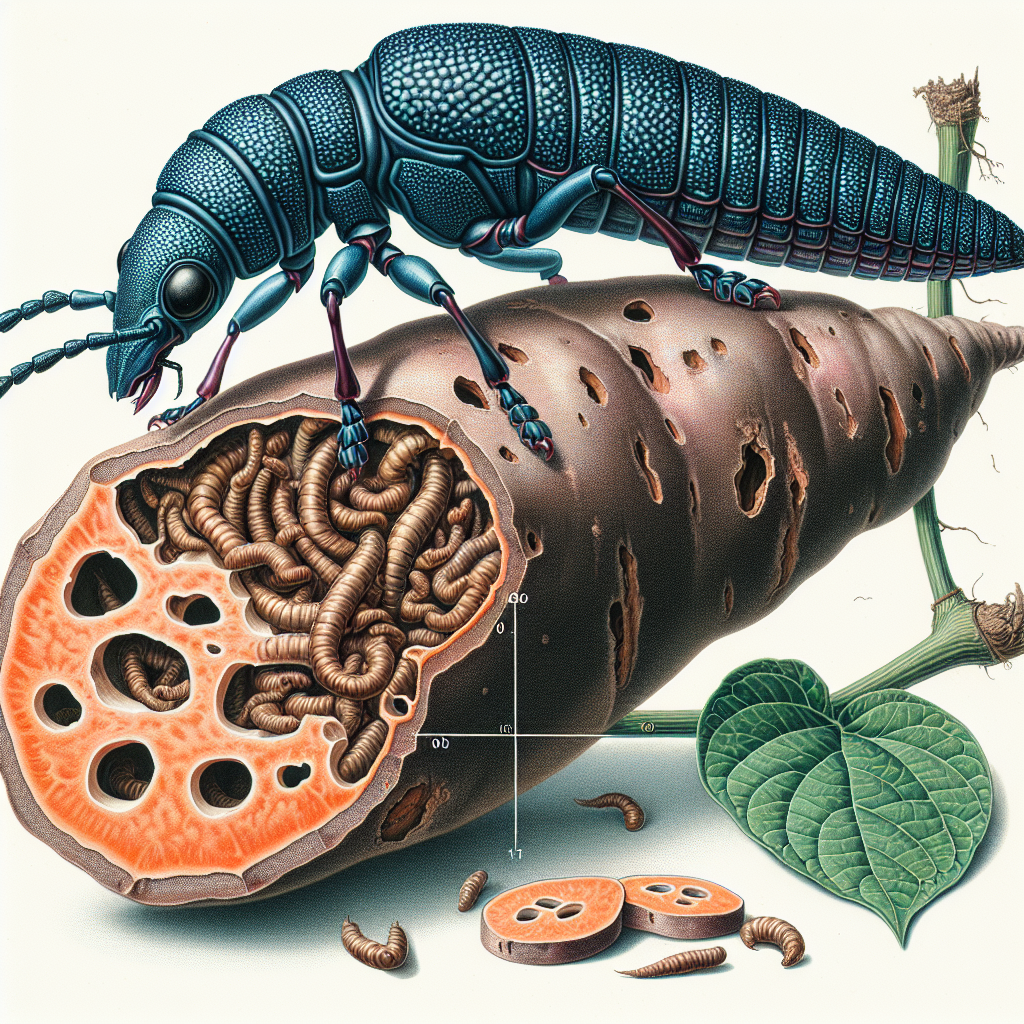
Introduction to Sweet potato weevil
The sweet potato weevil, scientifically known as Cylas formicarius, stands as one of the most destructive pests threatening sweet potato crops worldwide. This small, cylindrical beetle, often measuring just 5-8 mm in length, infests roots, tubers, vines, and leaves of sweet potatoes, leading to up to 90% yield losses in severe cases. Originating from tropical Asia, it has spread to Africa, the Americas, and the Pacific islands, posing a major challenge to smallholder farmers and commercial growers alike.
Recognizing this pest early is crucial, as its hidden larval tunneling renders tubers inedible and unmarketable. Adult weevils are distinctive with their shiny black or reddish-brown bodies, long antennae resembling ants, and a snout for boring into plant tissue. Females lay eggs in clusters on vines or directly into soil near roots, hatching into creamy-white larvae that feed voraciously inside plant parts. The economic impact is staggering: in regions like sub-Saharan Africa and the southeastern United States, infestations can wipe out entire harvests, exacerbating food insecurity and economic hardship for farmers reliant on sweet potatoes as a staple crop.
This guide provides comprehensive diagnostics, lifecycle insights, and proven management strategies to protect your Sweet Potato fields. By understanding its biology and implementing integrated pest management (IPM), growers can minimize damage and sustain productivity. For more on small farm pest strategies, check this Spring Pest Patrol blog.
Identifying Symptoms & Damage
Sweet potato weevil damage is often insidious, starting below ground and progressing visibly above. Key symptoms include:
- Small entry/exit holes: Tiny punctures (1-2 mm) on tubers, vines, and stems, often fringed with dark excrement (frass). These are adult feeding and oviposition sites.
- Internal tunneling: Larvae bore galleries inside tubers, creating spongy, discolored tunnels filled with frass. Affected tubers become misshapen, bitter, and unsuitable for consumption or sale.
- Vine wilting and dieback: Infested vines yellow, wilt, and break easily due to larval girdling at the base. Severely damaged plants collapse entirely.
- Gummosis: Oozing sap from stem wounds, especially in humid conditions, which attracts secondary pests like ants or fungal blights.
- Adult presence: Shiny black weevils with long legs and antennae, active at dusk, hiding in soil or leaf litter during the day.
Differentiate from similar pests: Unlike wireworms, which create straight tunnels, weevil larvae make branched, frass-packed galleries. Compared to root-knot nematodes, weevil damage shows clear bore holes rather than galls. Harvest inspection reveals up to 30% infestation rates, with tubers showing dark necrotic spots and off-odors.
Early scouting involves digging up sample plants every 7-10 days, slicing tubers lengthwise to check for larvae. Thresholds for action: 1 weevil per 10 plants or 5% tuber damage. Photoperiod-sensitive strains peak in summer, aligning with sweet potato flowering.
Lifecycle and Progression of Sweet potato weevil
Understanding the lifecycle is key to timing interventions. Cylas formicarius completes 4-6 generations per year in tropical climates, with each cycle lasting 21-45 days depending on temperature (optimal 25-30°C).
- Eggs (3-5 days): Females lay 50-300 eggs singly or in clusters on vines, petioles, or soil cracks near roots. Eggs are white, oval, 0.6 mm long.
- Larvae (10-20 days): Hatching larvae bore into vines or tubers, feeding on parenchyma tissue. They are legless, white with brown heads, growing to 10 mm. Fully grown larvae drop to soil to pupate.
- Pupae (5-10 days): In earthen cells 5-10 cm deep, reddish-brown, resembling adults.
- Adults (lifespan 30-60 days): Emerge at night, feed on foliage, and mate within 3 days. Dispersal up to 1 km via flight.
Progression accelerates in warm, humid conditions; cooler weather (below 20°C) halts development. Overwintering occurs as diapausing adults in soil or crop debris. Population booms post-rainy season when soil moisture favors egg hatch. Trap crops like cassava can monitor peaks.
Environmental Triggers & Risk Factors
Sweet potato weevils thrive in specific conditions, making certain farms vulnerable:
- Warm temperatures: Above 25°C year-round, with peaks at 28-32°C. Tropical/subtropical zones (USDA 9-12) are high-risk.
- High humidity: 70-90% RH promotes egg survival and adult activity.
- Infested planting material: Vine cuttings from contaminated fields spread eggs/larvae; 80% of outbreaks trace here.
- Continuous cropping: Monocultures without rotation allow buildup; avoid planting after potato or yam.
- Poor sanitation: Volunteer plants and unburied debris harbor pupae.
- Soil type: Sandy loams retain weevils; heavy clays reduce survival.
Risk spikes during rainy seasons, drought stress weakens plants, and nearby wild Ipomoea hosts (morning glories) serve as reservoirs. Proximity to infested fields (<500m) increases invasion by 50%. Climate change extends ranges northward.
Organic Control & Treatment Plans
Organic management emphasizes IPM to avoid chemical reliance:
Cultural Controls:
- Use certified clean slips; hot water dip (49°C for 30 min) kills eggs/larvae.
- Rotate with non-hosts like corn or legumes for 2-3 years.
- Plant early-maturing varieties (e.g., Beauregard) to evade peak infestations.
- Hill soil 20-30 cm high to deter larval entry.
Biological Controls:
- Release parasitoids like Edovum puttleri (egg parasite, 70% efficacy).
- Entomopathogenic nematodes (Heterorhabditis indica) target soil pupae; apply 10^9 IJ/ha.
- Promote predators: ground beetles, birds via perches.
Physical Barriers:
- Blue sticky traps (1/100m²) capture adults; pheromone lures enhance 3x.
- Row covers until vining; mulches disrupt soil emergence.
Botanicals:
- Neem oil (5 ml/L) sprays every 7 days suppress feeding.
- Garlic-chili extracts deter oviposition.
Treatment plan: Scout weekly; at 1 weevil/10 plants, deploy traps + neem. Bury infested tubers >50 cm deep. Combine for 80-95% control. Monitor root rot from wounds.
Preventing Sweet potato weevil in the Future
Long-term prevention builds resilient systems:
- Quarantine: Inspect all inputs; rogue infested plants immediately.
- Resistant varieties: 'Texas Maroon', 'Centennial' show tolerance.
- Sanitation: Deep plow post-harvest (>30 cm) exposes pupae to predators/sun.
- Trap crops: Border plantings of morning glory divert adults.
- Timing: Plant in dry season; harvest promptly, cure at 30°C/85% RH.
- Field hygiene: Remove volunteers, weeds; flood fields 2 weeks pre-plant.
Integrated approach reduces populations 90% over seasons. Track via apps for hyper-local alerts. Educate communities to curb spread.
Crops Most Affected by Sweet potato weevil
Primarily sweet potato, but attacks Ipomoea relatives:
- Sweet potato (Ipomoea batatas): Worst hit, 100% susceptibility.
- Morning glory (Ipomoea spp.): Wild hosts sustain populations.
- Water spinach (Ipomoea aquatica): Minor, but bridges to crops.
Rarely cassava or taro. Global impact: 50+ countries, billions in losses yearly.