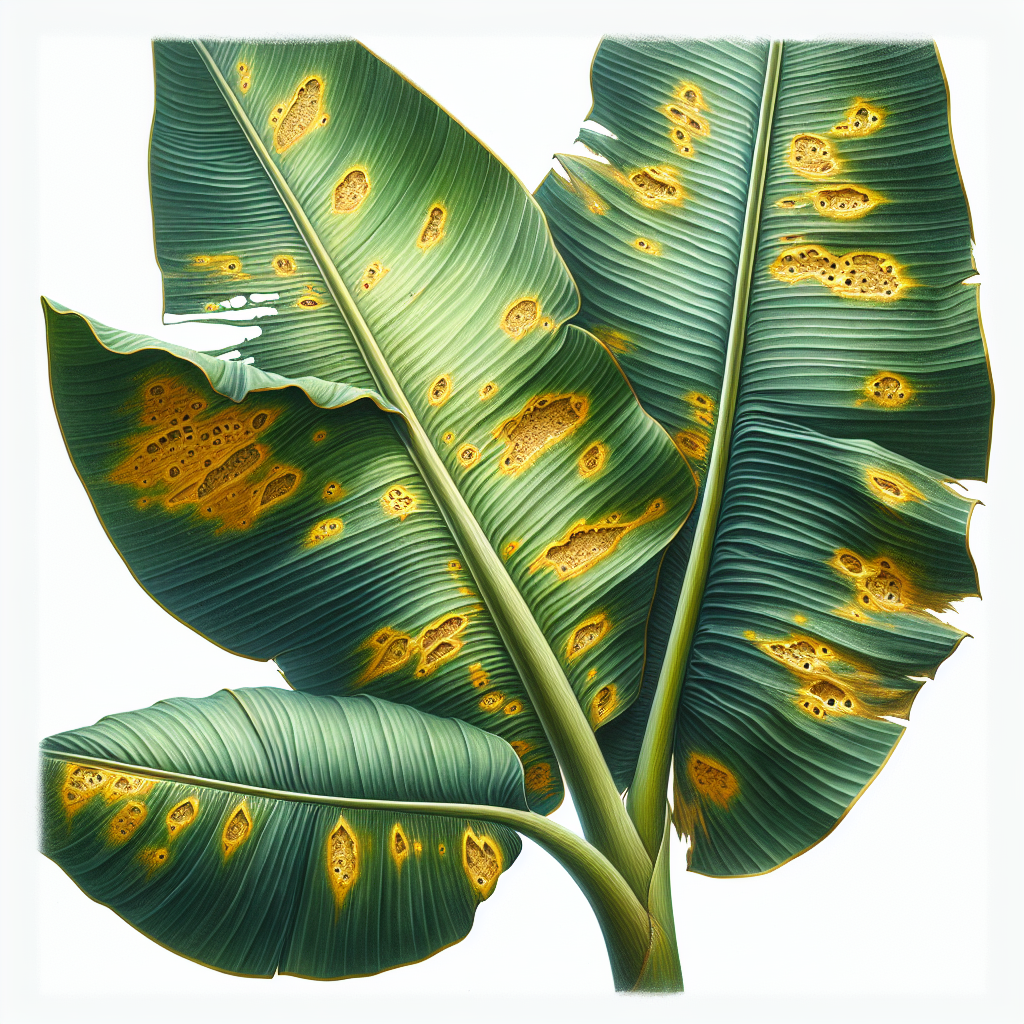
Introduction to yellow Sigatoka
Yellow Sigatoka, scientifically known as Mycosphaerella musicola, stands as one of the most pervasive fungal diseases threatening banana plantations globally. First identified in 1904 in Java (now Indonesia), this pathogen has since spread to major banana-producing regions including Latin America, the Caribbean, Africa, and Asia. Unlike its more aggressive relative, black Sigatoka, yellow Sigatoka progresses more slowly but remains a critical concern for commercial growers and small-scale farmers alike. The disease manifests as yellowing leaf spots that evolve into necrotic lesions, severely impairing the plant's ability to photosynthesize and produce healthy fruit bunches.
In banana-dependent economies, yellow Sigatoka can slash yields by 20-50%, driving up production costs through intensive fungicide programs. For small farms, where margins are tight, uncontrolled outbreaks can spell financial ruin. This guide provides professional-grade diagnostic tools, lifecycle insights, organic management strategies, and prevention tactics to help you safeguard your banana crops. Early detection and integrated approaches are key to minimizing losses while promoting sustainable agriculture. Understanding environmental triggers and implementing proactive measures can transform a potential crisis into manageable routine maintenance. Stay ahead by monitoring your fields regularly and adapting to local conditions.
Identifying Symptoms & Damage
Accurate identification of yellow Sigatoka is crucial for timely intervention. The disease begins subtly on the abaxial (underside) surface of younger leaves, typically 2-3 weeks after leaf emergence. Initial symptoms appear as small, pale yellow or greenish-yellow streaks, about 1-2 mm long, parallel to the leaf veins. These streaks elongate and widen into diamond-shaped spots with a grayish center and yellow halo, often surrounded by a narrow dark brown border.
As the lesions mature, the central necrotic area turns tan to light brown, sometimes with a faint chlorotic (yellow) margin. Unlike black Sigatoka, which produces larger, darker lesions with acervuli (fungal fruiting bodies), yellow Sigatoka spots rarely exceed 10 mm and lack prominent black streaks. Severe infections lead to coalescing lesions covering up to 30-50% of the leaf surface, causing premature necrosis and leaf death starting from the lower leaves upward.
Damage extends beyond aesthetics: extensive leaf loss reduces the photosynthetic area by up to 40%, stunting bunch growth, delaying fruit maturation by 2-4 weeks, and reducing bunch weight by 15-30%. In young plants, it suppresses sucker development, while in bearing plants, it weakens overall vigor. Differentiate from nutrient deficiencies (e.g., potassium shortage mimics striping) or other leaf spot diseases by confirming fungal spores under magnification or via lab testing. Regular scouting—checking 20-30 leaves per hectare weekly—ensures early detection. Use a hand lens to spot minute conidia (asexual spores) on lesion undersides during humid mornings.
Lifecycle and Progression of yellow Sigatoka
Mycosphaerella musicola follows a polycyclic lifecycle, completing multiple infection cycles per season. The pathogen overwinters as ascospores in pseudothecia on dead leaves or debris. Primary inoculum disperses via wind and rain splash during wet periods, germinating on wet leaf surfaces within 2-3 hours at 24-28°C (75-82°F). Conidia form on infected tissues within 10-14 days, serving as secondary inoculum for rapid spread within the canopy.
Optimal infection occurs at 25-30°C with leaf wetness exceeding 8-12 hours. Each lesion produces thousands of conidia, perpetuating epidemics. Progression accelerates in dense canopies where humidity lingers above 85%. From initial streak to full necrosis takes 20-30 days, with peak sporulation 15-20 days post-infection. In tropical regions, 15-25 cycles occur annually, amplifying damage exponentially.
Understanding this cycle informs timing: remove old leaves to eliminate inoculum sources, and apply treatments post-rain events. Disease gradients form from field edges inward, favoring windward borders. Track progression using the Stover scale (0-6), where 4+ indicates economic thresholds requiring action.
Environmental Triggers & Risk Factors
Yellow Sigatoka thrives in warm, humid tropics: temperatures of 22-30°C, relative humidity >80%, and frequent leaf wetness from dew, rain, or irrigation. Overhead sprinkling exacerbates spread by splashing conidia. Poor airflow in high-density plantings (>1600 plants/ha) traps moisture, creating microclimates ideal for infection. Coastal areas with marine fogs face heightened risk due to prolonged wetness.
Soil factors indirectly influence susceptibility: waterlogged roots stress plants, reducing resilience. Susceptible varieties like Cavendish Banana and Dwarf Cavendish Banana suffer most, while over-fertilization with nitrogen promotes lush, infection-prone foliage. Monoculture plantations amplify epidemics via uniform vulnerability. Rainy seasons (e.g., 2000+ mm annually) trigger outbreaks; drought-stressed plants show milder symptoms but recover poorly.
Risk spikes during leaf flush periods (post-harvest or ratoon stages). For small farms, check Why 80% of Small Farms Battle Weather Disasters - And How Hyper-Local AI Forecasts Can Save Your Harvest for predictive tools. Mitigate by pruning for ventilation and avoiding stress.
Organic Control & Treatment Plans
Organic management emphasizes integrated strategies over reliance on synthetics. Start with sanitation: de-sucker to maintain 2-3 functional leaves per plant, and remove and bury infected lower leaves weekly (leaf trash index <0.5). This cuts inoculum by 70%. Copper-based fungicides (e.g., Bordeaux mixture, copper oxychloride) at 2-3 kg/ha every 14-21 days during high-risk periods provide 80-90% control. Rotate with potassium phosphite (1-2 L/ha) to boost plant immunity and suppress sporulation.
Biological agents like Trichoderma harzianum or Bacillus subtilis applied foliarly (5-10 g/L) colonize lesions, outcompeting the pathogen. Neem oil (2-5 ml/L) disrupts spore germination. For curative action, apply post-symptom onset, ensuring 6+ hours dry time. Monitor via disease forecasting models based on rain hours and temperature.
Integrated plan: Scout weekly → Prune → Apply copper if 5% severity → Biologicals for maintenance. In organic-certified farms, this sustains yields within 10% of chemical controls. Test soil for balance; calcium amendments reduce lesion expansion.
Preventing yellow Sigatoka in the Future
Prevention hinges on cultural resilience. Plant resistant varieties like FHIA hybrids or FHIA-01 where available. Space plants 2.5x2.5m for airflow, intercropping with thyme or marigold as repellents. Mulch heavily to suppress soil splash and retain moisture evenly. Drip irrigation minimizes wet canopies.
Establish buffer zones (10-20m) around fields and quarantine new plant material. Hot-water treat suckers (50°C for 20 min) to kill latent infections. Annual leaf removal before rainy season disrupts overwintering. Monitor via apps for hyper-local alerts. Long-term, breed for resistance and diversify with non-hosts like pineapple. Consistent practices yield 90% prevention efficacy.
Crops Most Affected by yellow Sigatoka
Primarily devastating to Musa spp., especially dessert bananas: Cavendish Banana, Lady Finger Banana, and Dwarf Cavendish Banana. Plantains like Plantain (Horn) and cooking bananas suffer heavily in tropics. Minor hosts include heliconias and ornamental musas. Global hotspots: Ecuador, Colombia, Philippines, Central America. Yields drop 30-50% untreated; resistant cultivars mitigate to <10%. No significant impact on other staples like mango or avocado.