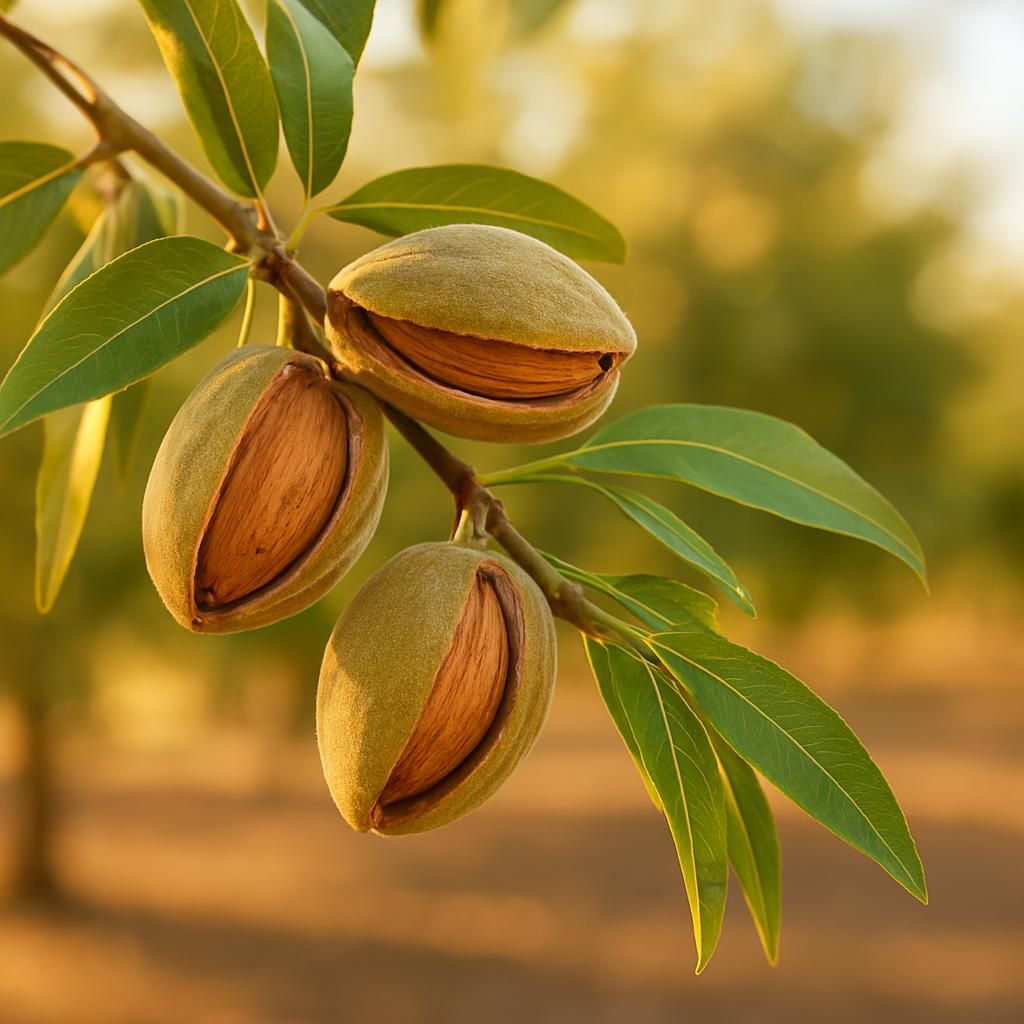
Introduction to Almond (Padre)
The Padre almond cultivar (Prunus dulcis 'Padre') is a late-blooming, self-incompatible variety developed for California's Central Valley but increasingly planted in similar Mediterranean climates worldwide. It produces large, smooth kernels with high oil content and excellent blanching characteristics, making it a favorite among processors and exporters. Because it blooms later than early cultivars such as Nonpareil, Padre often escapes damaging spring frosts while still maturing in early-to-mid fall. Its upright growth habit and moderate vigor allow dense orchard spacing without excessive shading, delivering reliable yields of 1.8–2.5 tons of kernels per hectare under optimal management.
Botanical Profile of Almond (Padre)
Padre belongs to the Rosaceae family and is botanically a drupe rather than a true nut. The tree reaches 4–7 m at maturity with an upright-spreading canopy and medium-density branching. Leaves are lanceolate, 7–12 cm long, with finely serrated margins and a glossy green upper surface. Flowers are pale pink, five-petaled, and appear in late February to early March depending on chill-hour accumulation (minimum 250–300 hours below 7 °C). The fruit consists of a fleshy hull that splits at maturity to reveal a hard shell containing a single edible kernel. Padre is cross-compatible with several pollenizers including Nonpareil Almond and Mission Almond.
Soil, pH, and Climate Requirements for Almond (Padre)
Almond (Padre) performs best on deep, well-drained sandy loam to loam soils with good aeration. Heavy clay or poorly drained sites increase the risk of Phytophthora root rot. The cultivar tolerates a wide pH range but shows optimal nutrient uptake between 6.0 and 7.5. It requires 200–300 chill hours and thrives in regions with hot, dry summers and 200–400 mm annual rainfall supplemented by irrigation.
| Parameter | Ideal Range | Notes |
|---|---|---|
| Soil Texture | Sandy loam to loam | Avoid compacted or saline soils |
| Soil pH | 6.0–7.5 | Maintain with gypsum or lime as needed |
| Soil Depth | >1.2 m | Critical for root development |
| Salinity (EC) | <2.0 dS/m | Monitor irrigation water quality |
| Temperature (Growing) | 18–32 °C | Optimal nut fill occurs at 25–30 °C |
| Chill Hours | 250–300 hours | Below 7 °C; late bloom reduces frost risk |
| Annual Rainfall | 200–400 mm | Supplemental irrigation essential |
| Frost Tolerance | -2 °C during bloom | Late bloom provides natural protection |
Step-by-Step Planting & Propagation
- Site Selection: Choose south- or southwest-facing slopes with full sun exposure and protection from strong winds.
- Soil Testing: Collect composite samples to 60 cm depth; amend based on laboratory recommendations for pH, organic matter, and macro-nutrients.
- Land Preparation: Rip to 1 m depth, level the field, and install drainage if water tables are high.
- Planting Density: Standard spacing is 6 m × 4 m (416 trees/ha) or 5.5 m × 3.5 m (520 trees/ha) on vigorous rootstocks.
- Rootstock Choice: Use peach-almond hybrids such as 'Nemaguard' or 'Hansen 536' for nematode resistance and vigor control.
- Planting Time: Late winter (January–February) when soils are workable and trees are dormant.
- Hole Preparation: Dig 60 cm wide × 60 cm deep holes; backfill with native soil mixed with aged compost.
- Tree Placement: Set bud union 5–8 cm above soil line; water thoroughly after planting.
- Initial Irrigation: Apply 20–30 L per tree immediately and maintain consistent moisture for the first six weeks.
- Pollinizer Layout: Plant one pollenizer row for every four rows of Padre or interplant compatible cultivars every third tree in the row.
Care & Maintenance regimes for Almond (Padre)
Padre requires disciplined irrigation, nutrition, and canopy management to sustain high kernel quality. Young trees need frequent light irrigations while mature orchards benefit from regulated deficit irrigation during hull-split to improve kernel quality and reduce hull rot.
| Growth Stage | Irrigation Frequency | Fertilizer (N-P-K per tree/year) | Pruning Action |
|---|---|---|---|
| Establishment (Yr 1–2) | 2–3× weekly, 15–25 L | 150 g N, 75 g P₂O₅, 100 g K₂O split | Train to modified central leader |
| Vegetative (Yr 3–4) | Weekly, 40–60 L | 300 g N, 150 g P₂O₅, 200 g K₂O | Remove crossing limbs, maintain 3–4 scaffolds |
| Mature Production | 10–14 day intervals, 80–120 L | 500–700 g N, 200 g P₂O₅, 400 g K₂O | Annual dormant pruning; summer hedging |
| Post-Harvest | Reduce 30–40 % | Maintenance dose only | Light renewal cuts to stimulate next season |
Pests, Diseases & Organic Management
Major arthropod pests include Navel orangeworm, peach twig borer, and mites. Primary diseases are hull rot, shot hole, and Phytophthora root rot. An integrated approach begins with sanitation—removing mummy nuts and pruning out diseased wood—followed by mating-disruption dispensers for navel orangeworm and Bacillus thuringiensis sprays timed to egg hatch. For mites, release predatory mites (Phytoseiulus persimilis) when populations exceed five per leaf. Copper-based fungicides applied at petal fall and 50 % hull-split suppress shot hole and hull rot when combined with improved airflow through canopy management.
Harvesting, Curing & Optimal Storage
Padre almonds are harvested mechanically when 100 % of hulls have split and kernels reach 5–6 % moisture. Shake trees in early morning to minimize kernel damage, then sweep and pick up within 24 hours. Field-dry nuts on tarps or in forced-air dryers to 6 % kernel moisture. Store in sealed bins at 0–5 °C and <65 % relative humidity for up to 18 months without quality loss. Monitor for storage beetles and maintain CO₂ levels below 1 % to prevent rancidity.
Companion Planting for Almond (Padre)
Inter-row cover crops such as clover and hairy vetch improve soil nitrogen and support beneficial insects. Lavender and rosemary strips attract pollinators and predatory wasps that reduce peach twig borer pressure. Avoid planting tomato or potato nearby, as they share susceptibility to Verticillium wilt and can serve as reservoirs for soil-borne pathogens.