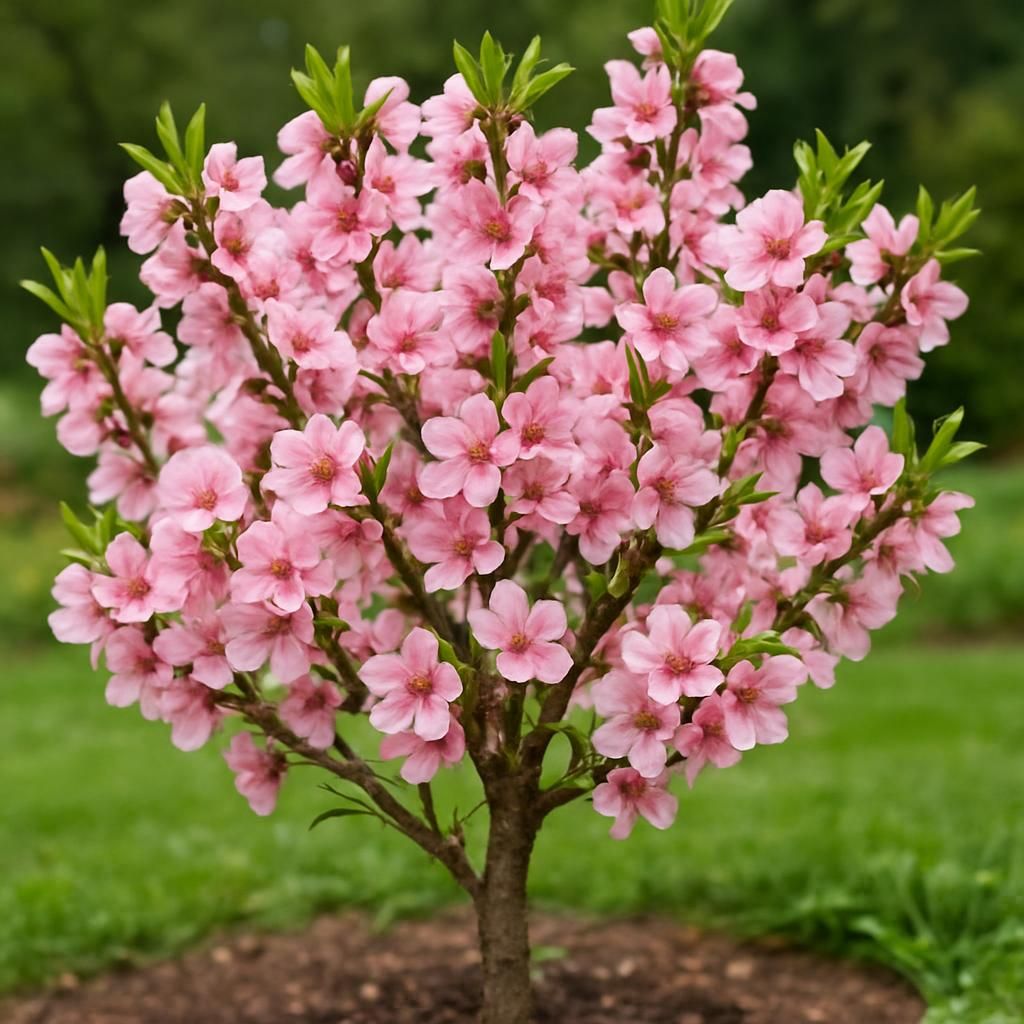
Introduction to Almond (Garden Prince Dwarf)
The Garden Prince Dwarf almond offers home growers and small-scale farmers an accessible entry into nut production without requiring vast acreage. Bred for compact growth and self-fertility, this cultivar produces sweet, edible kernels on trees that stay under 15 feet, making it suitable for urban lots, patios, and intensive orchards. Its showy pink blossoms appear in late winter to early spring, providing early-season pollinator support before most other tree crops flower.
Unlike standard almond varieties that demand cross-pollination and extensive space, Garden Prince reliably sets fruit with its own pollen, simplifying planting layouts. The tree’s smaller stature also reduces pruning labor and allows protective netting against birds during kernel fill. With proper site selection and consistent care, gardeners can expect 10–20 pounds of nuts per mature tree within five to seven years.
Commercial almond production focuses on large-scale orchards of Almond, yet the dwarf form brings the same culinary and nutritional benefits to backyard settings. Its drought tolerance once established and moderate chill requirement of 250–300 hours make it viable across USDA zones 7–9, expanding opportunities for growers outside traditional almond belts.
Botanical Profile of Almond (Garden Prince Dwarf)
Prunus dulcis 'Garden Prince' belongs to the Rosaceae family and shares the same genetic lineage as peaches and cherries. The tree exhibits a naturally vase-shaped canopy with short internodes that keep overall height to 10–15 feet at maturity. Leaves are lanceolate, finely serrated, and emerge after bloom, reducing competition for stored carbohydrates during flowering.
Flowers are self-fertile, hermaphroditic, and typically light pink with five petals. Each blossom contains both stamens and pistil, enabling single-tree plantings without sacrificing yield. The fruit is a drupe whose fleshy hull splits at maturity to reveal a hard shell containing the edible seed, or kernel.
Kernel quality is sweet with low bitterness, averaging 1.2–1.5 grams per nut. Shells are semi-hard, facilitating hand cracking for home use while still offering some protection from pests. The cultivar’s compact root system adapts well to containers or raised beds when soil volume is sufficient.
Soil, pH, and Climate Requirements for Almond (Garden Prince Dwarf)
Successful cultivation begins with matching site conditions to the tree’s preferences. Almonds demand well-drained soils to prevent root diseases and perform best in Mediterranean-type climates with dry summers.
| Parameter | Ideal Range | Notes |
|---|---|---|
| Soil Texture | Sandy loam to loam | Avoid heavy clay without amendment |
| Soil pH | 6.0–7.5 | Slightly acidic to neutral |
| Drainage | Excellent | Raised beds or berms recommended on clay |
| USDA Zones | 7–9 | Protect from late frosts below –5 °F |
| Chill Hours | 250–300 hours below 45 °F | Low-chill selection suits warmer winters |
| Summer Temperature | 75–95 °F daytime | Requires heat units for kernel fill |
| Annual Rainfall | 15–30 inches, mostly winter | Supplemental irrigation essential in summer |
| Sun Exposure | Full sun (minimum 6–8 hours) | South or west facing slopes ideal |
Site preparation includes ripping compacted layers to 3 feet and incorporating 2–3 inches of aged compost. On slopes, contour planting reduces erosion and improves water infiltration. Avoid low-lying frost pockets; elevated sites with good air drainage protect early blooms.
Step-by-Step Planting & Propagation
- Choose bare-root or container-grown trees during dormancy (late fall to early spring).
- Soak bare-root trees in water for 1–2 hours before planting to rehydrate roots.
- Dig a hole twice as wide as the root ball and equal in depth; create a small mound at the base for root spread.
- Position the graft union 2–3 inches above soil level to prevent scion rooting.
- Backfill with native soil amended with 20 % compost; firm gently to remove air pockets.
- Water thoroughly to settle soil and eliminate voids around roots.
- Apply 3–4 inches of organic mulch in a 3-foot ring, keeping mulch 6 inches from the trunk.
- Stake young trees only if wind exposure is severe; remove stakes after one season.
Propagation by seed is possible but does not preserve cultivar traits. T-budding or whip grafting onto seedling almond or peach rootstock in late summer yields true-to-type plants. Micropropagation is used commercially but remains impractical for home growers.
Care & Maintenance regimes for Almond (Garden Prince Dwarf)
Consistent cultural practices maximize both tree health and nut quality. Focus on balanced nutrition, timely irrigation, and annual pruning to maintain an open canopy.
| Season | Watering Schedule | Fertilizer Application | Pruning Tasks |
|---|---|---|---|
| Late Winter | Deep soak every 3–4 weeks if no rain | Apply 1 lb 10-10-10 per tree at bud swell | Remove dead, diseased, crossing branches |
| Spring | 1–1.5 inches/week during bloom & set | Side-dress 0.5 lb nitrogen at petal fall | Tip-prune new shoots to encourage branching |
| Summer | 1.5–2 inches/week during kernel fill | Foliar zinc & boron if deficiency shown | Summer prune to limit height to 12 ft |
| Fall | Reduce to every 4–6 weeks | Compost top-dress 2 inches | Remove water sprouts; sanitize tools |
| Winter | Minimal; protect roots with mulch | None unless soil test indicates need | Dormant prune for structure & light |
Monitor leaf nutrient levels every two years. Adjust potassium upward in sandy soils to support shell hardening. Avoid late-summer nitrogen to prevent tender growth before frost.
Pests, Diseases & Organic Management
Garden Prince almonds face fewer pest pressures than full-size cultivars due to their smaller canopy, yet vigilance remains essential. Primary insect concerns include Aphids, Spider mites, and navel orangeworm. Apply dormant oil in late winter to smother overwintering eggs. During the growing season, release lady beetles and lacewings for aphid control; use horticultural oil or insecticidal soap for mites when populations exceed 5 per leaf.
Fungal threats center on Brown rot blossom blight and Shot hole. Prune for airflow, remove mummified fruit, and apply copper-based sprays at 50 % bloom and petal fall. Hull rot can develop if humidity spikes near harvest; shake trees lightly after hull split to encourage drying.
Nematode pressure is low on well-drained sites, but pre-plant soil solarization for six weeks suppresses populations in sandy soils. Rotate with Cover crops such as mustard or marigold between orchard rows to further reduce pest carryover.
Harvesting, Curing & Optimal Storage
Harvest timing is indicated by hull split—when 50–75 % of hulls have opened along the suture. Shake or hand-pick clusters and collect fallen nuts daily to limit exposure to birds and insects. Lay nuts in single layers on screens in a shaded, well-ventilated area for 7–10 days until kernels reach 8 % moisture.
Cured almonds store best in-shell at 35–40 °F and 60–70 % relative humidity for up to 12 months. Shelled kernels maintain quality for 6–8 months when vacuum-sealed and frozen. Label batches with harvest date; rotate stock to preserve flavor and prevent rancidity from oxidation.
Companion Planting for Almond (Garden Prince Dwarf)
Strategic companions enhance biodiversity and reduce pest pressure. Interplant low-growing Strawberry beneath the canopy to suppress weeds and provide early-season ground cover. Aromatic Thyme and Rosemary planted along the drip line deter aphids and attract beneficial insects. Leguminous Clover in orchard alleys fixes nitrogen and improves soil structure while supporting pollinators.
Avoid planting Tomato or other solanaceous crops nearby, as they may share verticillium wilt susceptibility. Tall companions such as Corn should be kept outside the root zone to prevent shading. Diverse flowering borders of yarrow and nasturtium extend beneficial insect habitat throughout the season, contributing to a resilient, low-input system.