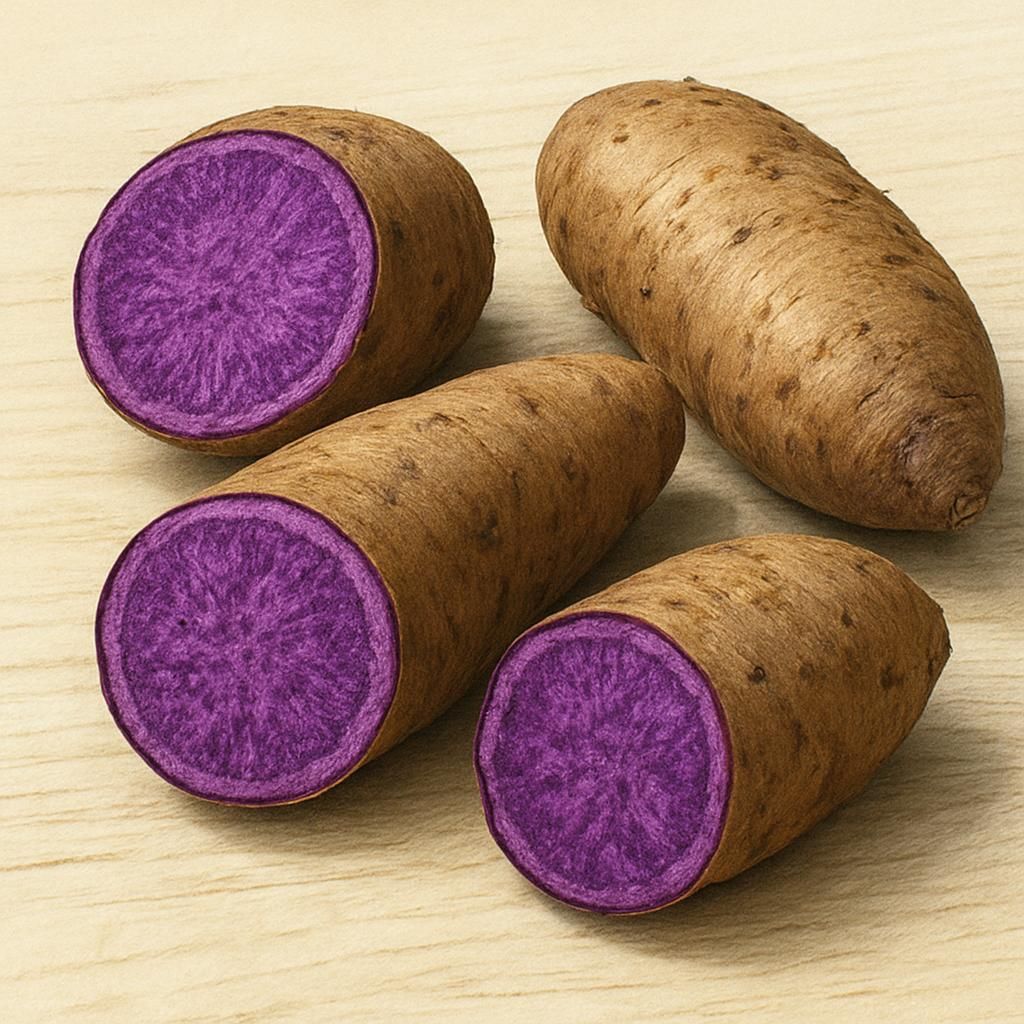
Introduction to Yam (Dioscorea alata - Purple Ube)
Dioscorea alata, commonly known as Purple Ube or greater yam, is one of the most economically important yam species in tropical and subtropical regions. The crop produces large, cylindrical tubers with striking purple flesh caused by high concentrations of anthocyanins. These compounds provide both visual appeal and potent antioxidant properties that drive demand in fresh markets, processing industries, and export channels.
Successful Purple Ube production requires understanding its long growth cycle, specific trellising needs, and sensitivity to waterlogging. With proper management, growers can achieve yields of 15–35 tons per hectare while maintaining tuber quality for six to nine months of storage. The crop also offers rotational benefits because of its deep rooting habit and relatively low pest pressure when grown with sound cultural practices.
Botanical Profile of Yam (Dioscorea alata - Purple Ube)
Dioscorea alata is a vigorous, dioecious, climbing perennial that behaves as an annual in cultivation. Plants produce twining, quadrangular stems that can reach 3–10 meters in length when supported. Leaves are opposite, broadly ovate to cordate, and 10–20 cm long. The species is characterized by the presence of bulbils (aerial tubers) in the leaf axils of some cultivars.
The underground tubers vary in shape from long-cylindrical to irregular and can weigh 2–10 kg at maturity. The skin is typically light brown to tan, while the flesh ranges from pale lavender to deep violet depending on genotype and growing conditions. The high starch content (20–28 %) and low fiber make the tubers suitable for boiling, roasting, flour production, and ice-cream manufacturing.
Soil, pH, and Climate Requirements for Yam (Dioscorea alata - Purple Ube)
Purple Ube thrives in well-drained, deep, fertile loamy soils with good structure. Heavy clay soils must be amended with organic matter to prevent waterlogging and tuber rot. The crop performs best in tropical climates with 1,200–2,000 mm of well-distributed rainfall and temperatures between 25 °C and 32 °C.
| Parameter | Ideal Range | Notes |
|---|---|---|
| Soil Type | Sandy loam to clay loam | Deep, friable, free-draining |
| Soil pH | 5.5 – 6.8 | Avoid alkaline soils; lime if below 5.0 |
| Temperature | 25 – 32 °C (day) | Growth stops below 15 °C |
| Annual Rainfall | 1,200 – 2,000 mm | Even distribution preferred |
| Altitude | 0 – 1,500 m | Lower yields above 1,800 m |
| Relative Humidity | 70 – 85 % | High humidity favors vine growth |
Step-by-Step Planting & Propagation
- Select healthy, disease-free seed tubers or setts weighing 150–250 g from the previous season’s harvest.
- Cure setts in the shade for 3–5 days to allow cut surfaces to suberize.
- Prepare ridges or mounds 30–40 cm high and 90–120 cm apart; incorporate 10–15 t/ha well-rotted manure.
- Plant setts 8–10 cm deep with the sprouting end oriented upward at the onset of the rainy season.
- Provide immediate light irrigation if rainfall is insufficient during the first two weeks.
- Install 2 m trellis poles and strings within 4–6 weeks after emergence to support vines.
Care & Maintenance regimes for Yam (Dioscorea alata - Purple Ube)
Consistent moisture, balanced nutrition, and timely weeding are critical. Mulching with 10 cm of rice straw or grass reduces soil temperature fluctuations and conserves moisture.
| Growth Stage | Watering Schedule | Fertilizer Application | Pruning & Training Schedule |
|---|---|---|---|
| Establishment (0–8 wks) | Light irrigation every 3–4 days | 20 kg N, 40 kg P₂O₅, 40 kg K₂O per ha at planting | Remove basal leaves; train vines to trellis |
| Vegetative (8–20 wks) | 25–30 mm/week; reduce if rainfall adequate | Side-dress 40 kg N at 10–12 weeks | Continue training; remove lateral shoots below 1 m |
| Tuber Bulking (20–32 wks) | Maintain even moisture; avoid waterlogging | Apply 30 kg K₂O and 20 kg N at 20 weeks | Minimal pruning; focus on canopy aeration |
| Maturation (32+ wks) | Withhold water 2–3 weeks before harvest | No further fertilizer | Cut back vines 10–14 days pre-harvest |
Pests, Diseases & Organic Management
Major pests include nematodes, scale insects, and aphids. The most common diseases are anthracnose, yam mosaic virus, and root rot. Implement a 3-year rotation with cassava or maize to break pest cycles.
Organic controls begin with certified clean seed and field sanitation. Apply neem oil (0.5 %) at 10-day intervals during early vine growth to suppress aphids and scale. Use Trichoderma harzianum drenches (10⁶ CFU/ml) at planting and again at 12 weeks to suppress soil-borne fungi. Encourage predatory beetles and spiders by maintaining flowering strips of marigold and thyme.
Harvesting, Curing & Optimal Storage
Harvest when vines senesce and tubers reach full size, typically 8–10 months after planting. Use a digging fork to lift tubers carefully to avoid skinning. Cure harvested tubers in a shaded, well-ventilated area at 28–32 °C and 85–90 % RH for 4–7 days to heal wounds.
Store cured tubers in single-layer racks or ventilated crates at 12–15 °C and 70–80 % RH. Under these conditions, Purple Ube maintains eating quality for 6–9 months. Inspect monthly and remove any tubers showing soft rot or sprouting.
Companion Planting for Yam (Dioscorea alata - Purple Ube)
Interplant with legumes such as cowpea or pigeon pea to improve soil nitrogen and provide living mulch. Maize planted on alternate rows offers partial shade and vertical support. Aromatic herbs including basil and rosemary repel aphids while attracting beneficial insects. Avoid planting near sweet potato to reduce shared nematode pressure.