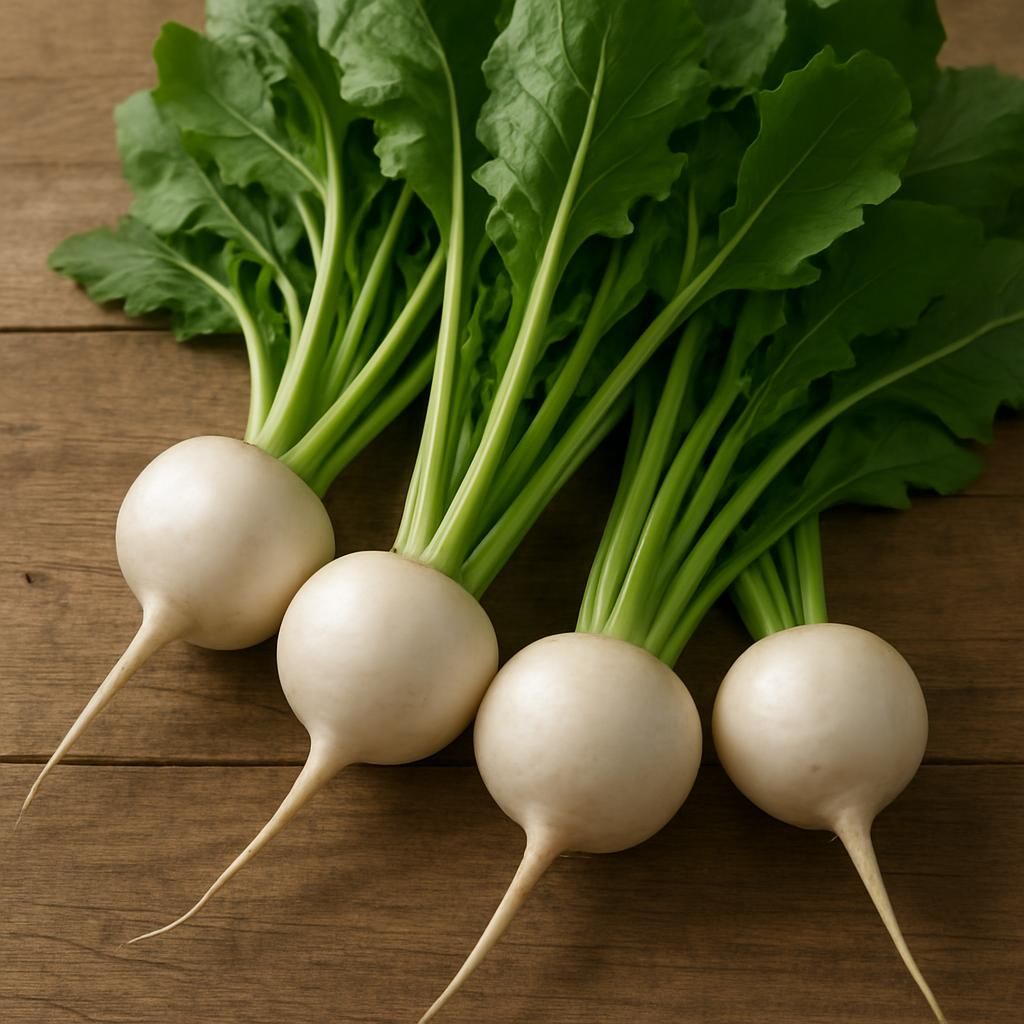
Introduction to Turnip (Hakurei Tokyo)
Hakurei Tokyo turnips represent a premium Japanese variety developed for direct consumption raw or lightly cooked. Unlike traditional storage turnips, these small, white globes remain tender and sweet even at full size, making them a favorite among market gardeners and home growers seeking quick, high-value roots. Their thin skins eliminate the need for peeling, while the mild-flavored tops can be harvested young for salad mixes or allowed to mature for bunching.
Because the variety matures rapidly and tolerates light frosts, it fits perfectly into intensive succession schedules and high-density plantings. Growers appreciate its reliable performance across a wide range of temperate climates and its ability to command premium prices at farmers’ markets when harvested at peak sweetness.
Botanical Profile of Turnip (Hakurei Tokyo)
Hakurei Tokyo belongs to the Brassicaceae family and is botanically classified as Turnip (crop). The plant produces a flattened-globe root 5–8 cm in diameter with smooth, ivory-white skin and crisp, white flesh that contains elevated sugar levels. The leaves are bright green, slightly lobed, and remain palatable throughout the growth cycle.
The root system is shallow and fibrous, making the crop sensitive to both drought and waterlogging. Flowering occurs after vernalization; plants produce bright yellow, four-petaled flowers typical of brassicas if left in the field past maturity.
Soil, pH, and Climate Requirements for Turnip (Hakurei Tokyo)
Hakurei Tokyo thrives in fertile, well-drained soils with consistent moisture. Heavy clay soils should be amended with compost or raised beds to prevent compaction and root forking.
| Parameter | Ideal Range | Notes |
|---|---|---|
| Soil Type | Sandy loam to loam | Avoid compacted or stony soils |
| Soil pH | 6.0–7.0 | Slightly acidic to neutral |
| Soil Temperature | 10–24 °C | Optimal for rapid germination |
| Air Temperature | 15–20 °C day / 5–10 °C night | Cool-season crop; bolt risk above 24 °C |
| Frost Tolerance | Light frost to –4 °C | Improves root sweetness |
| Drainage | Excellent | Raised beds recommended on heavy soils |
Step-by-Step Planting & Propagation
- Site Preparation: Incorporate 5–8 cm of well-rotted compost into the top 15 cm of soil two weeks before sowing.
- Sowing Window: Direct seed 2–4 weeks before the last spring frost or 6–8 weeks before first fall frost. In mild climates, successive sowings every 10–14 days extend the harvest window.
- Seeding Depth & Spacing: Sow seeds 6–12 mm deep in rows 30 cm apart; thin seedlings to 5–8 cm in-row once true leaves appear.
- Germination: Expect 4–7 days at 15–20 °C soil temperature. Maintain even moisture during this critical period.
- Transplant Option: Although direct seeding is preferred, 3-week-old cell-grown seedlings can be transplanted on 10 cm centers for ultra-high-density beds.
Care & Maintenance regimes for Turnip (Hakurei Tokyo)
Consistent moisture and balanced fertility are essential. Over-fertilization with nitrogen produces lush tops at the expense of root quality.
| Growth Stage | Water Schedule | Fertilizer (NPK) | Pruning / Thinning |
|---|---|---|---|
| Germination (Week 1) | Keep top 2 cm moist daily | None | None |
| Seedling (Weeks 2–3) | 2.5 cm/week; light daily watering | 5-10-10 at 200 kg/ha if soil test low | Thin to 5–8 cm spacing |
| Vegetative (Weeks 3–5) | 2.5–3 cm/week; mulch to conserve moisture | Side-dress 10-5-10 at 150 kg/ha | Remove any yellowing lower leaves |
| Pre-Harvest (Week 5+) | Maintain even moisture; avoid water stress | None | Harvest tops selectively if desired |
Mulch with 5 cm of straw or shredded leaves after thinning to suppress weeds and stabilize soil temperature.
Pests, Diseases & Organic Management
Common pests include flea beetles, cutworms, and aphids. Floating row covers installed immediately after seeding provide the most effective physical barrier. For organic control, apply Bacillus thuringiensis (Bt) against cutworms and release lady beetles for aphid suppression.
Diseases such as clubroot, Alternaria leaf spot, and downy mildew can affect brassica crops. Practice a minimum 3-year rotation away from other brassicas and maintain soil pH above 6.8 to reduce clubroot risk. Remove and destroy infected foliage to limit spread.
Harvesting, Curing & Optimal Storage
Harvest when roots reach 5–7 cm diameter for peak sweetness and tenderness; larger specimens become woody. Pull plants by hand or undercut with a spade on cool mornings. Rinse roots gently and remove tops, leaving 1–2 cm of stem to reduce moisture loss.
No curing is required. Store unwashed roots at 0–2 °C and 95 % relative humidity for up to 3 weeks. Bunched turnips with tops should be refrigerated and used within 5–7 days.
Companion Planting for Turnip (Hakurei Tokyo)
Pair Hakurei Tokyo turnips with nitrogen-fixing legumes such as Peas (crop) and Clover (crop) to improve soil fertility. Aromatic herbs like Thyme (crop) and Rosemary (crop) help deter flea beetles. Avoid planting near other brassicas to reduce disease pressure.
For additional insights on optimizing cool-season successions, read The Truth About Fall Garden Transitions for Small Farm Resilience.