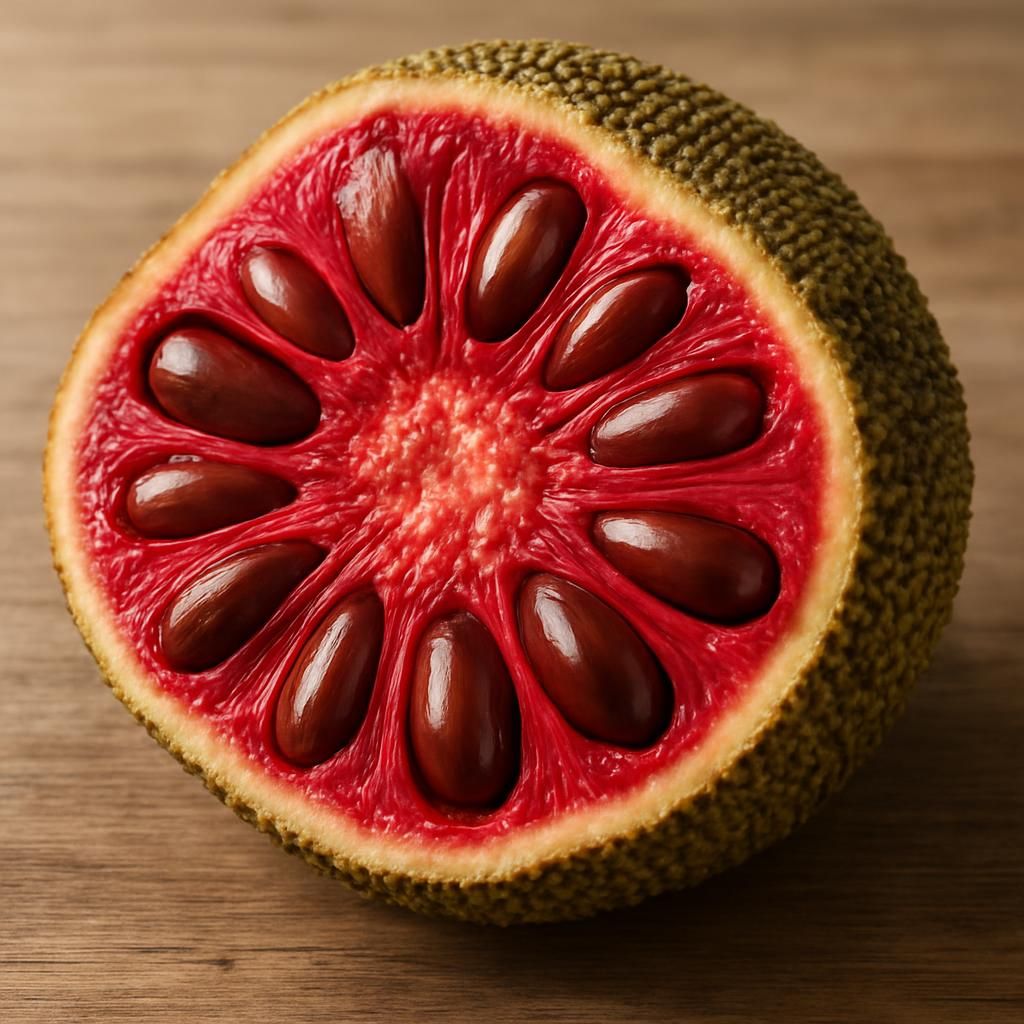
Introduction to Thai Red Jackfruit
Thai Red Jackfruit (Artocarpus heterophyllus 'Thai Red') is a striking tropical fruit tree renowned for its deep red to crimson flesh that offers a honey-like sweetness with subtle caramel notes. Native to Southeast Asia and selectively bred in Thailand, this cultivar stands out among standard jackfruit varieties for its compact growth habit, earlier bearing, and exceptional fruit quality. Farmers and home gardeners alike value Thai Red Jackfruit for both fresh consumption and value-added products such as dried chips, jams, and ice cream. With proper management, a single mature tree can produce 50–150 fruits annually, making it a lucrative option for small farms in suitable climates.
The tree thrives in humid tropical and subtropical regions where temperatures remain consistently above 15 °C. Its large, glossy leaves provide excellent shade, while the heavy, oblong fruits—often weighing 5–15 kg each—hang directly from the trunk and main branches. Because Thai Red Jackfruit is relatively fast-growing and begins fruiting within 3–5 years from seed or grafted plants, it has become a favorite for both commercial orchards and backyard agroforestry systems.
Beyond its culinary appeal, the tree contributes to soil health through leaf litter and offers habitat for beneficial insects. When integrated thoughtfully into mixed plantings, Thai Red Jackfruit supports biodiversity while generating steady income. This guide provides professional-grade, practical advice for establishing and maintaining a productive Thai Red Jackfruit orchard using organic and sustainable methods.
Botanical Profile of Thai Red Jackfruit
Thai Red Jackfruit belongs to the Moraceae family and shares the same species as common jackfruit but expresses a distinct anthocyanin-rich flesh phenotype. Mature trees reach 8–15 meters in height with a spreading canopy of 6–10 meters. The trunk is straight with smooth gray-brown bark that becomes rougher with age. Leaves are alternate, elliptic to obovate, 10–20 cm long, and dark green with prominent veins.
The inflorescences are cauliflorous, with male and female flowers borne separately on the same tree. Female flowers develop into the characteristic syncarp fruit, which matures in 90–120 days after pollination. Inside each fruit, the edible bulbs are surrounded by a fibrous core and covered by a spiny rind that turns from green to yellowish-brown at ripeness. The red flesh color intensifies as the fruit ripens, signaling peak sugar content.
Grafted specimens maintain true-to-type characteristics and exhibit greater uniformity in fruit size and color compared with seedling trees. The cultivar shows moderate resistance to wind damage due to its sturdy branch structure but benefits from windbreaks in exposed locations.
Soil, pH, and Climate Requirements for Thai Red Jackfruit
Thai Red Jackfruit demands well-drained, fertile soils rich in organic matter. It performs best in sandy loam to clay loam textures with good aeration. Waterlogging quickly leads to root rot, so raised beds or mounds are recommended in areas with heavy rainfall or poor drainage.
| Parameter | Ideal Range | Notes |
|---|---|---|
| Soil pH | 5.5 – 7.0 | Slightly acidic to neutral; lime if below 5.0 |
| Soil Texture | Sandy loam to clay loam | High organic matter improves structure |
| Temperature | 20 – 35 °C day / 15 – 25 °C night | Frost sensitive below 10 °C |
| Annual Rainfall | 1200 – 2500 mm | Even distribution preferred; supplement in dry season |
| Altitude | 0 – 1200 m | Lower elevations yield larger fruit |
| Sunlight | Full sun (6–8 hours) | Partial shade reduces fruit set |
Avoid saline or sodic soils. Incorporate 20–30 kg well-rotted compost per planting hole to boost microbial activity and water-holding capacity.
Step-by-Step Planting & Propagation
Site Selection: Choose a location with full sun, protection from strong winds, and deep, well-drained soil. Conduct a soil test and amend pH if necessary.
Propagation Methods: Although seeds are viable, grafted plants of known Thai Red clones are strongly preferred for uniformity and earlier fruiting. Air-layering or cleft grafting onto seedling rootstocks of Artocarpus heterophyllus produces reliable results.
Timing: Plant at the onset of the rainy season or when irrigation is available. In frost-free zones, year-round planting is possible.
Spacing: Standard spacing is 8 m × 8 m (156 trees/ha). High-density systems use 6 m × 6 m with rigorous pruning.
Planting Hole: Dig 1 m × 1 m × 1 m holes. Mix topsoil with 20 kg compost, 500 g rock phosphate, and 200 g potassium sulfate. Position the graft union 5–10 cm above soil level.
Initial Care: Water thoroughly after planting and apply a 5–10 cm mulch layer, keeping it 10 cm away from the trunk. Stake young trees in windy areas.
Care & Maintenance regimes for Thai Red Jackfruit
Consistent care ensures vigorous growth and high-quality fruit. The following table outlines seasonal schedules for water, fertilizer, and pruning.
| Season | Irrigation Schedule | Fertilizer Application (per tree) | Pruning Activity |
|---|---|---|---|
| Pre-monsoon (Mar–May) | 20–30 L every 4–5 days if no rain | 2 kg well-rotted manure + 300 g NPK 15-15-15 | Remove dead wood; shape young trees |
| Monsoon (Jun–Sep) | Reduce to 10 L every 7 days if rainfall adequate | 1 kg compost tea or vermicompost; avoid excess N | Light tipping of new shoots to encourage branching |
| Post-monsoon (Oct–Nov) | 30–40 L every 7–10 days | 500 g potassium sulfate + 1 kg bone meal | Remove water sprouts; open canopy for light |
| Cool/Dry (Dec–Feb) | 15–20 L every 10–14 days | 2 kg aged manure; micronutrient spray (Zn, B, Mg) | Structural pruning on mature trees |
Mulch annually with 10–15 cm organic material to suppress weeds and retain moisture. Monitor leaf color and adjust nitrogen if chlorosis appears.
Pests, Diseases & Organic Management
Thai Red Jackfruit faces several common tropical pests and diseases. Early detection and integrated organic strategies keep populations below economic thresholds.
Major Pests:
- Fruit flies lay eggs in ripening fruit; use bait traps and sanitation.
- Mealybugs and scale insects suck sap from stems and fruit; release Cryptolaemus beetles and apply neem oil.
- Aphids distort new growth; encourage lady beetles and spray insecticidal soap.
- Stem borers tunnel into trunks; maintain tree vigor and paint trunks with lime wash.
Major Diseases:
- Anthracnose causes fruit lesions; prune for airflow and apply copper-based sprays during flowering.
- Phytophthora root rot occurs in waterlogged soils; improve drainage and drench with Trichoderma.
- Powdery mildew affects leaves in dry seasons; sulfur dust or potassium bicarbonate sprays are effective.
Regular monitoring, removal of infected material, and biodiversity through companion planting reduce chemical inputs while protecting beneficial insects.
Harvesting, Curing & Optimal Storage
Thai Red Jackfruit typically matures 90–120 days after flowering. Harvest when the fruit emits a strong sweet aroma, the rind turns yellowish-brown, and the spines soften. Use a sharp knife or pruning saw to cut the stalk, leaving 5–10 cm attached.
Cure harvested fruit at 25–28 °C for 2–3 days to allow full flavor development. Once ripe, bulbs can be separated and stored in airtight containers at 4 °C for up to 7 days or frozen for 6 months. For long-distance transport, pick at mature-green stage and ripen at destination.
Companion Planting for Thai Red Jackfruit
Strategic companions enhance pollination, suppress pests, and improve soil fertility. Plant Thai Basil and Marigold to repel aphids and whiteflies while attracting pollinators. Pigeon pea and Gliricidia fix nitrogen and provide light shade for young trees. Nasturtium acts as a trap crop for aphids. Avoid planting heavy feeders such as Corn or Banana too close, as they compete for nutrients and water. Rotate legumes in the understory every three years to maintain soil health.
This integrated approach maximizes productivity while supporting a resilient, biodiverse orchard ecosystem.