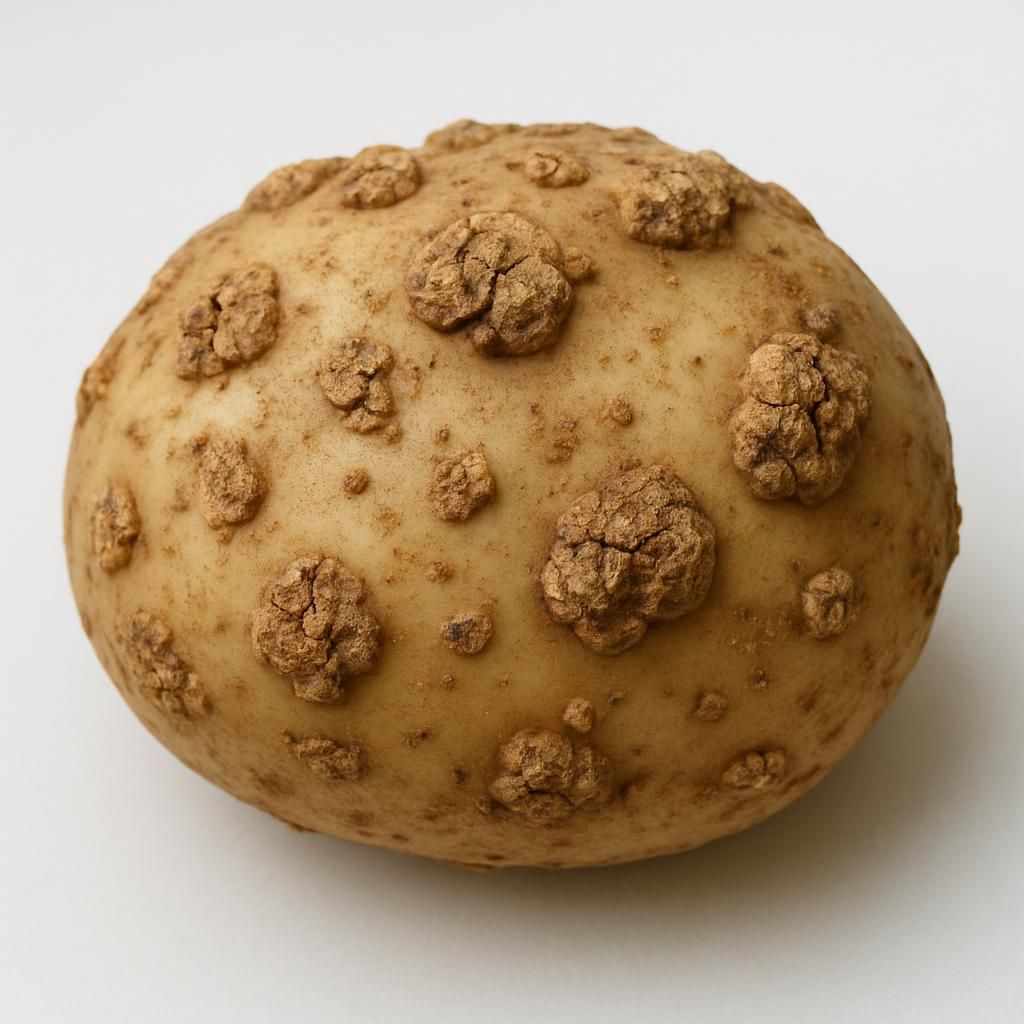
Introduction to Streptomyces scabies
Streptomyces scabies is a filamentous, Gram-positive, spore-forming actinomycete that causes common scab in potatoes and several other vegetable crops. The organism thrives in neutral to alkaline soils and produces thaxtomin phytotoxins that induce the characteristic corky lesions on tubers and roots. Although it does not typically kill plants, the disease significantly lowers tuber quality and economic value. Potato remains the most economically important host, but the pathogen also affects Carrot, Beet, Radish, and Turnip.
Identifying Symptoms & Damage
Common scab symptoms appear as superficial, raised, or pitted corky lesions on the surface of tubers. Early infections produce small, tan to brown spots that enlarge and become roughened as the tuber expands. Severe infections create deep, pitted craters surrounded by cracked periderm, often leading to secondary rot organisms entering the wounds. Above-ground symptoms are usually absent, making visual tuber inspection the primary diagnostic method. Lesions may be confused with Rhizoctonia or Powdery mildew damage, but the corky, non-fungal texture is distinctive.
Lifecycle and Progression of Streptomyces scabies
The pathogen survives in soil as spores or mycelial fragments for many years. Infection occurs when germinating spores contact young, rapidly expanding tubers. Thaxtomin toxins inhibit cellulose synthesis, triggering host wound periderm formation that creates the visible scab lesions.
| Lifecycle Stage | Description | Duration | Key Conditions |
|---|---|---|---|
| Spore Survival | Thick-walled spores persist in soil and crop debris | Years | Neutral-alkaline pH, dry soils |
| Germination | Spores germinate near developing tubers | 3–10 days | Soil moisture 60–80% field capacity, 20–25 °C |
| Infection | Thaxtomin production triggers host response | 7–21 days post-germination | Young tubers <5 mm diameter most susceptible |
| Lesion Development | Corky periderm forms raised or pitted scabs | 4–8 weeks | Continues as tuber bulks |
| Spore Production | New spores form on lesion surfaces and return to soil | At harvest | Dry harvest conditions favor survival |
Environmental Triggers & Risk Factors
Soil pH above 5.5 strongly favors disease; the pathogen is rarely problematic below pH 5.2. High soil calcium and low manganese levels also promote infection. Warm soil temperatures (20–25 °C) during tuber initiation increase severity, while excessive or irregular irrigation during early tuber set exacerbates symptoms. Poorly drained or compacted soils that dry quickly after wetting create ideal infection windows.
| Factor | Optimal Range for Disease | Management Implication |
|---|---|---|
| Soil pH | 5.5–8.0 | Acidify with elemental sulfur or ammonium sulfate |
| Temperature | 20–25 °C during tuber set | Plant early or use mulches to moderate soil heat |
| Moisture | Alternating wet-dry cycles | Maintain consistent moisture via drip irrigation |
| Calcium | High exchangeable Ca | Avoid excess lime; balance with potassium and magnesium |
Organic Control & Treatment Plans
No curative organic sprays exist once infection occurs. Management focuses on cultural suppression and biological competition. Acidifying amendments, green manures, and resistant varieties form the foundation of control.
| Treatment Option | Application Rate / Method | Frequency / Timing | Notes |
|---|---|---|---|
| Elemental Sulfur | 300–600 kg/ha incorporated to lower pH to 5.0–5.2 | Pre-plant, 3–6 months before planting | Monitor pH annually; reapply every 2–3 seasons |
| Mustard Green Manure | Broadcast 8–10 kg/ha seed; incorporate at flowering | One season before potatoes | Biofumigation reduces spore viability |
| Compost Tea + Trichoderma | 5 L/ha drench or seed piece treatment | At planting and 4 weeks later | Enhances microbial competition |
| Resistant Cultivars | Plant varieties such as ‘Russet Burbank’ or ‘Yukon Gold’ | Every planting | Combine with rotation for best results |
| Mulch + Drip Irrigation | 5–8 cm organic mulch; maintain 70–80% field capacity | Throughout tuber initiation | Prevents wet-dry cycles that trigger infection |
Preventing Streptomyces scabies in the Future
Long-term prevention requires a systems approach: maintain soil pH below 5.5, rotate potatoes with non-host crops for at least three years, and incorporate biofumigant mustards or brassicas. Use certified seed and avoid planting scab-infected tubers. Improve soil structure with cover crops and avoid compaction. Regular soil testing for pH, calcium, and manganese allows timely corrective actions. Consistent moisture management through drip irrigation minimizes infection windows during tuber set.
Crops Most Affected by Streptomyces scabies
While Potato suffers the greatest economic losses, the pathogen also infects Carrot, Beet, Radish, Turnip, Parsnip, and occasionally Sweet Potato. Root crops grown in neutral or alkaline soils are at highest risk. Onion and Garlic may show superficial lesions but rarely sustain economic damage.