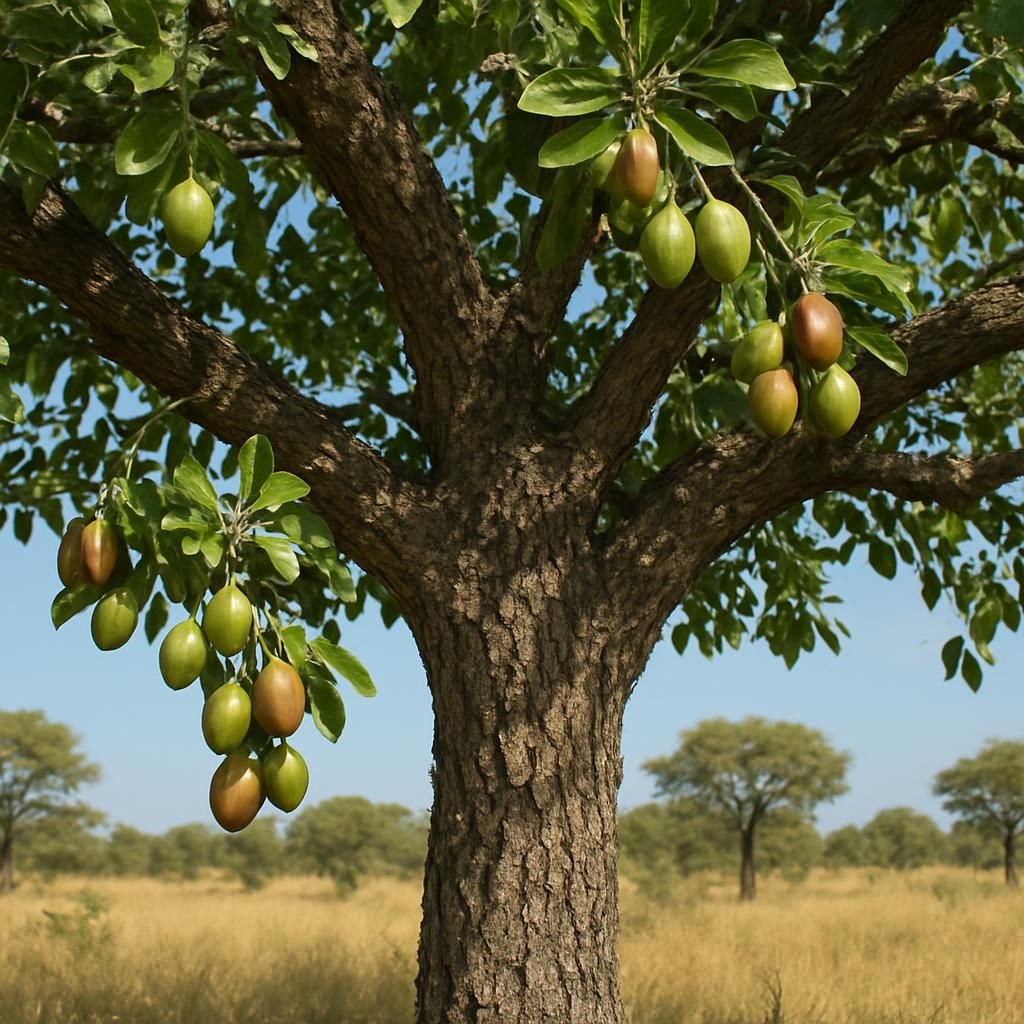
Introduction to Shea Nut (Vitellaria paradoxa)
Vitellaria paradoxa is a cornerstone of West and Central African agroforestry systems, providing critical income for over 16 million rural women who collect and process its nuts. The tree’s butter-rich kernels have been traded for centuries and now supply global markets demanding sustainable, traceable shea. Because the species is slow-growing and protected by local taboos against felling, successful cultivation requires patience, site selection, and long-term management.
Botanical Profile of Shea Nut (Vitellaria paradoxa)
Vitellaria paradoxa belongs to the Sapotaceae family and grows as a medium-sized deciduous tree reaching 10–15 m at maturity. It features a spreading crown, thick fissured bark, and simple leathery leaves arranged in whorls. The tree produces small white hermaphroditic flowers from December to March, followed by ellipsoid drupes 4–6 cm long that ripen during the rainy season. Each fruit contains one large seed (the shea nut) surrounded by a thin sweet pulp favored by wildlife. Genetic variation exists between the western subspecies paradoxa and the eastern nilotica, influencing kernel oil content (45–55 %).
Soil, pH, and Climate Requirements for Shea Nut (Vitellaria paradoxa)
Shea trees thrive on well-drained, sandy-loam to loam soils derived from granite, sandstone, or laterite. They tolerate low fertility but respond to organic matter incorporation. Avoid heavy clays or waterlogged sites.
| Parameter | Ideal Range | Notes |
|---|---|---|
| Soil Texture | Sandy loam to loam | Good drainage essential |
| Soil pH | 5.5–7.0 | Tolerates slight acidity |
| Annual Rainfall | 600–1,200 mm | Dry season of 5–7 months required |
| Temperature Range | 20–35 °C | Frost sensitive below 10 °C |
| Altitude | 0–1,200 m a.s.l. | Best growth below 800 m |
| Sunlight | Full sun | Partial shade acceptable when young |
Step-by-Step Planting & Propagation
- Seed Collection & Pre-treatment: Gather ripe fruits from superior mother trees in June–August. Remove pulp immediately and sun-dry nuts to 8–10 % moisture. Store in ventilated sacks for 3–6 months to break dormancy.
- Nursery Preparation: Use 15 cm × 25 cm polybags filled with a 2:1:1 mix of forest soil, river sand, and well-rotted manure. Sow nuts 3 cm deep, radicle down, and maintain 60–70 % shade.
- Germination: Expect 60–80 % germination within 3–6 weeks at 28–32 °C. Water twice weekly.
- Seedling Care: Transplant to larger bags at the 4-leaf stage. Apply foliar seaweed extract monthly. Hardening begins at 9 months by gradual sun exposure.
- Field Planting: Plant at 8 m × 8 m (156 trees/ha) or wider (10 m × 10 m) in drier zones. Dig 60 cm³ pits, incorporate 10 kg compost plus 100 g rock phosphate. Plant at onset of rains. Mulch 1 m radius with 10 cm organic material. Provide temporary shade for first two dry seasons.
Care & Maintenance regimes for Shea Nut (Vitellaria paradoxa)
Young trees require regular weeding and protection from fire and browsing livestock. Once established, minimal intervention is needed.
| Year Range | Irrigation Schedule | Fertilizer Application | Pruning Schedule |
|---|---|---|---|
| 0–3 | 20 L/week in dry season | 5 kg compost + 50 g NPK 15-15-15 per tree | Formative pruning to establish single leader |
| 4–10 | Supplemental only in severe drought | 10 kg compost + 150 g NPK every 2 years | Remove deadwood and crossing branches |
| 11+ | Rainfed | 15 kg compost every 3 years | Light crown thinning every 5 years |
Pests, Diseases & Organic Management
Major insect pests include Aphids, Scale insects, and Mealybugs. The shea defoliator Anaphe venata can strip leaves during outbreaks. Use neem oil (3 %) or introduce predatory beetles. Fungal issues such as Anthracnose and Root rot are managed by improving drainage and removing infected debris. Termites are deterred with wood ash barriers and regular soil mounding.
Harvesting, Curing & Optimal Storage
Fruits are collected from the ground from June to September when the mesocarp softens and turns brown. Sort daily to avoid fermentation. Remove pulp by trampling or mechanical depulpers, then sun-dry nuts on raised mats for 7–14 days until moisture reaches 6–8 %. Store in jute sacks inside ventilated warehouses at <25 °C and <65 % RH. Kernels remain viable for 12–18 months when kept dry and free of Storage Beetles.
Companion Planting for Shea Nut (Vitellaria paradoxa)
Intercropping with nitrogen-fixing legumes such as Cowpea and Pigeon pea improves soil fertility and provides early cash flow. Sorghum and Pearl Millet are compatible cereal companions during the first 5–7 years. Under mature canopies, shade-tolerant species like Ginger and Turmeric thrive. Avoid shallow-rooted vegetables that compete with young tree roots. Marigold borders help repel nematodes and enhance biodiversity.