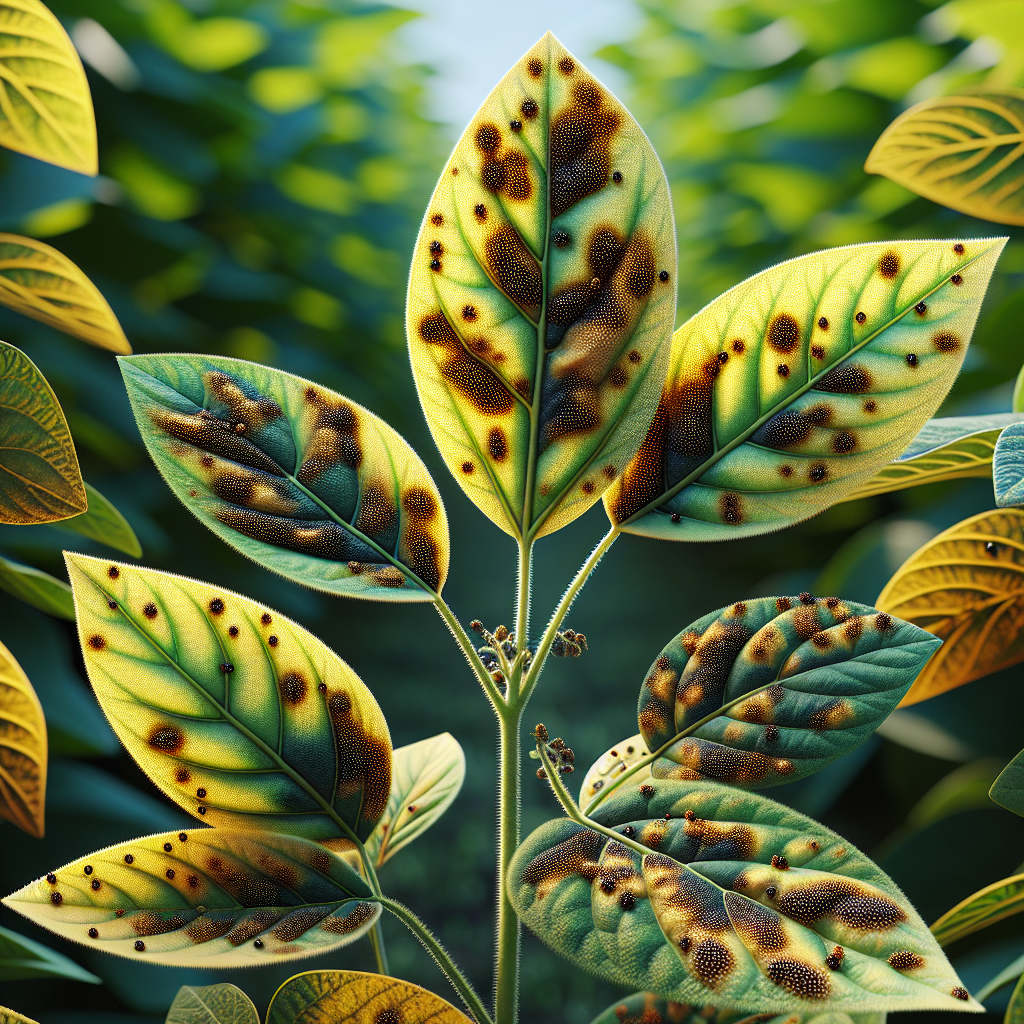
Introduction to Septoria brown spot
Septoria brown spot, caused by the fungus Septoria glycines, stands as one of the most common foliar diseases impacting soybeans worldwide, particularly in the humid soybean-growing regions of the United States, South America, and Asia. First identified in the early 20th century, this disease has become a persistent challenge for growers due to its ability to infect plants at any growth stage, from vegetative to reproductive phases. While it rarely kills plants outright, the cumulative effect of leaf damage leads to significant reductions in photosynthesis, pod fill, and overall grain yield—often ranging from 10% to over 40% in unmanaged fields under favorable conditions.
The pathogen produces pycnidia—tiny fruiting bodies filled with spores—that release conidia during wet periods, facilitating rapid spread within and between fields. Unlike more aggressive diseases like Fusarium wilt or Phytophthora, Septoria brown spot progresses gradually, making early detection crucial for minimizing economic losses. This guide provides professional-grade diagnostic criteria, lifecycle insights, and integrated management strategies tailored for commercial soybean producers and small-scale farmers alike. By understanding its biology and implementing proactive measures, growers can protect their crops effectively. For more on resilient soybean production, check out this Soil Health Mastery blog post.
Identifying Symptoms & Damage
Accurate identification of Septoria brown spot begins with recognizing its hallmark symptoms on soybean foliage. Initial signs appear as small, circular to irregular spots (1-3 mm in diameter) on lower leaves, typically starting 20-30 days after planting or during canopy closure. These spots are dark brown to reddish-brown with a lighter tan to gray center, often surrounded by a narrow yellow halo. As the disease advances, spots coalesce into larger blotches (up to 1 cm), causing leaves to turn yellow, then brown, and eventually drop prematurely—a process known as defoliation.
Pycnidia, the fungal fruiting structures, become visible as tiny black dots (0.1-0.3 mm) embedded in the lesion centers, confirming the diagnosis under magnification. Unlike Alternaria leaf spot, which produces concentric rings, or Cercospora leaf spot with larger, grayish lesions, Septoria spots are smaller and more numerous. Symptoms rarely affect stems, petioles, or pods directly but can lead to secondary infections by weakening plant defenses.
Damage manifests as reduced canopy photosynthesis, stunted pod development, and smaller seeds. Yield losses correlate with defoliation severity: 10-20% at 25% leaf loss, escalating to 30-40% at 50% or more. In severe epidemics, entire lower canopies senesce by R5 (pod fill) stage, mimicking drought stress. Scout fields weekly from V4 (four trifoliate leaves) onward, focusing on lower 1/3 of the canopy. Use a 10x hand lens to spot pycnidia and differentiate from abiotic issues like nutrient deficiencies or chemical injury. Early symptoms may resemble bacterial blight, but Septoria lesions lack water-soaked margins and bacterial ooze.
Lifecycle and Progression of Septoria brown spot
Septoria glycines follows a polycyclic lifecycle, with multiple infection cycles per season driven by rain-splashed conidia. Primary inoculum overwinters in infected crop residue, soil, and volunteer soybeans as pycnidia-embedded pycnidiospores. In spring, prolonged leaf wetness (6-12 hours at 20-30°C) triggers spore release and germination. Conidia infect stomata or wounds, forming new pycnidia in 7-14 days under optimal conditions (25°C, 95% humidity).
The latent period is short (4-7 days), enabling 5-10 cycles per season. Disease progression accelerates post-canopy closure (R1-R3 stages), when microclimate humidity exceeds 90% for extended periods. Secondary spread occurs via wind-driven rain, splashing spores up to 1-2 meters vertically. Unlike airborne pathogens like rusts (rusts), Septoria relies on splash dispersal, limiting long-distance movement but favoring dense plantings.
Peak severity hits during R3-R5 (beginning pod to beginning seed), coinciding with high yield potential. Infection ceases below 10°C or above 35°C, but warm nights (18-25°C) with frequent dew promote sporulation. Crop rotation disrupts residue-based inoculum, reducing primary infections by 50-70%. Understanding this lifecycle informs timing for scouting and fungicide applications, targeting early cycles to truncate epidemic development.
Environmental Triggers & Risk Factors
Septoria brown spot epidemics require a trifecta: susceptible host, virulent pathogen, and conducive environment. Key triggers include prolonged leaf wetness (>12 hours), temperatures of 20-28°C, and high relative humidity (>85%). Heavy dews, frequent light rains (2-5 mm), and poor air circulation in dense canopies (>300,000 plants/ha) create ideal microclimates. Fields with history of the disease, minimal tillage, and narrow row spacings (<50 cm) face elevated risk.
Susceptibility peaks in mid-maturity groups (3.0-5.0) without resistance genes. High nitrogen rates promote lush foliage, extending wetness duration. Continuous soybeans amplify inoculum buildup, with volunteers serving as bridges. Overhead irrigation mimics rain splash, boosting spread by 2-3x. Free moisture on foliage from dense planting or lodged crops sustains infections.
Regional hotspots include the U.S. Corn Belt (Illinois, Iowa, Indiana) and Argentine Pampas during wet summers. Climate change may intensify outbreaks via warmer nights and erratic rains. Risk assessment tools integrate weather data, predicting outbreaks 7-10 days ahead based on wetness hours and temperature thresholds.
Organic Control & Treatment Plans
Organic management emphasizes cultural, biological, and resistant variety strategies to suppress Septoria brown spot without synthetic fungicides. Start with certified resistant cultivars like 'AG 4933' or 'Pioneer 93Y92', which reduce severity by 40-60%. Implement 2-3 year rotations with non-hosts like corn or wheat to degrade residue inoculum.
Cultural practices include wider rows (76 cm), lower plant densities (250,000/ha), and timely canopy drying via directed airflow. Bury residue via tillage or cover crops (clover) to accelerate decomposition. Biological controls feature Trichoderma viride or Bacillus subtilis sprays (1-2 kg/ha) at 10-14 day intervals from R1, applied in evenings to maximize colonization.
Neem oil (0.5-1%) or potassium bicarbonate (2-3 kg/ha) provide protectant action during high-risk windows. Remove lower leaves at V6-R1 to eliminate primary infection sites. Scout thresholds: Apply treatments at 20-50 lesions/leaf on 20% of lower canopy plants. Integrate with nutrition: Balanced K and Mn nutrition bolsters tolerance. Organic yields under control average 5-15% below conventional but maintain profitability via premiums. Monitor via sticky traps for spore loads.
Preventing Septoria brown spot in the Future
Long-term prevention hinges on integrated pest management (IPM) fusing host resistance, cultural shifts, and precision scouting. Select varieties with confirmed tolerance (e.g., via university trials) and stack with Rpp genes if available. Rotate crops rigorously, avoiding soybeans for 3+ years, and incorporate cover crops like rye or vetch to suppress residue.
Optimize planting: Sow early-maturing groups in narrow windows to evade peak wetness. Maintain 7-10 day residue-free strips around fields. Fungicide resistance management rotates modes of action (FRAC 3, 11, 7). Use decision aids like apps tracking wetness hours for spray timing (R3 at first symptoms).
Field sanitation: Destroy volunteers pre-planting. Enhance airflow with desiccants at R6. Seed treatments with Bacillus spp. provide insurance. Future breeding targets quantitative resistance and CRISPR-edited lines. Annual risk mapping via drones identifies hotspots early. Sustainable prevention sustains yields while cutting inputs 20-30%.
Crops Most Affected by Septoria brown spot
Soybeans dominate as the primary host, with global losses exceeding $1 billion annually. No other major crops suffer direct infection, though minor reports exist on mung beans and kudzu under extreme conditions. Septoria glycines exhibits strict host specificity to Glycine max, distinguishing it from broader Septoria species affecting tomato (Septoria leaf spot) or wheat (Septoria).
Within soybeans, maturity groups III-V are hardest hit in temperate zones; tropical lines show partial tolerance. Edamame (Edamame (Soybean)) and tofu varieties face similar risks. Mixed rotations with peanuts (peanuts) or cassava minimize carryover. Focus prevention on soybean monocultures.