Introduction to Sclerotinia blight
Sclerotinia blight, caused by the soilborne fungus Sclerotinia sclerotiorum, poses a significant threat to legume crops worldwide, particularly in temperate regions with high humidity. This pathogen produces durable sclerotia—hard, black resting structures—that can survive in soil for up to 8 years, making long-term control challenging. First identified in the early 20th century, it has become a major issue in peanut production in the southeastern U.S., where yield losses can exceed 50% in severe outbreaks.
The disease thrives in cool (60-75°F), wet conditions, infecting plants at the soil line and spreading rapidly through splashing rain or irrigation. Unlike foliar diseases, Sclerotinia blight targets lower stems and crowns, often appearing suddenly after canopy closure. Farmers must integrate diagnostic vigilance with proactive strategies, as chemical controls are limited in organic systems. For detailed insights on soybeans, a key host, see our wiki. Early detection prevents sclerotia buildup, preserving soil health for future seasons.
Identifying Symptoms & Damage
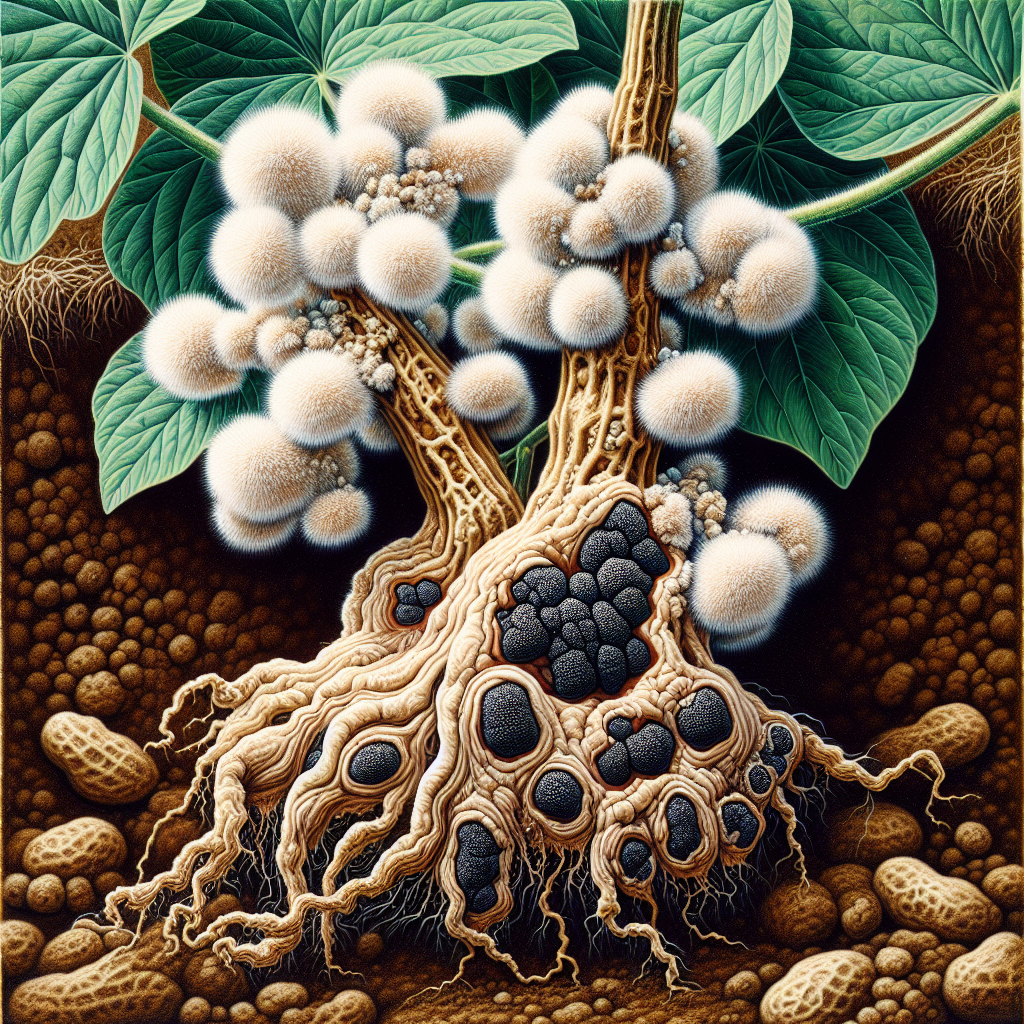
Recognizing Sclerotinia blight early is crucial for limiting spread. Initial symptoms emerge 4-6 weeks after planting, often on lower stems near the soil surface. Look for water-soaked, tan-to-brown lesions that girdle the stem, accompanied by fluffy white mycelial growth under humid conditions. As infection advances, stems shred longitudinally, revealing black sclerotia (1/8 to 1/2 inch) embedded in rotted tissue.
Affected plants wilt during the day, recovering slightly at night, before permanent collapse. In peanuts, runner tips show 'blighting' with lesions progressing upward, causing canopy gaps. Yield losses stem from pod infection in peanuts, where sclerotia contaminate harvest, rendering nuts unmarketable. Differentiate from southern blight by sclerotia shape—Sclerotinia sclerotia are irregular and larger than the spherical ones of Sclerotium rolfsii.
In advanced stages, entire rows die, with white cottony growth visible after rain. Cut stems lengthwise to confirm: healthy tissue is firm and white, while infected areas are soft, discolored, and sclerotia-filled. Damage quantification shows 20-70% plant mortality in peanuts, reducing pod yield by up to 40%. Scout weekly post-canopy closure, using a hand lens for mycelia. For more on white mold, a related issue, check our resources.
Lifecycle and Progression of Sclerotinia blight
Sclerotinia sclerotiorum has a complex lifecycle centered on sclerotia, which germinate under favorable conditions to produce mycelia or apothecia (mushroom-like structures). Dormant sclerotia in soil or crop residue activate in cool, moist soil (55-75°F, >70% moisture). Mycelial germination directly infects plant bases via wounds or natural openings; ascosporic germination occurs when apothecia form after 4-8 weeks of saturation, releasing airborne spores that infect senescing tissues.
Primary infection happens at the canopy base, with mycelia colonizing stems and producing oxalic acid to kill host cells. Secondary spread via rain splash moves mycelia 1-2 feet. Disease progression accelerates in dense canopies with prolonged leaf wetness (>48 hours). Sclerotia form inside stems 7-14 days post-infection, dropping into soil to perpetuate the cycle. In peanuts, infection peaks mid-season, with sclerotia maturing by harvest.
Lifecycle duration varies: mycelial phase is rapid (3-5 days to symptoms), while apothecia take 6-12 weeks. Overwinter survival relies on sclerotia depth (top 2 inches most vulnerable to tillage). Understanding this informs rotation: 4-6 years break needed. Check our blog on soil health mastery for rotation tips.
Environmental Triggers & Risk Factors
Sclerotinia blight epidemics require specific triggers: cool temperatures (60-70°F optimal), high humidity (>90%), and free water on lower stems. Prolonged leaf wetness from dew, rain, or overhead irrigation (>2 days) promotes apothecia formation. Soil moisture at 20-30% field capacity activates sclerotia.
Risk factors include dense planting (narrow rows <30 inches), heavy nitrogen favoring lush growth, and prior host crops like peas or sunflowers. Acidic soils (pH <6.0) enhance sclerotia germination. Conservation tillage buries sclerotia shallowly, increasing risk. In peanuts, irrigation timing post-peg coincides with vulnerability.
Climate change extends outbreaks via erratic rains. Assess risk with soil sampling: >4 sclerotia/lb soil signals high threat. Monitor weather; avoid planting in low-lying, poorly drained fields. Integrating cover crops like clover reduces moisture but monitor for alternate hosts.
Organic Control & Treatment Plans
Organic management emphasizes cultural, biological, and approved fungicides. Cultural: Rotate 4+ years with non-hosts like corn or grasses. Tillage (moldboard plow) buries sclerotia >6 inches, promoting decay. Promote drainage with raised beds; space rows 36+ inches for airflow.
Biological: Apply Coniothyrium minitans or Trichoderma spp. (e.g., Contans WG) pre-plant to parasitize sclerotia—up to 90% reduction in trials. Bacillus subtilis (Serenade) suppresses via competition.
Fungicides: OMRI-listed options like potassium bicarbonate or sulfur post-symptom. In peanuts, gypsum (2 tons/acre) raises soil pH, inhibiting germination.
Integrated Plan: Scout weekly; rogue infected plants. Apply biofungicides at 50% canopy. For small farms, solarization (clear plastic, 6 weeks summer) kills 70-90% sclerotia. Monitor efficacy; combine with resistant varieties like 'Tifguard' peanuts. Avoid over-irrigation; use drip systems.
Preventing Sclerotinia blight in the Future
Prevention hinges on breaking the sclerotia cycle. Long rotations (5-7 years) with cereals like wheat or sorghum dilute inoculum. Deep tillage (8-12 inches) every 2 years exposes sclerotia to UV/decay. Select resistant cultivars: 'Georgia-06G' peanuts show 30% less incidence.
Soil amendments: lime to pH 6.5-7.0; mustard biofumigant covers release volatiles killing sclerotia. Flooding fields 4-6 weeks pre-plant drowns 80% inoculum. Enhance beneficials with compost teas boosting Trichoderma. Clean equipment to prevent spread.
Forecast models using soil temperature/moisture predict outbreaks—scout at risk thresholds. Crop insurance covers losses; document practices for certification. Long-term, breed multi-disease resistance. Sustainable prevention yields 20-30% higher returns.
Crops Most Affected by Sclerotinia blight
Sclerotinia blight strikes over 400 hosts, but legumes dominate losses. Peanuts suffer most: U.S. losses >$10M annually, with southern runners highly susceptible. Soybeans see stem rot in Midwest, up to 25% yield hits. Dry beans, chickpeas, and lentils wilt in dense stands.
Vegetables: Lettuce head rot, cabbage drop. Sunflowers ([/wiki/sunflower]) and rapeseed in oilseed rotations amplify risk. Forage crops like alfalfa perpetuate inoculum. Tomatoes, potato affected peripherally. Manage rotations avoiding clusters of hosts.