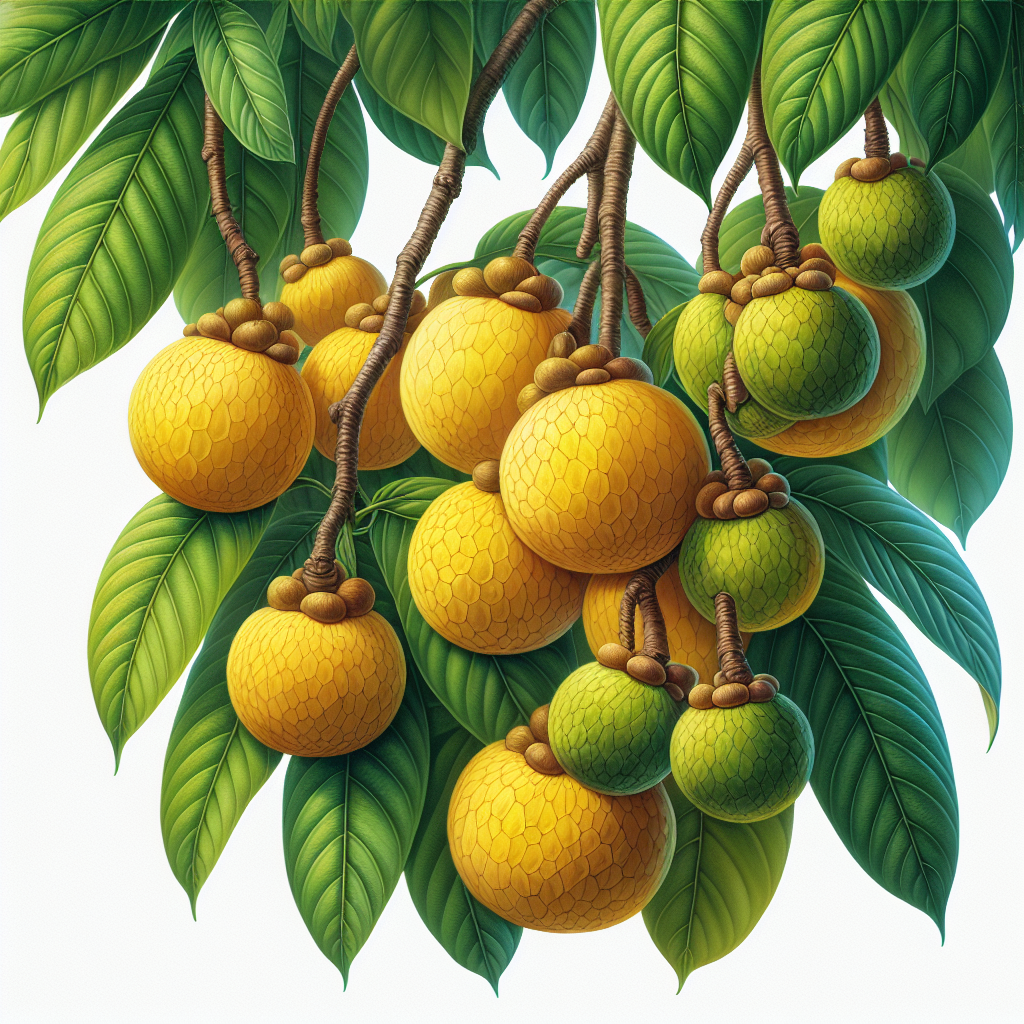
Introduction to Santol (Bangkok)
Santol (Bangkok), a select cultivar of Sandoricum koetjape, stands out among tropical fruits for its unique combination of sweet, tangy pulp and versatile edible rind. Originating from Southeast Asia, this Bangkok-selected strain has been refined for larger fruits, improved sweetness, and better adaptability to urban and small-farm settings. Known locally as 'graton' in Thailand, Santol (Bangkok) trees can reach 20-30 meters in height but are often pruned for manageability, producing golf-ball-sized to softball-sized fruits in clusters during peak seasons from May to August.
The fruit's appeal lies in its multifaceted uses: eaten fresh after peeling, pickled in salt or vinegar, made into jams, or blended into refreshing juices and sherbets. Nutritionally, it boasts high vitamin C content, fiber, and antioxidants, making it a superfood in tropical diets. For growers, Santol (Bangkok) offers economic potential with fruits selling at premium prices in local markets—up to 3-5 times that of common mango varieties. Yields can exceed 50-100 kg per mature tree annually, with trees bearing fruit as early as 3-5 years when grafted. This guide equips professional growers and hobbyists with proven strategies for propagation, care, and pest management to maximize productivity. Mango (crop) serves as a comparable tropical fruit for intercropping insights.
Botanical Profile of Santol (Bangkok)
Santol (Bangkok) belongs to the Mahogany family Meliaceae, genus Sandoricum, with S. koetjape as its scientific name. This evergreen tree features a straight trunk, dense canopy of compound leaves (3-5 leaflets, 10-25 cm long, glossy green), and small, yellowish-green flowers in panicles up to 30 cm long. The Bangkok cultivar is distinguished by its larger fruit size (6-10 cm diameter), thicker edible rind, and less fibrous pulp compared to wild types.
Fruits are round to oval, with a tough, yellowish-brown rind enclosing 5-12 large brown seeds surrounded by translucent, white, juicy pulp. Male and female flowers occur on the same tree (monoecious), but fruit set improves with cross-pollination from nearby trees. Botanically, it's a drupe-like syncarp, ripening green to yellow. Growth is rapid in youth (1-2 m/year), slowing after 10 years. Root system is deep-taprooted with extensive laterals, aiding drought tolerance once established. Similar to Durian (crop), it thrives in lowland tropics but requires wind protection due to brittle wood.
Soil, pH, and Climate Requirements for Santol (Bangkok)
Santol (Bangkok) demands well-drained, fertile loamy soils rich in organic matter, with pH 5.5-7.0 optimal—slightly acidic to neutral. Avoid heavy clays or waterlogged sites to prevent root rot. Incorporate 20-30% compost or aged manure during planting for best establishment. Sandy loams with good aeration support vigorous growth, while volcanic soils in Thailand yield premium fruits.
Climatically, it flourishes in USDA zones 10-12, requiring average temperatures of 24-32°C (75-90°F), with no frost tolerance. Annual rainfall of 1500-2500 mm is ideal, evenly distributed; supplement with irrigation during dry spells (<3 months). High humidity (70-90%) promotes flowering, but prolonged rains (>2000 mm without dry periods) reduce fruit quality. Full sun (6-8 hours daily) is essential; partial shade stunts yields. Windbreaks are crucial in exposed sites, as young trees snap easily. For heatwave-prone areas, see Why Summer Heatwaves Are Silently Killing Small Farm Yields - And 7 Organic Strategies to Fight Back for resilience tactics.
Elevations up to 800 m suit Bangkok strains, with lower altitudes producing sweeter fruits. Soil testing pre-planting is recommended; amend with lime if pH <5.5 or sulfur if >7.5. Mulch heavily (10-15 cm organic layer) to retain moisture and suppress weeds.
Step-by-Step Planting & Propagation
Propagation of Santol (Bangkok) favors grafting over seeds for true-to-type, precocious bearing. Seeds germinate in 2-4 weeks at 25-30°C but result in variable offspring and 7-10 year fruiting.
Seed Propagation: Extract seeds from ripe fruits, wash off pulp, sow in 1:1:1 sand-compost-perlite mix. Maintain 80% humidity under shade cloth; transplant at 30 cm height.
Grafting (Preferred): Use cleft or veneer grafting on 1-2 year rootstocks in rainy season. Select scions from high-yield Bangkok mother trees. Success rate: 70-90%. Air-layering (marcotting) yields rooted branches in 2-3 months—slit bark, apply rooting hormone, wrap in moist sphagnum.
Planting Steps:
- Site prep: Dig 60x60x60 cm pits, fill with topsoil + 20 kg compost + 500g superphosphate + 200g muriate of potash.
- Plant grafted saplings 8-10 m apart (10x10 m for mature orchards).
- Stake and prune to single leader.
- Initial irrigation: 50-100 L/week until established.
Best planting: start of rainy season. Expect 20-50 fruits/tree in year 3, scaling to 100+ by year 7.
Care & Maintenance regimes for Santol (Bangkok)
Young trees need fortnightly watering (50 L/tree), reducing to weekly for matures. Fertilize 3x/year: NPK 15-15-15 at 1-2 kg/tree young, 5-10 kg mature, plus micronutrients (Zn, B, Mg). Foliar sprays boost uptake.
Pruning: Annually after harvest, remove deadwood, watersprouts, and canopy for light penetration. Shape to 5-7 m height for harvest ease. Mulch roots to 2 m radius.
Irrigation: Drip systems deliver 20-40 L/day/tree in dry seasons. Withhold briefly pre-flowering to synchronize bloom. Monitor for nutrient deficiencies: yellow leaves indicate N lack; interveinal chlorosis signals Zn.
Weed control: Slash around base; cover crops like Clover (crop) suppress competition. Intercrop with legumes years 1-3 for nitrogen fixation.
Pests, Diseases & Organic Management
Common pests: Aphids, mealybugs, fruit borers, and seed weevils. Organic controls: Neem oil sprays (2-3 ml/L weekly), introduce ladybugs, or Bacillus thuringiensis for caterpillars. Sticky traps for flies.
Diseases: Anthracnose (black spots on leaves/fruit), Phytophthora root rot in wet soils, powdery mildew. Prevent with copper fungicides (Bordeaux mix), good drainage, and resistant rootstocks. Remove infected parts; apply Trichoderma for soil drench.
For integrated management, consult Why 90% of Small Farms Fail at Pest Management - And 8 Organic Fixes That Actually Work. Monitor weekly; early intervention preserves 90% yields.
Harvesting, Curing & Optimal Storage
Harvest when fruits yellow 70-80% and slightly soft—typically 120-150 days post-bloom. Clip clusters with shears, avoiding rind damage. Yields peak June-August in tropics.
Curing: Store at 25-28°C, 85% humidity for 3-5 days to even ripening. For export, wax fruits and refrigerate at 13-15°C (90% RH) up to 4 weeks.
Fresh storage: Room temp 5-7 days; fridge 2-3 weeks. Process excess into rind pickles (boil in brine) or pulp preserves—shelf-stable 6-12 months. Market as premium 'Bangkok Sweet Santol' for 20-50% price uplift.
Companion Planting for Santol (Bangkok)
Enhance orchard health with companions: Nitrogen-fixers like Pigeon pea (crop) or Gliricidia (crop) for shade/fertilizer. Repellents: Marigold (crop) deters nematodes; Thyme (crop) repels borers. Understory: Ginger (crop) or pineapples suppress weeds without competing.
Avoid deep-rooted trees like mature mango. Spacing allows Thai Basil (crop) interplanting for pest deterrence and microclimate cooling. See Fall Companion Planting Guide: Boost Yields and Soil Health for Small Farms and Gardens for seasonal plans.