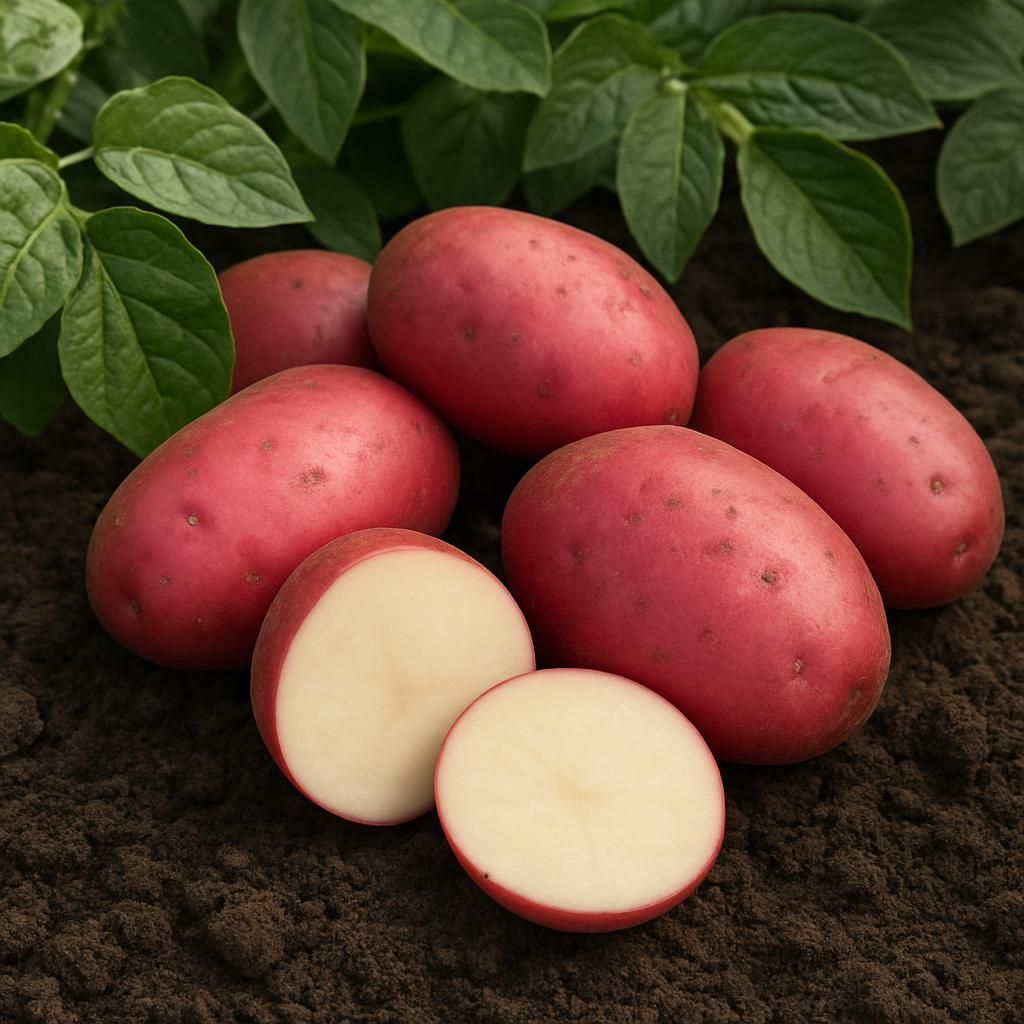
Introduction to Potato (Red Pontiac)
The Red Pontiac potato is a popular early-to-midseason variety known for its vibrant red skin, white flesh, and reliable performance across a wide range of growing conditions. Gardeners and commercial growers value it for its high yields, resistance to common scab, and excellent storage qualities that keep tubers firm for months after harvest. Whether you are planting in raised beds, traditional rows, or containers, this variety delivers consistent results when proper cultural practices are followed.
Botanical Profile of Potato (Red Pontiac)
Red Pontiac belongs to the nightshade family (Solanaceae) and is classified as a herbaceous perennial grown as an annual for its edible tubers. Plants produce upright to semi-upright vines reaching 18–24 inches in height with compound leaves and clusters of white to pale lavender flowers. The tubers are oval to oblong, featuring smooth, thin red skin and shallow eyes that reduce peeling waste. Unlike some varieties, Red Pontiac maintains good shape and size even under moderate stress, making it a dependable choice for both home gardens and market farms.
Soil, pH, and Climate Requirements for Potato (Red Pontiac)
Successful Red Pontiac production begins with well-drained, fertile soil that supplies consistent moisture without waterlogging. The variety performs best in cool-season climates but adapts to many regions when planting dates are timed correctly.
| Parameter | Ideal Range | Notes |
|---|---|---|
| Soil Type | Sandy loam to loam | Good drainage prevents rot |
| Soil pH | 5.8 – 6.5 | Slightly acidic reduces scab risk |
| Temperature (Day) | 60–70°F (15–21°C) | Optimal tuber formation |
| Temperature (Night) | 50–60°F (10–15°C) | Avoid frost after emergence |
| Spacing (In-row) | 10–12 inches | Allows tuber expansion |
| Spacing (Between Rows) | 30–36 inches | Facilitates hilling and harvest |
| Planting Depth | 4–6 inches | Deeper planting reduces greening |
Step-by-Step Planting & Propagation
- Source certified seed potatoes free of disease. Cut larger tubers into pieces with at least two eyes each and allow cuts to callus for 1–2 days.
- Prepare soil by incorporating 2–3 inches of well-rotted compost or aged manure. Avoid fresh manure that promotes scab.
- Plant when soil temperature reaches 45–50°F, typically 2–3 weeks before the last frost date.
- Place seed pieces 4–6 inches deep with eyes facing upward, spacing 10–12 inches apart in rows 30–36 inches wide.
- Water thoroughly after planting to settle soil around tubers.
- Begin hilling when plants reach 6–8 inches tall by mounding soil around stems, repeating every 2–3 weeks until vines flower.
Care & Maintenance regimes for Potato (Red Pontiac)
Consistent moisture and balanced fertility support vigorous vines and high-quality tubers. Mulching helps retain moisture, suppress weeds, and moderate soil temperature.
| Task | Schedule | Details |
|---|---|---|
| Watering | 1–1.5 inches per week | Deep watering; avoid overhead during bloom |
| Fertilizer (N-P-K) | At planting: 10-10-10 or 8-16-16 | Side-dress with nitrogen at hilling |
| Fertilizer (Organic) | Compost tea or fish emulsion | Apply every 3–4 weeks until flowering |
| Pruning | Remove flowers if desired | Directs energy to tuber development |
| Mulching | 2–3 inches straw or shredded leaves | Apply after hilling; keep away from stems |
Pests, Diseases & Organic Management
Red Pontiac shows good resistance to common scab but remains susceptible to Colorado potato beetle, aphids, late blight, and early blight. Monitor weekly and use integrated strategies.
- Handpick Colorado potato beetle adults and larvae; apply Bacillus thuringiensis (Bt) or spinosad for heavy infestations.
- Control aphids with insecticidal soap or neem oil; encourage natural predators such as lady beetles.
- Prevent late blight by planting resistant seed, spacing for airflow, and applying copper-based fungicides at first sign of disease.
- Rotate crops on a 3–4 year cycle and remove volunteer plants to reduce soil-borne pathogens.
Harvesting, Curing & Optimal Storage
Harvest new potatoes 60–70 days after planting when vines begin to flower. For mature storage potatoes, wait until vines naturally senesce or cut them back 2–3 weeks prior. Use a garden fork to gently lift tubers, avoiding skin damage. Cure harvested potatoes in a dark, well-ventilated area at 50–60°F for 10–14 days, then store at 38–42°F with 85–90% humidity. Properly cured Red Pontiac tubers maintain quality for 4–6 months.
Companion Planting for Potato (Red Pontiac)
Strategic companions improve soil health, deter pests, and maximize space. Plant Nasturtium nearby to repel aphids and Colorado potato beetles. Marigold flowers attract beneficial insects while suppressing nematodes. Avoid planting near Tomato or other nightshades to reduce shared disease pressure. Clover or hairy vetch grown as living mulch fixes nitrogen and improves soil structure between rows.
Potato (crop) varieties share similar requirements and can be rotated with Onion and Garlic for natural pest suppression. For deeper insights on seasonal transitions and soil health, see The Truth About Fall Garden Transitions for Small Farm Resilience.