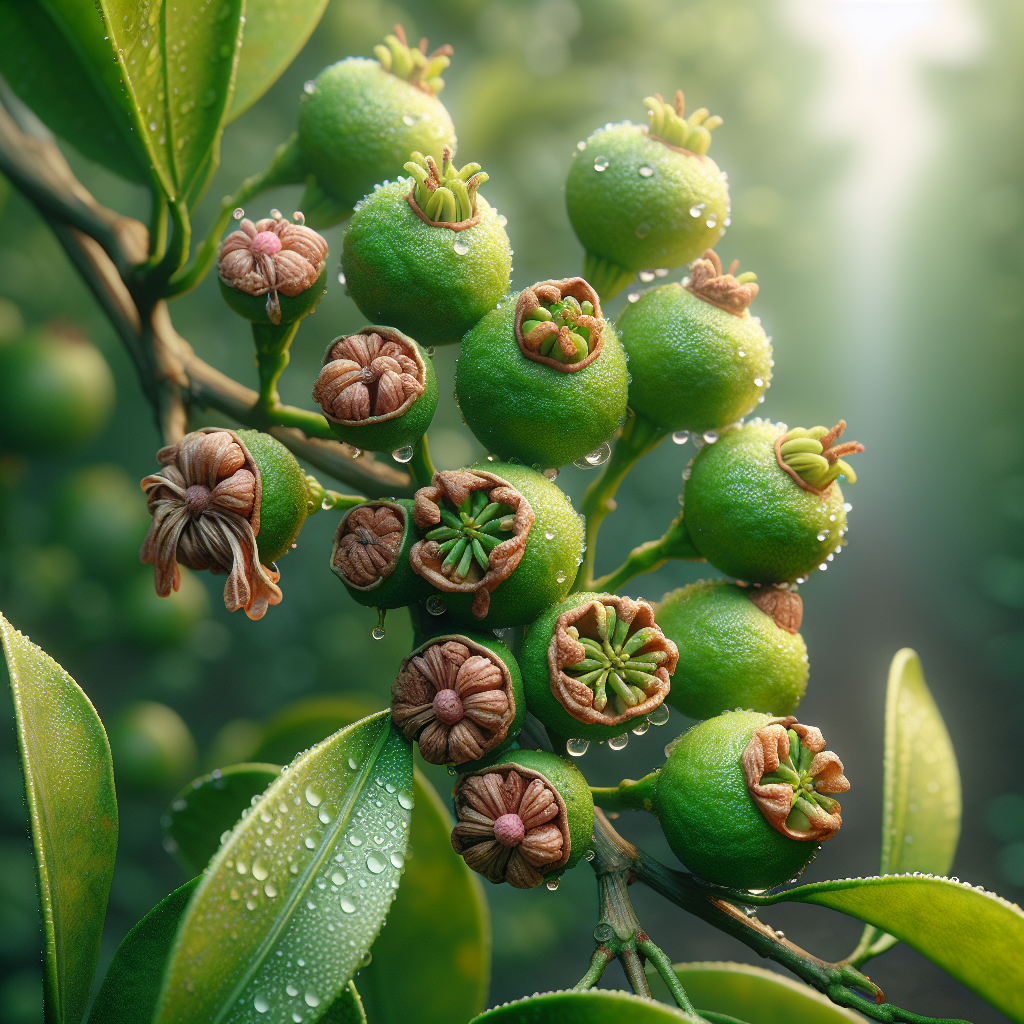
Introduction to Post-bloom fruit drop
Post-bloom fruit drop (PFD) represents one of the most devastating physiological and pathological disorders in citrus production worldwide, capable of causing yield losses exceeding 80-90% in severe outbreaks. Primarily driven by the fungal pathogen Colletotrichum gloeosporioides and related species (commonly linked to anthracnose), PFD manifests as excessive abscission of flowers, flower petals, and immature fruitlets (typically 3-14 days post-bloom). This non-infectious physiological response is triggered when the tree's hormonal balance—particularly ethylene production—is disrupted by fungal colonization under conducive environmental conditions.
Unlike typical fruit drop during cell division stages, PFD is uniquely tied to post-bloom timing, distinguishing it from pre-bloom drop or June drop. First documented in Florida citrus groves in the 1980s, it has since spread to major production regions including Brazil, Spain, Australia, and India, correlating with humid subtropical climates. Economic impacts are profound: a single outbreak can nullify an entire season's bloom investment, with global losses estimated in billions annually. Understanding PFD requires integrating botany, pathology, and agrometeorology, as the syndrome blends abiotic stress with biotic infection. Successful management hinges on predictive modeling, cultural practices, and targeted organic interventions, as detailed in this comprehensive guide. For small farms, integrating AI-driven weather forecasting can prevent disasters, as explored in Why 80% of Small Farms Battle Weather Disasters - And How Hyper-Local AI Forecasts Can Save Your Harvest.
Identifying Symptoms & Damage
Accurate diagnosis of PFD begins with recognizing its hallmark symptoms during the critical 2-4 week window post-bloom. Primary signs include:
- Floral Necrosis: Infected flowers turn brown to black, with petals adhering to calyces. Lesions often show acervuli (fungal spore masses) under humid conditions, appearing as pinkish-orange gelatinous spots.
- Fruitlet Drop: Young fruit (king fruitlets <10mm) yellow, shrivel, and abscise, leaving persistent calyces ('button drop'). Affected fruitlets may exhibit necrotic lesions at the stylar end.
- Corolla Retention: A diagnostic feature—dried petals remain attached to peduncles, unlike natural drop.
Secondary symptoms include twig dieback and leaf yellowing from defloration stress. Damage assessment involves counting dropped fruitlets per tree: >50% bloom loss indicates severe PFD. Differentiate from nutrient deficiencies (e.g., zinc shortage causes smaller, uniform drop) or herbicide drift (irregular patterns). Lab confirmation via PCR for Colletotrichum or culturing on selective media (e.g., PDA) is recommended. Yield impact scales exponentially: 10% bloom loss reduces fruit set by 20-30%; 70%+ loss demands replanting considerations. Scout weekly post-bloom using a 10x hand lens for acervuli, documenting with photos for threshold-based decisions.
Lifecycle and Progression of Post-bloom fruit drop
The PFD lifecycle synchronizes with citrus bloom phenology and Colletotrichum biology. Conidia (asexual spores) overwinter in mummified fruit, leaf litter, and bark cankers. Primary inoculum disperses via rain splash during bloom (anthesis), infecting receptive floral tissues (stigmas, petals) within 24-48 hours.
Progression Stages:
- Inoculation (Bloom Peak): Spores germinate in free water (>12 hours at 25-30°C), penetrating via wounds or natural openings.
- Incubation (3-7 days): Latent infection; no visible symptoms. Fungal mycelia colonize ovaries.
- Symptom Expression (7-14 days post-bloom): Necrosis appears; ethylene surge triggers abscission zone formation.
- Sporulation (Post-Drop): Acervuli form on dropped tissue, releasing secondary conidia in wet cycles.
- Dormancy: Survives epiphytically on leaves until next bloom.
A single rain event (10-20mm) during 80% bloom can initiate epidemics. Disease progresses fastest at 28°C and 90% RH, completing a cycle in 10 days. In perennial citrus, polycyclic infections amplify losses across flushes. Understanding this enables predictive IPM: monitor spore traps pre-bloom.
Environmental Triggers & Risk Factors
PFD epidemics require the interaction of susceptible host, virulent pathogen, and favorable environment (McKinney's triangle). Key triggers:
- Weather: Prolonged leaf wetness (>48 hours) from rain or dew during bloom, with temperatures 20-32°C. High humidity (>85% RH) prolongs sporulation.
- Cultural Practices: Dense canopies (poor pruning), excessive N fertilization (lush bloom), overhead irrigation.
- Varietal Susceptibility: 'Valencia' orange most prone; 'Navel' orange resistant. Young trees (<5 years) suffer 2x losses.
- Site Factors: Poor drainage, heavy clay soils increase humidity microclimates.
Risk models (e.g., Florida's PFD forecaster) integrate bloom stage, rainfall, and temperature for 7-day alerts. Climate change exacerbates via erratic springs. Mitigate via site selection: slopes >2% for drainage.
Organic Control & Treatment Plans
Organic management emphasizes prevention over curative sprays, complying with USDA NOP standards. No single product eradicates latent infections; integrate tactics:
Cultural Controls (Foundation):
- Prune for 20-30% canopy openness pre-bloom to reduce humidity.
- Apply gypsum (2-4 tons/ha) for Ca nutrition, stabilizing cell walls.
Biologicals:
- Bacillus subtilis (Serenade) or Trichoderma harzianum at 50% bloom (2-3 apps, 7-day intervals).
- Compost teas with mycorrhizae enhance tree resilience.
Organic Fungicides:
- Copper octanoate (1-2 L/ha) at early bloom; rotate with potassium bicarbonate.
- Neem oil (0.5%) + sulfur for acervuli suppression.
Treatment Protocol:
- Pre-bloom: Sanitation (remove mummies), prune.
- Bloom: Biofungicide at 20% flowers open.
- Post-Bloom Scout: If 5% infection, apply copper + Ca.
Efficacy: Integrated organics reduce PFD 60-80%. Monitor via sticky traps for thrips vectors (thrips).
Preventing Post-bloom fruit drop in the Future
Long-term prevention builds resilient orchards:
- Resistant Cultivars: Plant 'Lane Late' or hybrids.
- Orchard Design: 6x4m spacing, windbreaks for dry air.
- Nutrition: Balanced NPK + micronutrients (Zn 50ppm, B 30ppm foliar).
- Irrigation: Drip only; avoid bloom wetting.
- Monitoring: AI apps for bloom/rainfall alerts.
- Sanitation: Shred prunings, mulch litter.
Annual IPM calendar: Jan prune, Mar fertilize, Apr scout. Rotate tactics to prevent resistance. Economic threshold: Treat at 10% floral infection.
Crops Most Affected by Post-bloom fruit drop
PFD primarily plagues citrus, with orange (80% cases), grapefruit, and lime most vulnerable. Mango shows similar anthracnose drop; avocado (e.g., Hass) experiences 'flower blight'. Minor reports in mango and guava. Global hotspots: Florida (Valencia), Brazil (Pera), Spain (Navelina).