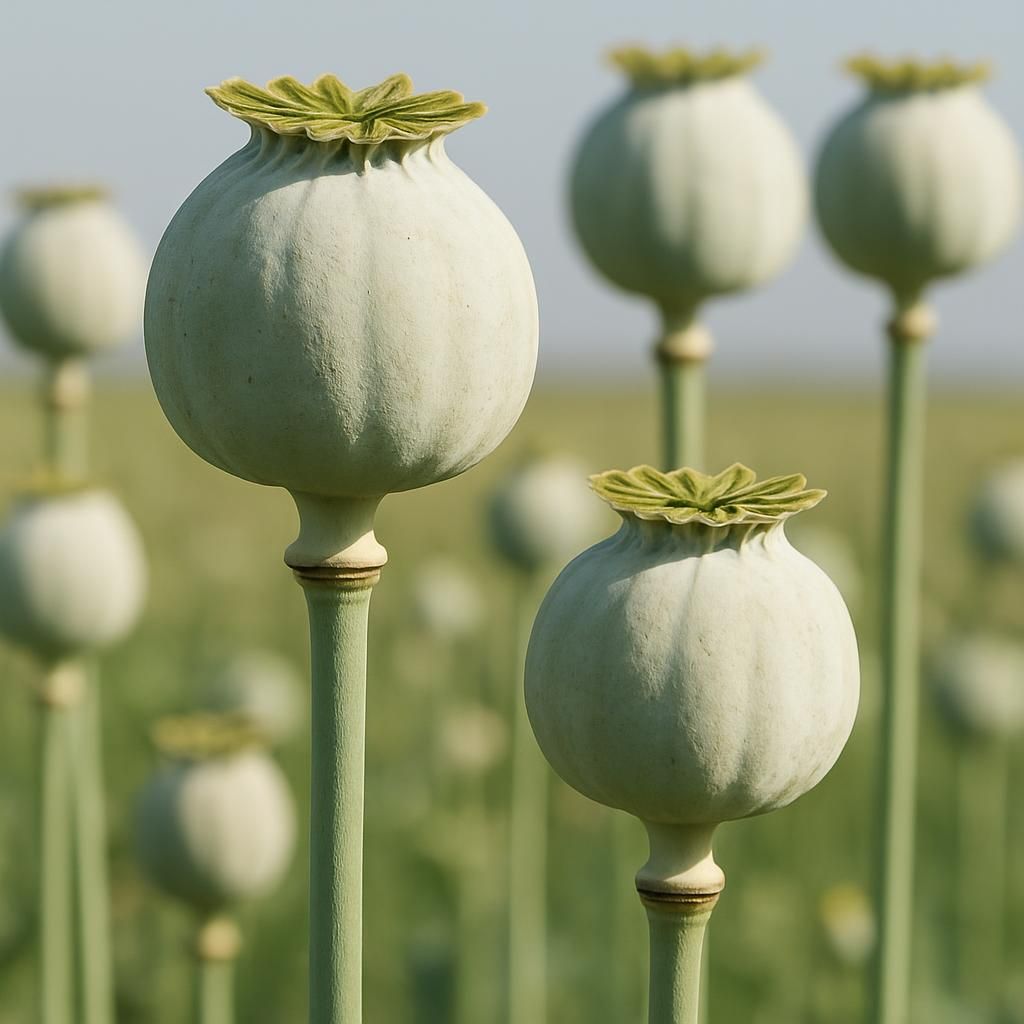
Introduction to Poppy Seed (White)
White poppy seed (Papaver somniferum var. album) is a specialized oilseed crop grown for its pale, mild-flavored seeds used in baking, confectionery, and high-quality culinary oils. Unlike darker opium poppy varieties, white-seeded types produce a neutral flavor profile that does not overpower delicate dishes. Commercial production focuses on both seed yield and oil extraction, with modern cultivars offering improved disease resistance and higher oil percentages.
The crop has a long history in temperate agriculture, thriving in regions with cool springs and dry summers. Growers value white poppy for its relatively short 90–120 day cycle and its ability to fit into rotations with Wheat or Barley. Seed oil content commonly ranges from 42–50 %, making it competitive with Sunflower and Flax for specialty oil markets.
Successful production requires attention to soil structure, precise sowing timing, and careful post-harvest handling to preserve seed quality. This guide provides the technical detail needed for consistent, high-yielding crops.
Botanical Profile of Poppy Seed (White)
Papaver somniferum var. album is an annual herbaceous plant in the Papaveraceae family. It develops a taproot and erect, glaucous stems reaching 60–120 cm. Leaves are alternate, deeply lobed, and covered with a light bloom. Solitary terminal flowers are typically white or pale lilac with four petals; the large, globose capsule contains thousands of tiny white seeds.
The white-seeded variant differs from blue or brown types by lacking anthocyanin pigments in the seed coat, resulting in the characteristic pale color. Capsules mature from green to light tan and dehisce through small pores beneath the stigmatic disc, releasing seed when fully dry.
Soil, pH, and Climate Requirements for Poppy Seed (White)
White poppy performs best on well-drained loamy or sandy loam soils with good structure and moderate fertility. Heavy clays restrict root development and increase disease risk. The crop tolerates a wide pH range but shows optimal nutrient uptake between 6.0 and 7.5.
Cool temperatures during early growth followed by warm, dry conditions during flowering and seed fill are essential. Excessive rainfall at capsule maturity promotes shattering and fungal infection. The table below summarizes ideal environmental parameters.
| Parameter | Ideal Range | Notes |
|---|---|---|
| Soil Type | Loam to sandy loam | Well-drained; avoid compacted clays |
| Soil pH | 6.0 – 7.5 | Optimal nutrient availability |
| Temperature (Day) | 15–22 °C (vegetative) | 18–25 °C during flowering and seed fill |
| Temperature (Night) | 5–12 °C | Prevents bolting stress |
| Annual Rainfall | 400–700 mm | Supplemental irrigation in dry periods |
| Frost Tolerance | Seedlings to –4 °C | Protect young plants from hard freezes |
| Growing Degree Days | 1 800–2 200 GDD (base 5 °C) | Typical 90–120 day cycle |
Step-by-Step Planting & Propagation
Site selection should prioritize fields with a history of low weed pressure and good drainage. Prepare seedbeds by incorporating 20–30 t ha⁻¹ well-rotted compost or manure the previous autumn, followed by shallow cultivation in spring.
Sowing occurs when soil temperature reaches 8–10 °C, typically 2–3 weeks before the last expected frost. Use a precision seeder to place seed at 5–8 mm depth with 20–30 cm row spacing and 3–5 cm in-row spacing (target 80–100 plants m⁻²). Calibrate equipment for the small seed size; many growers mix seed with fine sand or pelleted fertilizer to improve flow.
Germination occurs in 7–14 days. Thin seedlings to final spacing once they reach the 4-leaf stage. Avoid transplanting; the taproot is sensitive to disturbance. In regions with short seasons, direct sowing is the only reliable method.
Care & Maintenance regimes for Poppy Seed (White)
White poppy requires minimal intervention once established. Weed control during the first 30 days is critical; use shallow cultivation or flame weeding before canopy closure. Mulching between rows reduces moisture loss and suppresses weeds.
The crop responds to moderate nitrogen but excess promotes lodging. Split applications—50 % at sowing and 50 % at stem elongation—optimize uptake. Irrigation is rarely needed after establishment except during prolonged drought at flowering.
| Growth Stage | Water (mm/week) | Fertilizer (N-P-K) | Pruning / Other |
|---|---|---|---|
| Establishment (0–30 d) | 15–20 | 20-20-20 at 40 kg N ha⁻¹ | Weed control; no pruning |
| Vegetative (30–60 d) | 10–15 | 10-5-10 at 30 kg N ha⁻¹ | Monitor for lodging |
| Flowering (60–80 d) | 5–10 | None | Avoid overhead irrigation |
| Seed Fill (80–110 d) | 0–5 | None | Cease irrigation 14 days pre-harvest |
| Post-harvest | 0 | Cover crop or green manure | Shallow stubble incorporation |
Pests, Diseases & Organic Management
Major insect pests include Aphids, Thrips, and Capsule borers. Early scouting and releases of beneficial insects such as lady beetles and lacewings provide effective biological control. Neem-based sprays or insecticidal soaps are approved organic options when populations exceed thresholds.
Fungal diseases such as Powdery mildew, Botrytis, and Downy mildew can reduce seed quality. Cultural practices—wide row spacing, crop rotation with non-hosts, and removal of crop residue—form the foundation of management. Copper-based fungicides or potassium bicarbonate sprays offer limited organic suppression when applied at first sign of infection.
Nematode pressure is generally low but can increase after repeated poppy plantings; include Marigold or Mustard cover crops in the rotation to suppress populations.
Harvesting, Curing & Optimal Storage
Harvest when capsules turn light tan and rattle when shaken, usually 110–120 days after sowing. Use a combine with reduced cylinder speed (400–600 rpm) and wide concave clearance to minimize seed damage. Windrowing followed by pick-up is an alternative in small fields.
Immediately after harvest, dry seed to 8–10 % moisture using forced-air dryers at 35 °C or less to preserve oil quality. Clean seed with air-screen cleaners to remove chaff and lightweight capsules. Store in cool (10–15 °C), dark conditions at <60 % relative humidity. Properly cured and stored seed retains viability and flavor for 18–24 months.
Companion Planting for Poppy Seed (White)
White poppy integrates well with cereal companions such as Wheat and Barley in strip-cropping systems, improving biodiversity and reducing pest pressure. Low-growing herbs including Thyme and Rosemary planted on field borders attract pollinators and beneficial insects while providing additional revenue streams.
Avoid planting near brassicas or solanaceous crops that share common pests. Nasturtium sown as a trap crop diverts Aphids away from the main stand. After poppy harvest, follow with nitrogen-fixing legumes such as Clover to rebuild soil fertility for the next season.