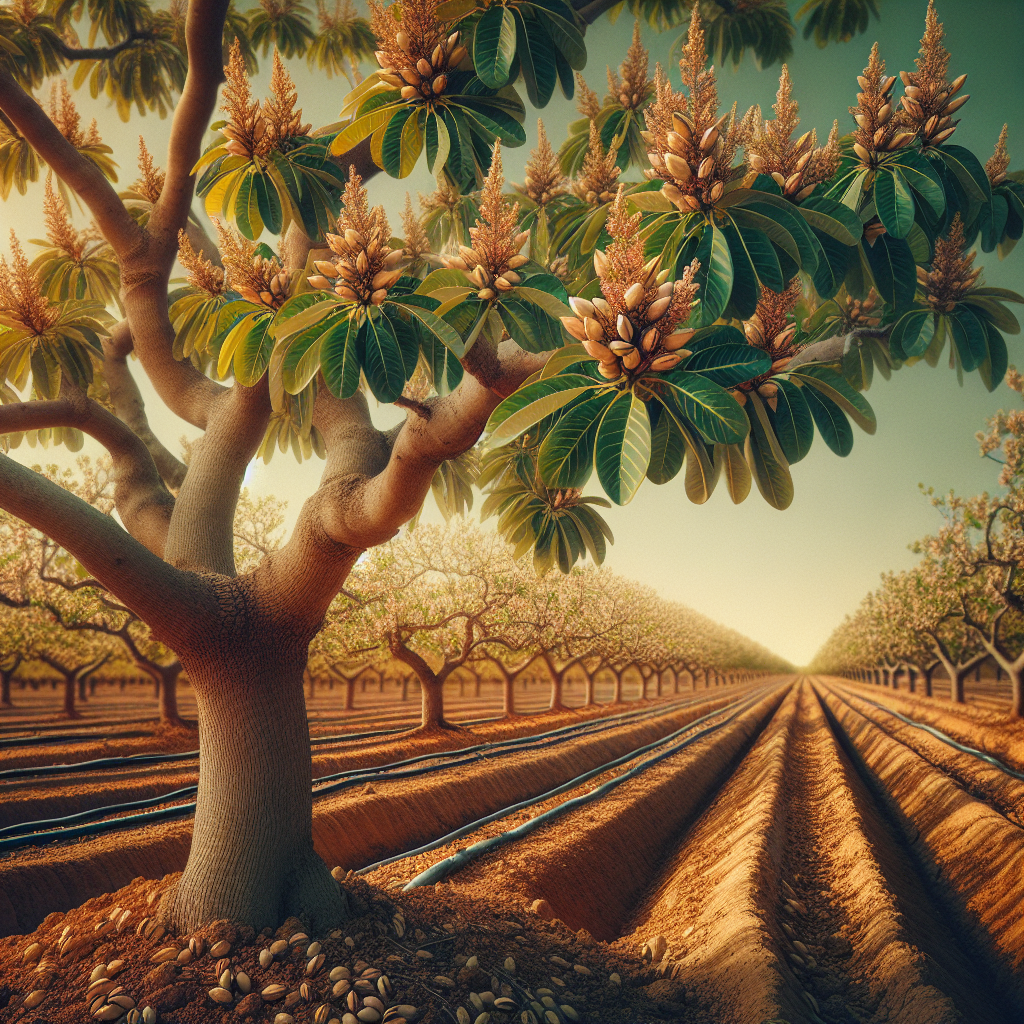
Introduction to Pistachio (Peters)
A successful pistachio orchard depends as much on pollination management as on irrigation, soil preparation, and pruning, and this is where 'Peters' becomes indispensable. Unlike female pistachio cultivars that bear the edible nuts, Peters is a male selection of Pistacia vera planted specifically to provide abundant viable pollen during bloom. In most traditional California-style orchards, it has long been paired with Kerman because its flowering window generally overlaps well with that female cultivar’s bloom period.
Pistachio is a dioecious species, meaning male and female flowers occur on separate trees. A male tree therefore never produces marketable nuts, but without enough synchronously blooming male trees, female trees can carry heavy bloom and still deliver disappointing yields due to poor fertilization. Peters is valued because it tends to produce large quantities of pollen, has a strong upright growth habit, and performs reliably in the arid to semi-arid environments where pistachios excel.
Historically, commercial pistachio expansion in the western United States depended on stable male-female pairing systems. While newer pollinizers have emerged for specific flowering windows, Peters remains a foundational reference point in pistachio orchard design. For growers establishing a traditional orchard, understanding Peters is really understanding the reproductive engine of the entire planting. For broader orchard context, see Kerman Pistachio. A good background on orchard soil strategy is also in this soil health article.
Botanical Profile of Pistachio (Peters)
This cultivar belongs to the Anacardiaceae family, the same family that includes mango, cashew, and sumac. As a male Pistacia vera selection, Peters forms staminate flowers in branched panicles and contributes pollen rather than fruit. Flowers are apetalous, wind-pollinated, and visually modest, so orchard bloom monitoring must focus on panicle development and anther dehiscence rather than showy flowering cues.
The tree is typically vigorous, upright, and structurally strong, often growing with a more vertical framework than some female cultivars. Leaves are compound, leathery, and gray-green to medium green, reflecting adaptation to bright, dry conditions. As with other pistachios, Peters is deciduous and enters winter dormancy, requiring chill accumulation for proper spring development. Chill needs in pistachio are often discussed in relation to females, but male bloom timing is equally sensitive to winter temperatures because insufficient chill can compress, delay, or unevenly distribute pollen shed.
Root systems are extensive and benefit from deep, aerated profiles. Commercial trees are usually grafted onto hardy rootstocks selected for tolerance to soil-borne disease, salinity, calcareous soils, or nematode pressure. Common rootstocks in pistachio systems may include Pistacia integerrima, P. atlantica, P. terebinthus, or interspecific hybrids, with rootstock choice significantly affecting vigor, adaptation, and disease resilience.
A key nuance with Peters is bloom synchronization. A male pollinizer is only useful if its pollen shed overlaps female stigma receptivity. Peters is considered a mid-bloom male and has historically matched well with mid-season female bloom patterns. However, local microclimate, winter chill, rootstock, orchard elevation, and spring heat accumulation can all shift bloom. Professional growers often observe bloom over several years before finalizing pollinizer ratios in expanded plantings.
Soil, pH, and Climate Requirements for Pistachio (Peters)
Pistachios are among the most climate-specific nut trees in commercial agriculture. Peters performs best in regions with long, hot, dry summers; low summer humidity; cool winters with adequate chill; and minimal spring rainfall during bloom. Ideal summer conditions regularly exceed 32b0C (90b0F), and high heat helps overall orchard performance, even though Peters itself is not grown for nuts. Dry air during bloom is particularly valuable because rainfall and prolonged humidity can reduce pollen movement and viability.
Winter chill needs vary by site and season, but pistachios generally require substantial chilling to break dormancy uniformly. Mild winter regions may produce erratic bloom, weak leaf-out, and poor synchrony between male and female trees. Late spring frosts are another concern because bloom tissues are vulnerable once dormancy breaks.
Soils should be deep, well-drained, and preferably at least 1.5 to 2 meters effective rooting depth. Sandy loam, loam, gravelly loam, and some well-structured silt loams are suitable. Heavy clay can work only if internal drainage is excellent and irrigation is meticulously managed. The species tolerates moderately calcareous soils better than many fruit and nut crops, and pH from about 7.0 to 8.0 is often acceptable. It can survive outside that band, but the practical target for balanced nutrient uptake is roughly pH 7.2 to 7.8.
Peters does not tolerate prolonged waterlogging. Saturated soil for even a few days in warm conditions can damage fine roots and predispose trees to Phytophthora and other decline problems. A useful field benchmark is that soil in the active root zone should dry down between irrigation events enough to restore oxygen without causing prolonged severe stress. In orchards using soil moisture monitoring, many growers aim to irrigate before trees experience extreme depletion, but still allow moderate dry-down cycles in deeper layers rather than keeping the profile constantly wet. If a hand-sampled soil ball from 20 to 30 cm depth feels sticky, smears easily, and leaves a glossy sheen, the site may be too wet for immediate re-irrigation. By contrast, if soil at 30 to 60 cm depth is powdery, non-cohesive, and roots are absent or desiccated, irrigation intervals may be too long.
Salinity tolerance is better than in many orchard crops, which is one reason pistachio has been adopted in marginal western soils. However, tolerance does not mean immunity. Excess sodium, chloride, or boron can still reduce vigor and disrupt bloom. Good drainage and periodic leaching, where water quality permits, remain essential.
Wind is beneficial for pollination because pistachio is wind-pollinated, but extreme desiccating winds during establishment can stress young trees. Site planning should balance airflow with protection from sustained sandblasting or trunk damage.
Step-by-Step Planting & Propagation
Commercially, Peters is almost always established as a grafted tree rather than grown from seed. Seedling males are too variable in bloom timing, vigor, and compatibility to rely on in a professional orchard. Buy certified grafted nursery trees from reputable sources, specifying the intended female cultivar and local bloom conditions.
Select the orchard design first. Determine the female cultivar, expected bloom window, wind direction during spring, and pollinizer placement pattern. Common pollinizer ratios range from about 1 male for every 8 to 24 female trees depending on block shape, wind behavior, and management intensity. In rectangular orchard layouts, males are often placed in every few rows and at intervals within rows so pollen can travel across the block efficiently.
Prepare the soil well in advance. Rip compacted layers before planting if a hardpan exists. Correct drainage issues before trees go in the ground; pistachios are unforgiving of poorly drained establishment sites. If pH is extremely high and micronutrient lock-up is expected, plan a long-term nutrient correction strategy rather than expecting one-time amendments to solve the problem.
Plant during dormancy or early spring, depending on nursery format. Bare-root trees are typically planted while dormant. Container-grown grafted trees can also be planted in spring once severe frost risk has passed. Avoid planting into cold, waterlogged soils.
Dig a hole no deeper than the root system. Width should be sufficient to spread roots naturally without circling. The graft union must remain well above the soil line. Planting too deep is a frequent cause of poor establishment and crown problems.
Backfill with native soil. Avoid over-amending the planting hole with rich compost, which can create a texture interface that impedes root exploration. Light incorporation of well-finished organic matter across the whole planting strip is more effective than creating a pocket of soft soil.
Irrigate immediately after planting. The first irrigation should settle soil around roots and eliminate air pockets. After that, maintain uniform but not saturated moisture. Young trees need frequent establishment irrigations compared with mature trees, but each event should still allow oxygen to re-enter the root zone.
Train the scaffold early. Head the tree at the desired trunk height if not already formed by the nursery. Select 3 to 5 primary scaffolds with wide crotch angles. Since male trees must survive and shed pollen for decades, strong branch architecture is important.
Propagation by budding or grafting is standard. T-budding and chip budding onto established rootstocks are common methods in nursery and orchard topworking systems. Scionwood should come from healthy, true-to-type Peters mother trees. Timing matters: successful budding depends on bark slip, temperature, and rootstock vigor.
Care & Maintenance regimes for Pistachio (Peters)
Even though Peters is not harvested for nuts, it requires the same serious orchard management as a productive female tree because its bloom quality governs the yield potential of surrounding trees.
Irrigation: During the first 1 to 3 years, keep the root zone consistently moist but never chronically saturated. Young trees often need irrigation when the upper 15 to 20 cm of soil has dried substantially, while deeper layers still retain some moisture. Mature trees are more drought-tolerant, but drought stress before and during bloom can reduce panicle development and pollen shed. Conversely, overwatering causes pale leaves, weak extension growth, root disease risk, and reduced soil oxygen. In drip systems, avoid daily shallow watering that concentrates roots at the surface. Deep, less frequent irrigation generally encourages a stronger root profile.
Fertilization: Male pistachios are often fertilized within the same block program as females, but their needs can be adjusted by leaf and soil testing. Nitrogen drives canopy and flower-bearing wood development, yet excess nitrogen can create rank growth and increased disease susceptibility. Apply modest, split nitrogen doses in spring and early summer where deficiency is confirmed. Zinc is commonly important in pistachio systems, especially on high-pH soils; deficiency shows as small leaves, shortened internodes, and rosetting. Boron is another key micronutrient because it influences flowering and reproductive processes, but the margin between deficiency and toxicity is narrow, so test before applying.
Pruning: Peters should be pruned to maintain accessible, well-lit flowering wood throughout the canopy. Remove crossing limbs, weak crotches, vigorous interior water sprouts, and any growth that compromises airflow. Excessively dense canopies can reduce effective pollen release and increase disease pressure under humid bloom conditions. Mature male trees often benefit from periodic renewal pruning to stimulate productive one-year shoots that bear strong flower clusters.
Bloom monitoring: This is more critical in Peters than in many other orchard trees. Track bud swell, panicle emergence, and actual pollen shed. A male tree can appear healthy but still fail functionally if bloom shifts out of sync with female receptivity. In large orchards, pollen shed should be checked from multiple canopy positions and at several times across the day, especially during variable spring weather.
Weed management: Keep a vegetation-free strip around the trunk during establishment to reduce water competition. In mature orchards, managed groundcovers can be useful if they do not compete excessively for moisture during bloom and summer heat. Low-growing covers like Clover can add soil benefits when managed carefully.
Sunburn and trunk protection: Young trunks are vulnerable in high-radiation climates. Use white trunk paint diluted appropriately with water or approved wraps to prevent southwest injury.
Pests, Diseases & Organic Management
Peters faces the same pest and disease complex as other pistachio trees, although the practical threshold for intervention may differ because the concern is preserving canopy health and reliable pollen production rather than protecting nuts directly.
Botryosphaeria panicle and shoot blight can be damaging in wet springs or where irrigation wets the canopy. Symptoms include shoot dieback, blighted inflorescences, and cankers. Management begins with sanitation, improved airflow, avoiding overhead irrigation, and pruning out infected wood during dry weather.
Alternaria late blight is more severe in humid regions or dense canopies. Although more famous for affecting female nut quality, it can weaken foliage and reduce tree vigor. Good air circulation, balanced nitrogen, and open canopies are important cultural tools.
Phytophthora crown and root rot is among the most serious threats in poorly drained soils. Warning signs include reduced vigor, sparse foliage, gumming near the crown, leaf yellowing, and sudden collapse after heat or irrigation events. The best organic management is prevention: excellent drainage, careful irrigation scheduling, clean planting stock, and avoiding trunk wetting.
Verticillium wilt can be severe on susceptible rootstocks, especially in land previously planted to crops such as cotton, tomato, or stone fruit. Pre-plant field history matters. Avoid high-risk replant sites whenever possible.
Navel orangeworm and other insect pests are primarily female crop pests, but male trees can serve as part of the orchard habitat and should not be neglected. Soft scales, Mealybugs, Stink bugs, and Leaf-footed bugs may also occur. For organic systems, encourage beneficial insects with strips of Yarrow, thyme, or other flowering insectary plants placed outside the immediate trunk zone.
Organic management principles:
- Maintain dry foliage and an airy canopy.
- Use compost and organic matter strategically, not excessively.
- Monitor for nutrient imbalances that predispose disease.
- Remove mummified plant debris and diseased shoots.
- Favor biological balance over repeated reactive sprays.
- Use dormant oils or approved biologicals only when scouting justifies them and label restrictions allow orchard use.
Bird pressure is usually less relevant for male trees, but rodents can injure trunks and irrigation lines in young orchards. Keep guards in place and avoid heavy mulch piled against bark.
Harvesting, Curing & Optimal Storage
Because Peters is a male pollinizer, it is not grown for edible nut harvest. The practical “harvest” value of this cultivar lies in pollen production and timing. For orchard managers, the seasonal objective is to maximize healthy bloom, effective pollen shed, and long-term structural soundness.
That said, some growers collect and evaluate pollen from male trees for bloom studies, pollination assurance, or research. If pollen is to be collected, do so from freshly dehiscing flower clusters under dry conditions. Panicles can be cut just as anthers begin opening, dried briefly in a clean low-humidity environment, and shaken or screened so pollen can be separated. Pollen viability declines quickly with heat and moisture, so storage must be cold and dry. Short-term holding may be possible under refrigerated, low-humidity conditions, while longer storage generally requires sealed low-moisture packaging and freezing protocols. Even then, viability should be tested before use.
For routine orchard management, after bloom the focus shifts to maintaining health rather than postharvest handling. Inspect male trees after the pollination window for weak limbs, disease symptoms, and irrigation uniformity. Trees that repeatedly bloom too early or too late relative to the female block should be flagged for topworking or replacement.
Wood from pruned branches should be chipped only if disease-free; infected material is better removed from the orchard or composted under conditions that achieve reliable breakdown. Clean tools between trees when disease pressure is suspected.
Companion Planting for Pistachio (Peters)
Companion planting in pistachio orchards is less about crowding the tree row with mixed crops and more about designing a functional understory or alley system that supports pollination ecology, weed suppression, soil stability, and beneficial insects without competing heavily for scarce water.
The best companions are usually low-growing, drought-aware, and easy to mow or terminate. Clover can contribute nitrogen cycling and living cover where irrigation and rainfall are sufficient to support it seasonally. Yarrow is especially useful near orchard margins because its umbels attract predatory wasps, hoverflies, and other beneficial insects. Thyme works well in dry border plantings thanks to its low water demand and pollinator-friendly flowering. Garlic can be used in limited orchard-edge or garden-scale systems where its pungency and upright habit help diversify the planting, though it is not typically used in mechanized commercial pistachio blocks.
Avoid tall, shading companions, aggressive perennial grasses near the trunk, and water-hungry annual vegetables in the tree root zone. The drip line and immediate trunk strip should remain competition-light, particularly in the first years after planting. In mature orchards, companion species are best located in alleyways, berm shoulders, or designated insectary strips rather than directly against the trunk.
A good companion system for Peters should meet four tests: it must not disrupt wind pollination, must not raise humidity excessively during bloom, must not compete strongly for spring moisture, and must be manageable with mowing and irrigation infrastructure. In arid pistachio regions, restrained companion planting usually outperforms lush understories.