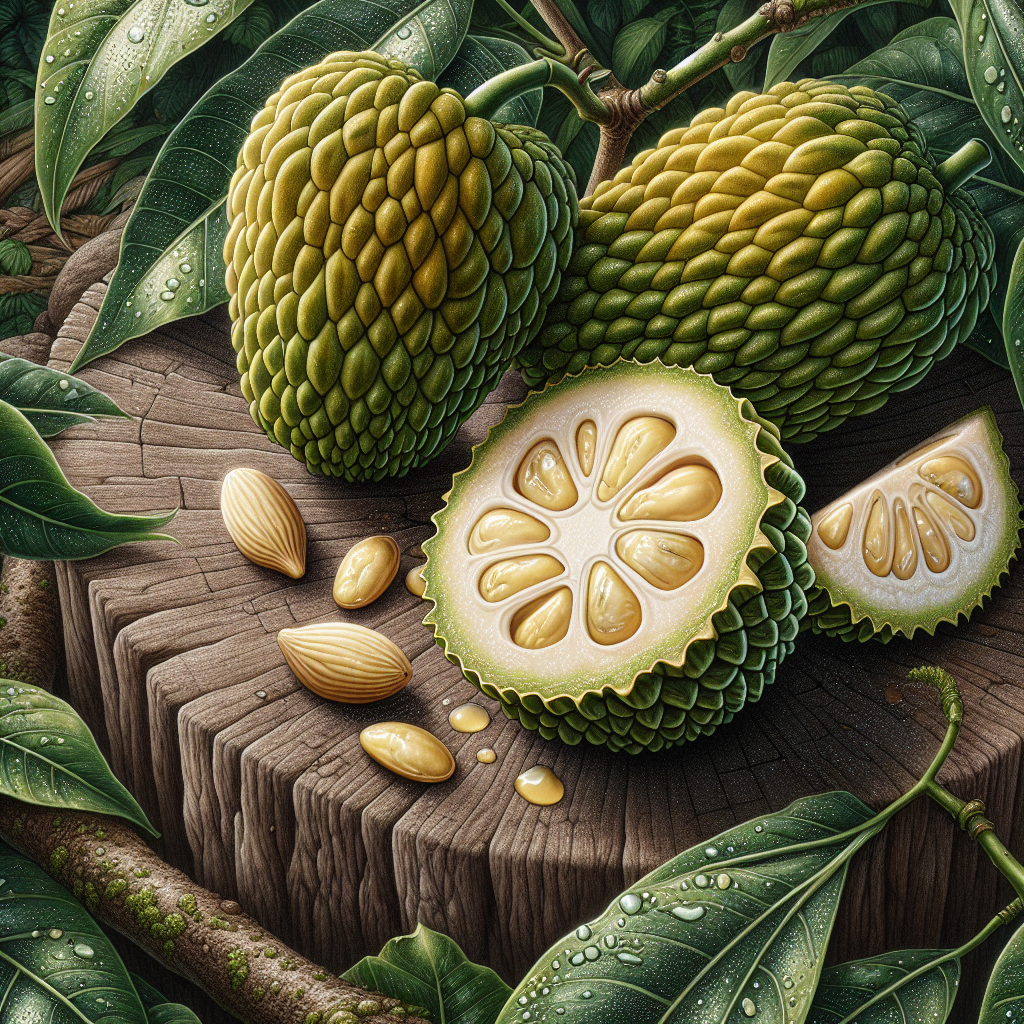
Introduction to Pedalai (Artocarpus sericicarpus)
Pedalai, scientifically known as Artocarpus sericicarpus, is an intriguing tropical fruit tree from the Moraceae family, closely related to jackfruit (Mango (crop)) and breadfruit. Native to the rainforests of Borneo, Sumatra, and Peninsular Malaysia, this underutilized species produces large, oval fruits weighing 2-5 kg, with thick, fibrous skin enclosing sweet-sour, custard-like flesh and large edible seeds. The fruit's unique flavor—combining pineapple, jackfruit, and banana notes—makes it a delicacy in local cuisines, often eaten fresh, roasted, or in desserts.
Though not widely commercialized, pedalai holds immense potential for small-scale farmers in humid tropics. Its trees can reach 30-40 meters in height, providing shade, timber, and year-round harvests after 5-7 years. Nutritionally, the fruit is rich in carbohydrates, vitamins A and C, potassium, and antioxidants, while seeds offer protein comparable to chestnuts. Challenges like limited seed availability and specific climate needs are offset by its resilience to poor soils and low maintenance once established. This guide equips growers with professional strategies for successful cultivation, drawing from ethnobotanical knowledge and modern agricultural practices. For more on tropical fruit companions, see Why Companion Planting Feels Like Guesswork for Small Farms - And How AI Makes It Foolproof.
Botanical Profile of Pedalai (Artocarpus sericicarpus)
Artocarpus sericicarpus is an evergreen dioecious tree (separate male and female plants) belonging to the Moraceae family. It features a straight bole up to 20 meters tall, buttressed at the base, with a spreading canopy of large, glossy leaves (20-40 cm long, deeply lobed like young jackfruit leaves). Young leaves are reddish-bronze, maturing to dark green, providing striking ornamental value.
Flowers are tiny and borne on club-shaped spikes: males produce pollen-rich inflorescences, while females develop into syncarps—the compound fruits. Fruits are ellipsoid to ovoid, 15-25 cm long, covered in hexagonal, blunt tubercles with silky hairs (hence 'sericicarpus' meaning silky-fruited). Ripe fruits turn yellowish-green to brown, emitting a sweet aroma. Seeds inside are large (3-5 cm), ellipsoidal, with thin brown testa and white hilum.
Growth is moderately fast in ideal conditions, reaching fruiting size in 5-8 years from seed. The tree's latex-rich sap deters herbivores, and its deep taproot system enhances drought tolerance once mature. Phenologically, flowering occurs year-round in equatorial zones but peaks during dry seasons, with fruits maturing 3-4 months later. Genetic diversity is high in wild populations, with cultivars selected for larger fruits and sweeter flesh in Malaysian orchards.
Soil, pH, and Climate Requirements for Pedalai (Artocarpus sericicarpus)
Pedalai thrives in the humid tropics, requiring USDA zones 10b-12 with minimal frost risk. Optimal temperatures range from 24-32°C (75-90°F), tolerating brief dips to 15°C but suffering above 38°C without shade. Annual rainfall of 2000-4000 mm is ideal, evenly distributed; it endures short dry spells (2-3 months) via deep roots but demands irrigation in establishment phase.
Soils should be deep, well-drained loams or clay-loams with high organic matter (>3%). It tolerates marginal sites including laterites, ultisols, and degraded lands common in Southeast Asia, thanks to mycorrhizal associations enhancing nutrient uptake. Avoid waterlogged or saline conditions. pH tolerance is broad: 5.0-7.5, with best growth at 5.5-6.5. Conduct soil tests; amend acidic soils with lime (1-2 tons/ha) and incorporate compost for fertility.
Full sun to partial shade suits young trees; mature ones form dense canopies. Windbreaks are essential in exposed areas to prevent fruit drop. For elevation, sea level to 800 m works, with reduced yields above 1000 m. In suboptimal climates, greenhouse culture or Breadfruit (crop) intercropping mimics native understory conditions.
Step-by-Step Planting & Propagation
Seed Propagation (Primary Method)
- Seed Collection: Harvest ripe fruits from healthy mother trees. Extract seeds, wash off pulp, and air-dry in shade for 1-2 days. Viability lasts 1-3 months; store in moist peat at 15°C.
- Preparation: Soak seeds in water 24-48 hours, changing daily. Treat with 1% bleach (10 min) then rinse to prevent fungal issues.
- Sowing: Plant in polybags (15x25 cm) with 1:1:1 topsoil-compost-sand mix. Sow 2-3 cm deep, 1 seed/bag. Germination: 70-90% in 10-20 days at 28-32°C.
- Seedling Care: Provide 50% shade, keep moist. Transplant to field at 30-50 cm tall (4-6 months), spacing 10-12 m apart (80-100 trees/ha).
Vegetative Propagation
Grafting (veneer or cleft) onto rootstock succeeds at 70-80%. Air-layering yields 60% take on branches >2 cm diameter. Cuttings root poorly. Use for superior clones.
Field Planting
Dig pits 60x60x60 cm, fill with topsoil + 10 kg manure + 200g superphosphate. Plant at onset of rains, stake, and mulch 10 cm thick. Initial irrigation: 20-30 L/tree/week until established.
Care & Maintenance regimes for Pedalai (Artocarpus sericicarpus)
Irrigation: Critical first 2 years; 30-50 L/week/tree, reducing as roots develop. Mature trees need supplemental water only during >2-month droughts.
Fertilization: Year 1: NPK 15-15-15 at 100g/tree monthly. Years 2-4: 500g/tree split 3x/year. Mature: 2-3 kg/tree/year + 20 kg manure. Foliar micronutrients (Zn, B) boost fruit set.
Pruning: Remove deadwood annually; train to single leader. Desuckering enhances light penetration. Male trees: thin to maintain 1:6 male:female ratio for pollination.
Weeding/Mulching: Mulch with rice hulls or leaves to suppress weeds and retain moisture. Intercrop with legumes like Pigeon pea (crop) years 1-3.
Pollination: Wind/pollinator-dependent; plant 10-20% males. Hand-pollination increases yields in isolated orchards.
Monitor growth: Expect 1-2 m/year height gain. Thin fruits to 20-30/tree for size.
Pests, Diseases & Organic Management
Pests: Fruits attract fruit flies (Fruit flies (pest)); bag at marble size with newspaper. Watch for Aphids (pest), Mealybugs (pest), and shoot borers. Neem oil (2-3 ml/L) or Bacillus thuringiensis sprays control. Termites (pest) at base: soil drench with beneficial nematodes.
Diseases: Phytophthora root rot (disease) in wet soils—improve drainage, use Trichoderma biofungicide. Anthracnose (disease) on fruits: copper oxychloride pre-monsoon. Leaf spots (Leaf spot diseases (disease)): remove debris, potassium phosphite.
Integrated management: Companion plant Marigold (crop) for nematodes; release predatory beetles. See Why 90% of Small Farms Fail at Pest Management - And 8 Organic Fixes That Actually Work for strategies.
Harvesting, Curing & Optimal Storage
Harvest at full yellow-brown color, slight softness, sweet aroma—typically 3-4 months post-anthesis. Use pole pruners or ladders; cut with 5 cm stalk to avoid latex sap. Yields: 50-100 fruits/tree at maturity (20-50 kg/tree).
Post-Harvest: Ripen in shaded crates 3-7 days. Seeds: boil 20 min, peel, roast. Fruits store 1-2 weeks at 13-15°C, 85-90% RH; process into chips, pastes for longer shelf-life.
Market fresh or value-add: jams, juices. Seeds grind into flour rivaling jackfruit seeds.
Companion Planting for Pedalai (Artocarpus sericicarpus)
Pedalai's canopy suits agroforestry. Underplant shade-tolerant Ginger (crop), Turmeric (crop), or Pineapple (crop) for ground cover. Nitrogen-fixers like Gliricidia (crop) or Clover (crop) improve soil. Avoid competitive tall trees; pair with Coconut (crop) for wind protection. Benefits: pest deterrence, soil enrichment, diversified income.