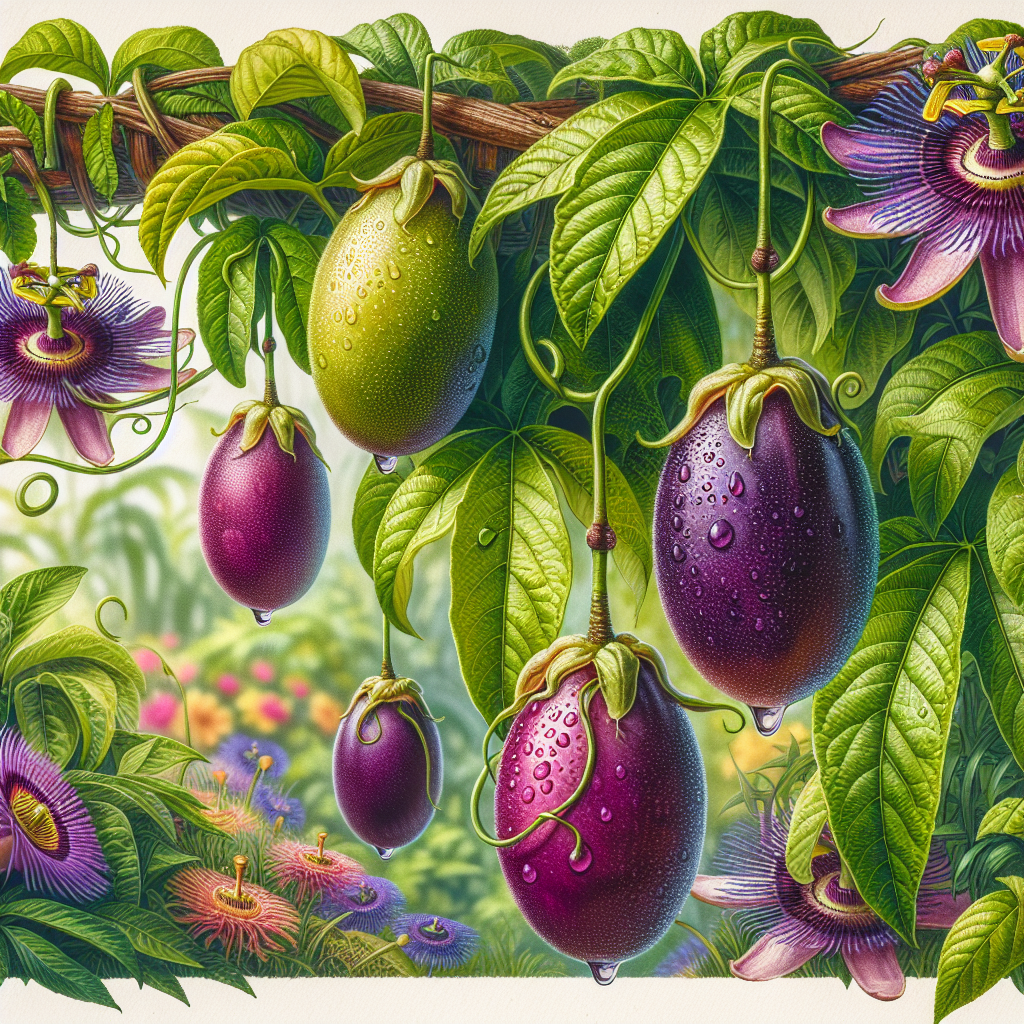
Introduction to Passion Fruit (Possum Purple)
Passion Fruit (Possum Purple), known scientifically as Passiflora edulis f. edulis 'Possum Purple', stands out among passion fruit varieties for its robust growth, prolific fruiting, and superior taste profile. Originating from selective breeding in Australia, this cultivar produces large, oval fruits with thick, deep purple skin and vibrant orange-yellow pulp packed with crunchy black seeds. The flavor combines sweet-tart notes, making it a favorite for home gardeners and commercial growers alike.
This vine is particularly appealing due to its self-fertility, eliminating the need for hand-pollination common in other varieties. Mature plants can yield 50-100 fruits per vine annually under ideal conditions, with each fruit weighing 80-120 grams. Possum Purple excels in warm, humid environments but can be adapted to cooler subtropical zones with proper care. Its vigorous growth reaches 6-10 meters, requiring sturdy support structures. Dragon Fruit (crop) growers often appreciate its similar trellis needs and tropical vibe.
Beyond its culinary uses—fresh in salads, blended into smoothies, or reduced into sauces—Possum Purple offers nutritional benefits like high vitamin C, antioxidants, and fiber. Successful cultivation demands attention to climate, soil drainage, and pest vigilance, but rewards include year-round harvests in frost-free areas. This comprehensive guide equips growers with professional strategies for thriving Possum Purple vines.
Botanical Profile of Passion Fruit (Possum Purple)
Possum Purple belongs to the Passifloraceae family, a perennial evergreen vine with semi-woody stems and tendrils for climbing. Leaves are glossy, dark green, lobed (3-5 lobes), measuring 10-15 cm long. The plant's signature feature is its exotic flowers: 5-8 cm diameter, with white petals, a corona of purple filaments, and a central purple ovary. Flowers bloom year-round in warm climates, peaking in spring and summer.
Fruits develop 4-6 weeks post-pollination, turning from green to deep purple at maturity. The rind is tough yet edible, protecting aromatic pulp with 100-200 seeds embedded in jelly-like arils. Roots are shallow and fibrous, spreading 2-3 meters, making mulching essential. As a hermaphroditic variety, it self-pollinates efficiently via bees or wind, though manual aid boosts yields in enclosed spaces.
Growth is rapid, with first fruits appearing 12-18 months from planting. Vines live 5-7 years productively, after which rejuvenation pruning is needed. Cold tolerance extends to 0°C briefly, but prolonged frost kills above-ground growth. In marginal areas, rootstock like Passiflora caerulea enhances hardiness.
Soil, pH, and Climate Requirements for Passion Fruit (Possum Purple)
Possum Purple demands well-draining, fertile soil to prevent root rot, its primary killer. Sandy loam or volcanic soils are ideal, amended with 30-40% organic matter like compost or aged manure. Avoid heavy clay; raised beds or mounds (30-50 cm high) ensure drainage in wet areas. Soil depth should exceed 60 cm for root expansion.
Optimal pH ranges 6.0-7.5; test and adjust with dolomite lime for acidity or sulfur for alkalinity. Micronutrients like magnesium and iron prevent deficiencies—yellowing leaves signal issues. Mulch with 10 cm organic layers to retain moisture and suppress weeds.
Climatically, it thrives in USDA zones 9-11, requiring 25-35°C daytime temps and minimum 15°C nights. Annual rainfall of 1000-2000 mm suits it, supplemented by drip irrigation during dry spells (weekly 25-50 liters per vine). Full sun (6-8 hours) is mandatory; partial shade reduces yields by 30-50%. High humidity (60-80%) aids flowering, but windbreaks protect blooms. In cooler regions, south-facing walls or greenhouses extend seasons. Read more on heat management in Why Summer Heatwaves Are Silently Killing Small Farm Yields - And 7 Organic Strategies to Fight Back.
Step-by-Step Planting & Propagation
Propagation
Seed propagation is straightforward but variable; soak fresh seeds 24 hours, sow in 72°F sterile mix, germinate in 2-4 weeks. Select superior seedlings for uniformity. Cuttings (10-15 cm semi-hardwood) root in perlite under mist, 80% success in 3-6 weeks. Grafting onto hardy rootstock improves disease resistance.
Planting
Plant in early spring after frost risk. Space vines 3-4 m apart along trellises (2 m high, wires at 50 cm, 1 m, 1.5 m). Dig 50x50x50 cm holes, fill with 50% compost-soil mix. Position graft union above soil. Water deeply post-planting; stake young vines.
Transplants from pots: acclimate 1 week outdoors. For containers (20-50 L), use trellis pots with drainage. Initial fertilizer: 10-10-10 at 50 g per plant.
Care & Maintenance regimes for Passion Fruit (Possum Purple)
Water consistently: 20-40 L weekly, more in fruiting. Drip systems prevent wet foliage. Fertilize monthly in growth (NPK 10-5-20 + micronutrients), reduce in winter. Prune annually post-harvest: remove 30-50% old wood to stimulate new shoots.
Train to single trunk, then lateral branches. Thin crowded areas for airflow. Mulch refreshes yearly. Monitor for nutrient lockout; foliar sprays correct deficiencies.
Pollination boost: attract bees with nearby flowers. In greenhouses, vibrate flowers daily.
Pests, Diseases & Organic Management
Common pests include aphids, mealybugs, and spider mites. Blast with water, apply neem oil (2 ml/L weekly), or release ladybugs. Scale insects require alcohol rubs or horticultural oil.
Diseases: root rot from Phytophthora—ensure drainage, use biofungicides like Trichoderma. Powdery mildew treated with potassium bicarbonate sprays. Anthracnose via copper fungicides, prune infected parts.
Organic IPM: Companion plants like marigolds deter nematodes. Check Why 90% of Small Farms Fail at Pest Management - And 8 Organic Fixes That Actually Work for advanced tips. Rotate crops, sanitize tools.
Harvesting, Curing & Optimal Storage
Harvest when fruits drop or purple fully (60-80 days from flower). Cut with pruners, avoiding rind tears. Yields peak years 2-4. For market, cure 3-5 days at 25°C to enhance flavor.
Store ripe fruit at 8-10°C, 90% humidity up to 4 weeks; freeze pulp 12 months. Process into juice: blend, strain, pasteurize. Dry seeds for replanting.
Companion Planting for Passion Fruit (Possum Purple)
Pair with Thai Basil for pest repulsion, nitrogen-fixers like peas for soil enrichment. Avoid potato due to shared pests. Nasturtium traps aphids. Marigold suppresses nematodes. Discover more in Why Companion Planting Feels Like Guesswork for Small Farms - And How AI Makes It Foolproof. Groundcovers like sweet potato prevent erosion.