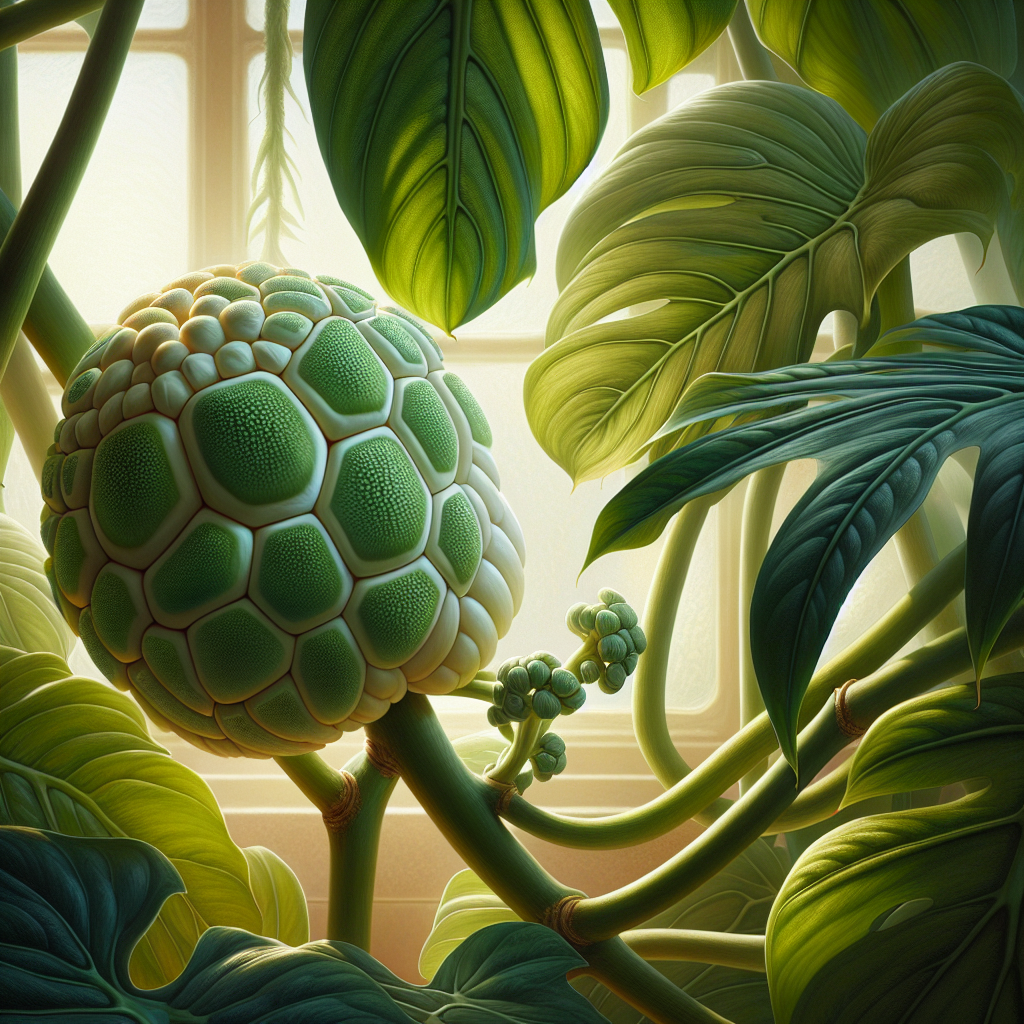
Introduction to Monstera Deliciosa (Fruit)
Monstera deliciosa, commonly called Swiss cheese plant or split-leaf philodendron, is a tropical aroid celebrated for its perforated leaves but equally valued for its edible fruit. Native to Central American rainforests, the fruit—known as ceriman, monstera, or windowleaf fruit—ripens into a creamy, custard-like delicacy blending pineapple, banana, and guava flavors with a subtle sweetness. Unlike the ubiquitous houseplant propagation, growing Monstera deliciosa for fruit demands specific tropical conditions, patience (3-5 years to first harvest), and meticulous care, making it a rewarding challenge for dedicated growers.
This fruit crop thrives in humid, warm environments mimicking its jungle origins, producing 10-20 pound infructescences covered in green hexagonal scales that turn yellow when ripe. The edible core is rich in vitamin C, potassium, and digestive enzymes like actinidin, but unripe fruit contains stinging oxalic acid crystals—always wait for full ripeness. Commercial production is limited to regions like Hawaii and Southeast Asia due to its slow maturation, but small-scale cultivation is booming among gourmet farmers seeking exotic, high-value yields. Why Companion Planting Feels Like Guesswork for Small Farms - And How AI Makes It Foolproof offers insights into optimizing polycultures with this crop.
Yields per mature plant can reach 20-50 fruits annually, fetching premium prices ($10-30 per fruit) in specialty markets. Success hinges on replicating dappled sunlight, high humidity, and well-draining soils while managing pests common to aroids. This guide provides professional-grade protocols for propagation, maintenance, and harvesting to maximize your Monstera fruit production.
Botanical Profile of Monstera Deliciosa (Fruit)
Monstera deliciosa belongs to the Araceae family, a hemiepiphyte that starts life on the forest floor and climbs trees via aerial roots. Stems grow 20-60 feet long, supporting massive, fenestrated leaves up to 3 feet wide with iconic holes aiding light penetration in crowded canopies. The fruiting spadix forms within a thick, leathery spathe, developing into a collective berry structure 8-12 inches long and 2-4 inches thick.
Flowering occurs year-round in optimal conditions, with female flowers maturing first to produce fruit, followed by male flowers for pollen. Pollination is typically by beetles in nature, but cultivated plants rarely set fruit without hand-pollination or mature age. Fruits mature in 10-12 months, weighing 1-5 pounds each, with 100-200 edible segments covered by a protective rind that must be peeled away.
Nutritionally, the pulp offers 15-20% sugars at peak ripeness, low acidity (pH 5.5-6.5), and high fiber. Varieties like 'True Fruiting' strains outperform ornamental clones, which often fail to produce viable fruit. Related to Banana (crop), it shares tropical affinities but requires less wind protection. Growth is perennial, with plants living 20+ years and increasing productivity with size.
Soil, pH, and Climate Requirements for Monstera Deliciosa (Fruit)
Monstera deliciosa demands loose, aerated soil rich in organic matter to support its extensive root system. Ideal mix: 40% orchid bark or coconut coir, 30% peat moss or coco peat, 20% perlite/pumice, 10% compost or worm castings for mycorrhizal benefits. pH range 5.8-6.8 ensures nutrient uptake; test regularly and amend with dolomite lime if below 5.5.
Avoid heavy clays prone to waterlogging, which invite root rot. Mulch with orchid bark or leaf litter to 4 inches deep, maintaining 70-90% moisture without saturation. In containers, use 20-50 gallon pots with trellises for climbing; elevate for drainage.
Climatically, USDA zones 10b-12 or equivalent: temperatures 65-95°F daytime, never below 50°F. Humidity 70-90%; mist daily or use pebble trays in greenhouses. Full success requires 2000+ chill-hour free environments with 60-80 inches annual rainfall or equivalent irrigation. Partial shade (2000-4000 foot-candles) prevents leaf scorch—think rainforest understory. Protect from winds exceeding 15 mph, which shred leaves and reduce fruit set. In marginal climates, grow under 50% shade cloth with heat mats.
Step-by-Step Planting & Propagation
Propagation Methods
- Stem Cuttings: Select 12-18 inch nodes with aerial roots. Dip in rooting hormone (IBA 1000ppm), plant in sterile mix. Root in 75-85°F under high humidity (plastic dome) for 4-8 weeks. Success rate 80-90%.
- Air Layering: Ideal for fruiting. Girdle stem, apply rooting hormone, wrap moist sphagnum. Roots form in 2-3 months; sever and pot.
- Seed (Rare): Soak fresh seeds 24 hours, germinate at 80°F on heat mats. Slow (3-6 months), variable genetics.
Planting Protocol
- Acclimate rooted cuttings 1 week in 50% shade.
- Plant in prepared mounds (12-18 inches high) spaced 8-12 feet apart for vining support.
- Install sturdy trellis or pole (10-20 feet tall); train stems clockwise.
- Water deeply post-planting; apply 2-4 inches compost top-dress.
- Fertilize lightly first month (half-strength balanced 20-20-20).
Transplant every 2-3 years into larger pots/supports. Expect fruiting after 3 years minimum.
Care & Maintenance regimes for Monstera Deliciosa (Fruit)
Watering: Keep evenly moist; allow top 2 inches to dry between waterings. Drip irrigation ideal (1-2 gallons/plant/week). Overwatering causes Phytophthora.
Fertilization: Monthly during growth (spring-fall): 1 tsp/gallon fish emulsion + micronutrients (Ca, Mg, Fe). Reduce winter. Foliar feed calcium nitrate biweekly.
Pruning: Remove dead leaves/stems; tip-prune to encourage branching. Thin crowded canes for airflow.
Support: Essential—use moss poles or living trees. Aerial roots stabilize; mist for uptake.
Pollination: Hand-pollinate at anthesis using soft brush from male to female flowers. Boosts fruit set 50-70%.
Monitor EC 1.2-1.8 mS/cm; adjust for tropical vigor. Soil Health Mastery: 5 Proven Strategies for Small Farms to Build Fertile Ground Without Breaking the Bank complements these practices.
Pests, Diseases & Organic Management
Pests:
- Mealybugs: Alcohol swabs, neem oil (1% solution weekly).
- Scale insects: Horticultural oil, introduce ladybugs.
- Spider mites: Sulfur spray, predatory mites.
- Aphids: Insecticidal soap, beneficial insects.
Diseases:
- Root rot (Pythium/Phytophthora): Improve drainage, biofungicides (Trichoderma).
- Leaf spot diseases: Copper fungicide, airflow.
- Powdery mildew: Potassium bicarbonate sprays.
Organic IPM: Scout weekly, release predatory insects (lacewings, predatory mites). Neem/azadirachtin rotations. Avoid overhead watering. Quarantine new plants.
Harvesting, Curing & Optimal Storage
Harvest when 75% scales lift easily and yellow, exuding milky sap (10-12 months post-pollination). Cut infructescence with shears, leaving stem stub. Handle gently—ripe fruit bruises easily.
Curing: Place in paper bag at 75-80°F, 85% humidity 3-7 days to fully ripen. Peel scales sequentially; discard unripe tips.
Storage: Refrigerate ripe fruit 40-45°F up to 7 days (texture softens). Freeze pulp for smoothies (6 months). Yields peak June-October.
Market fresh or process into juices/pies. Post-harvest dips in calcium chloride extend shelf life.
Companion Planting for Monstera Deliciosa (Fruit)
Pair with humidity-loving companions:
- Thai Basil: Repels pests, shades base.
- Ginger: Shared soil prefs, suppresses nematodes.
- Pineapple: Groundcover, acidifies soil.
- Taro: Moisture retention, pest diversion.
Avoid legumes (nitrogen competes). Plant nasturtiums as trap crop for aphids. Polycultures boost microclimate humidity 10-15%, enhancing fruit set.