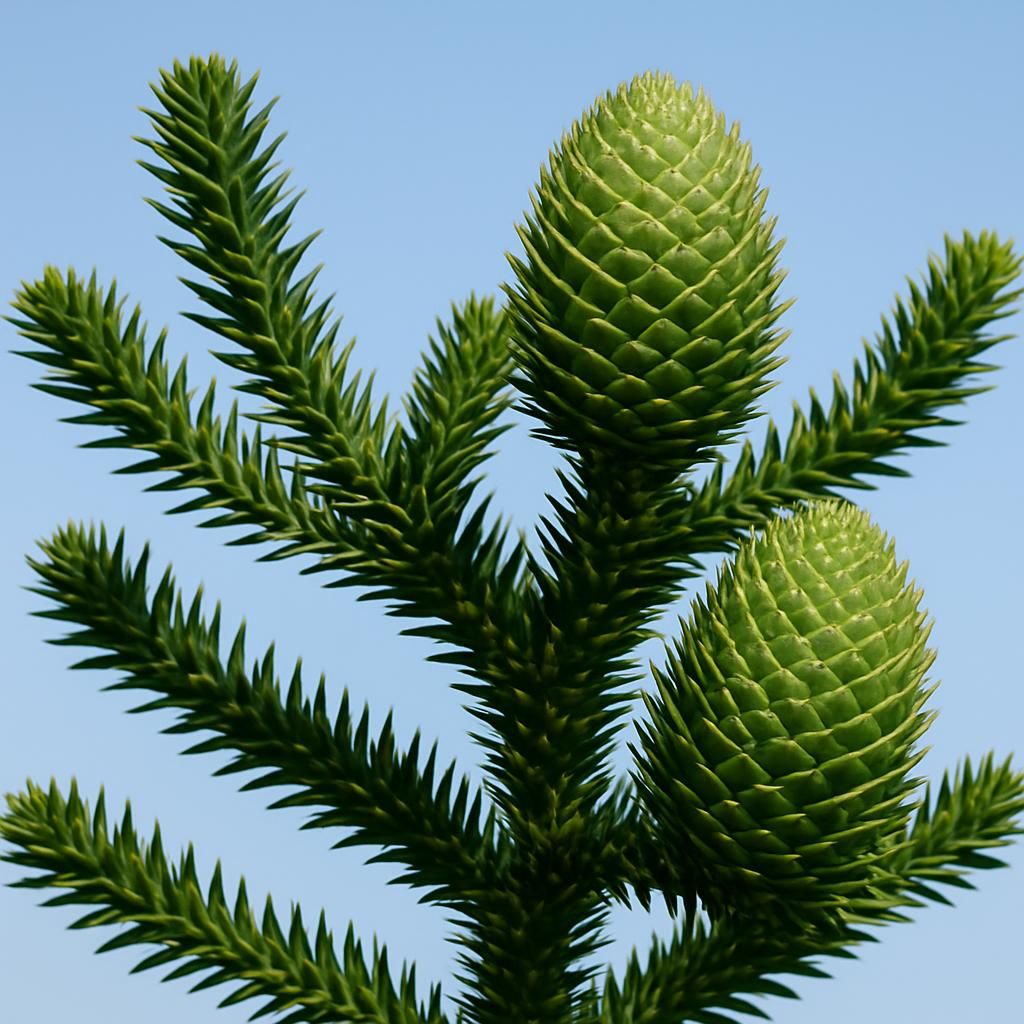
Introduction to Monkey Puzzle Nut (Araucaria araucana)
The Monkey Puzzle Nut (Araucaria araucana) is one of the oldest living tree species still cultivated for food. Indigenous Mapuche communities in Chile and Argentina have harvested its large, chestnut-flavored seeds for thousands of years. The tree’s distinctive whorled branches and sharp, overlapping leaves give it a prehistoric appearance that has made it a protected species in its native range.
Commercial interest in Monkey Puzzle Nut is growing among specialty nut growers and permaculture designers seeking climate-resilient, long-lived crops. While yields are modest compared with Walnut or Hazelnut, the nuts command premium prices in gourmet and health-food markets.
Botanical Profile of Monkey Puzzle Nut (Araucaria araucana)
Araucaria araucana is a dioecious conifer belonging to the family Araucariaceae. Mature specimens reach 30–50 m in height with a straight trunk up to 2 m in diameter. Female trees produce large, globose cones 15–20 cm across containing 120–200 seeds. Male trees bear smaller pollen cones. The tree is extremely long-lived, with documented individuals exceeding 1,000 years.
Soil, pH, and Climate Requirements for Monkey Puzzle Nut (Araucaria araucana)
Monkey Puzzle Nut performs best in deep, well-drained volcanic or sandy loam soils. It tolerates poor fertility but demands consistent moisture during establishment.
| Parameter | Ideal Range | Notes |
|---|---|---|
| Soil Type | Volcanic loam, sandy loam | Avoid heavy clay and waterlogged sites |
| Soil pH | 5.5–7.0 | Slightly acidic to neutral |
| Annual Rainfall | 800–1,500 mm | Supplemental irrigation needed in dry summers |
| USDA Hardiness Zones | 7–10 | Tolerates light frost once established |
| Temperature Range | −15 °C to 30 °C | Young trees sensitive to late spring frost |
| Sun Exposure | Full sun | At least 6 hours direct sunlight daily |
| Elevation | 0–1,200 m | Performs well in coastal and montane sites |
Step-by-Step Planting & Propagation
- Site Selection: Choose a sheltered location with protection from strong winds. Allow 8–10 m spacing between trees.
- Soil Preparation: Incorporate 5–10 cm of well-rotted compost into the top 30 cm of soil. Perform a percolation test to confirm drainage.
- Propagation: Collect fresh seeds from mature female cones in autumn. Soak seeds for 24 hours, then stratify at 4 °C for 60–90 days. Sow in deep pots with free-draining mix; germination occurs in 4–8 weeks at 15–20 °C.
- Planting: Transplant seedlings when they reach 30–40 cm. Plant at the same depth as the root ball and water thoroughly.
- Initial Protection: Install tree guards against rodent damage and mulch with 8–10 cm of wood chips, keeping mulch 10 cm from the trunk.
Care & Maintenance regimes for Monkey Puzzle Nut (Araucaria araucana)
Young trees require consistent care for the first five years. Once established, maintenance is minimal.
| Task | Frequency | Details |
|---|---|---|
| Watering | Weekly during first 3 summers | 20–30 L per tree; reduce after year 4 |
| Fertilizer | Early spring and mid-summer | Apply 5–5–5 organic fertilizer at 200 g per tree in years 1–5 |
| Pruning | Late winter (dormant season) | Remove only dead or damaged branches; never top the leader |
| Mulching | Renew annually | Maintain 8–10 cm layer within 1 m radius |
| Weed Control | As needed | Hand-pull or shallow cultivate; avoid herbicides near trunk |
Pests, Diseases & Organic Management
Monkey Puzzle Nut has few serious pests in its native range. In cultivation, monitor for Aphids, Scale insects, and Spider mites. Fungal issues such as Root rot and Phytophthora can occur in poorly drained soils. Apply neem oil or insecticidal soap for sucking insects. Improve drainage and avoid overwatering to prevent root diseases. Beneficial nematodes can suppress soil-dwelling larvae.
Harvesting, Curing & Optimal Storage
Female trees begin producing cones at 15–25 years of age. Cones mature in late summer to early autumn and disintegrate on the tree. Collect fallen seeds promptly. Air-dry seeds for 7–10 days at 15–20 °C until moisture content reaches 8–10 %. Store in breathable sacks or refrigerated at 4 °C for up to 12 months. For longer storage, freeze at −18 °C in vacuum-sealed bags.
Companion Planting for Monkey Puzzle Nut (Araucaria araucana)
Understory planting with nitrogen-fixing species such as Clover or Lupin improves soil fertility. Deep-rooted Comfrey provides dynamic nutrient accumulation and mulch material. Avoid shallow-rooted crops that compete with the extensive lateral root system of young Araucaria. In mixed orchards, pair with Hazelnut or Chestnut at wide spacing to create a multi-layered canopy.
For additional guidance on soil health strategies, see The Forgotten Art of Fall Soil Revival: 8 Organic Strategies for Small Farm Resilience.