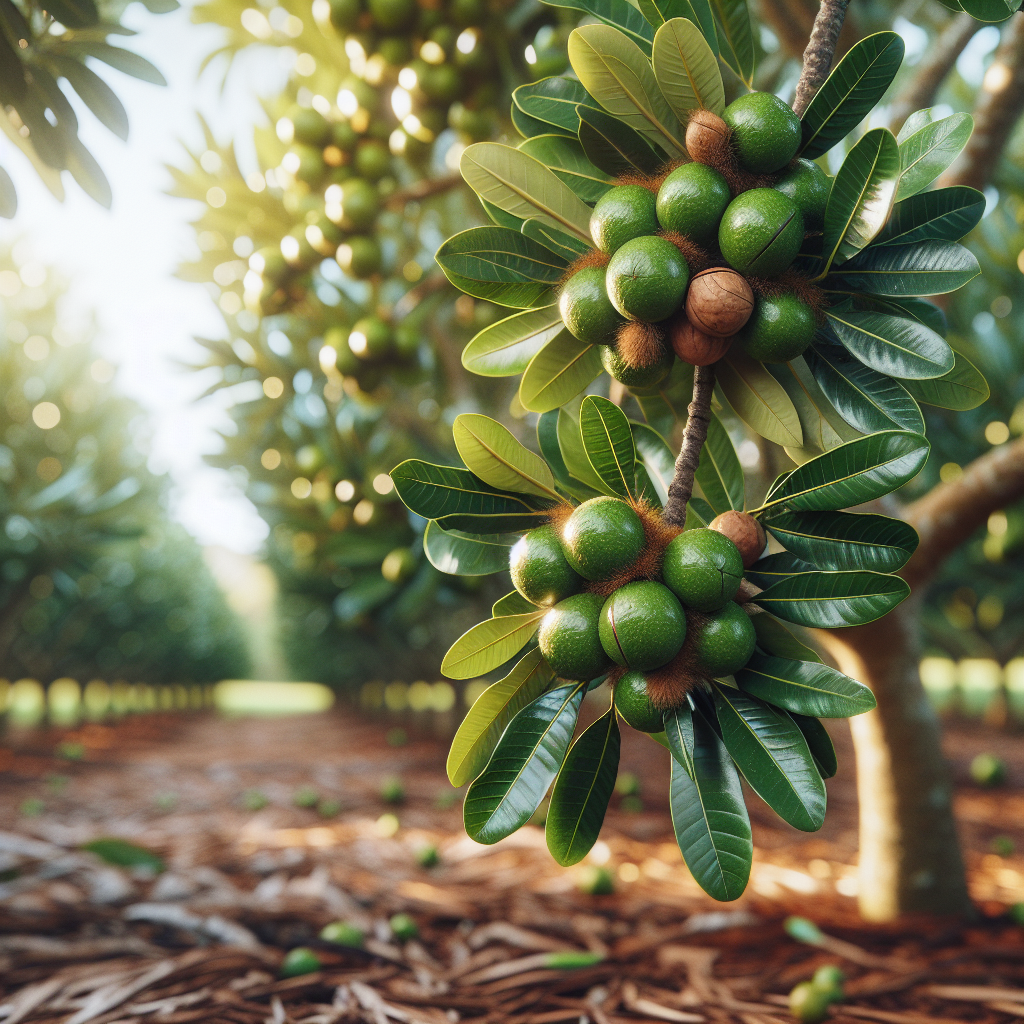
Introduction to Macadamia (Nelmac)
A premium tree nut grown for its rich, buttery kernels, this cultivar belongs to the small but economically important genus Macadamia, native to eastern Australia and later commercialized in Hawaii, South Africa, Australia, Kenya, and parts of Latin America. Nelmac is generally treated as a selected orchard cultivar or regional selection within commercial macadamia production systems, and like many named macadamias, it is usually propagated vegetatively rather than from seed so that nut size, shell characteristics, cropping habit, and tree architecture remain true to type.
In practical terms, growers choose a cultivar like Nelmac for orchard performance rather than novelty. Important selection criteria include precocity, annual yield consistency, canopy structure, compatibility with pollinizers, nut drop timing, kernel recovery, and tolerance to local climate stresses such as hot dry winds, intermittent cold, or high humidity. Macadamias are long-lived evergreen trees, but they are not forgiving of poor siting. A well-planted tree can remain productive for decades; a poorly drained or frost-exposed tree may struggle from the start and never reach its genetic potential.
Nelmac should be approached as a high-value perennial orchard crop that rewards precision. Compared with annual crops, establishment is slower and capital costs are higher, but once the root system and canopy are properly formed, management becomes more about balance: vegetative growth versus flowering, soil moisture versus root aeration, and nitrogen supply versus excessive soft flush that invites pests and reduces nut set. For broader background on the crop group, see the Macadamia guide. A useful general reference on orchard soil-building is this soil health article.
Botanical Profile of Macadamia (Nelmac)
This tree is an evergreen member of the Proteaceae, a family notable for species that evolved in nutrient-poor soils and often form specialized root structures called proteoid or cluster roots. These roots are highly efficient at scavenging phosphorus and certain micronutrients, which explains one of the most important management rules in macadamia culture: avoid heavy phosphorus applications unless a documented deficiency exists. Overapplication can damage root function and create nutrient imbalance.
Commercial macadamias are commonly derived from two species, Macadamia integrifolia and Macadamia tetraphylla, with many orchard cultivars showing hybrid influence. Integrifolia types tend to have smoother shells and high kernel quality, while tetraphylla influence may contribute rougher shell texture and sometimes greater adaptation to cooler subtropical conditions. Nelmac is best understood as a commercial orchard type that may express characteristics of this hybrid background, including vigorous evergreen growth, dense leaf canopies, and high responsiveness to management.
Leaves are typically leathery, glossy, and arranged in whorls or clusters, especially on young growth. Flowers are borne in pendent racemes, often cream to pinkish depending on genetic background and environmental conditions. Each raceme may carry hundreds of flowers, but only a small proportion set nuts. Pollination is largely insect-mediated, with bees playing an important role. Even where a cultivar is considered self-fertile to some degree, cross-pollination frequently improves set, kernel fill, and yield stability.
The fruit is a follicle-like husk surrounding the hard shell and edible kernel. Mature nuts usually fall naturally when the husk begins to split or when the fruit reaches physiological maturity. Kernel quality depends on full development, careful drying, and prevention of mold or rancidity during postharvest handling. Trees can eventually reach 8-15 meters if unmanaged, though commercial orchards usually maintain lower, more accessible canopies through pruning and spacing design.
Soil, pH, and Climate Requirements for Macadamia (Nelmac)
Deep drainage is the single most important soil trait. Macadamia roots require oxygen, and Nelmac is especially vulnerable to decline where water lingers in the root zone after rain or irrigation. The ideal soil is a friable, well-structured loam or sandy loam at least 1 meter deep, with no hardpan, no perched water table, and moderate organic matter. Red volcanic soils are excellent where available, but any deep, aerated soil can work if drainage is genuinely good.
Preferred pH is slightly acidic, roughly 5.0 to 6.5, with an ideal working range around 5.5 to 6.0. Above pH 6.8, micronutrient availability declines and trees may show iron, manganese, or zinc deficiency, especially in calcareous soils. Below pH 4.8, root stress and aluminum toxicity become more likely. If liming is needed, apply small corrective amounts based on soil testing rather than large single doses. Dolomitic lime is useful only where magnesium is also low.
Soil organic matter should be stable but not waterlogging. A target of 3-5% organic matter is beneficial in many orchard soils. Organic mulches improve microbial activity, reduce soil temperature fluctuations, and help maintain even moisture. However, mulch must never be piled directly against the trunk, because constant bark moisture encourages collar rot and can harbor Rodents or insects.
Climatically, Nelmac performs best in warm subtropical to tropical highland conditions. Optimal mean temperatures for growth are generally 20-30°C. Flowering and fruit set can be reduced by extreme heat during bloom, especially when hot dry winds desiccate flowers. Young trees are sensitive to frost, and damage can occur near 0°C, with more severe injury below -2°C. Mature trees are somewhat tougher but still not suited to climates with repeated freezing events.
Annual rainfall of 1,000-2,000 mm is adequate if well distributed, though irrigated orchards can succeed in drier regions. The key is consistency. Extended drought causes poor nut set, premature nut drop, and reduced kernel fill, while chronically wet conditions favor root disease. Wind protection is also essential. Macadamia wood can be brittle, and strong winds may snap branches, strip flowers, or reduce bee activity during pollination. Windbreaks should filter rather than completely block airflow to avoid turbulence.
Slope is often beneficial because it improves air drainage and reduces frost risk, but very steep sites complicate mechanized harvest. Low-lying frost pockets and heavy clay depressions are poor choices even if soil fertility appears high.
Step-by-Step Planting & Propagation
Use grafted nursery trees from a reputable source. Seedling macadamias are highly variable and unsuitable if uniform orchard performance is the goal. A quality Nelmac planting tree should have a healthy graft union, a straight central leader or well-formed framework, no girdling roots, no stem cankers, and leaves free from chlorosis or mite damage.
Test the site before planting. Conduct soil analysis for pH, texture, cation balance, organic matter, and key nutrients. Also assess drainage by digging a hole 60-80 cm deep, filling it with water, and checking whether water clears within 24 hours. If it does not, improve drainage or choose another site.
Prepare the planting area. Control perennial weeds well before planting. Deep ripping may be helpful where a compacted layer exists, but do not smear wet subsoil. In high-rainfall regions, raised beds or mounded rows are often the safest approach because they elevate the crown and reduce root disease pressure.
Plan spacing. Typical commercial spacing ranges from 7 × 4 m to 10 × 5 m depending on vigor, soil fertility, pruning system, and equipment. Nelmac should not be crowded. Excessively tight spacing increases shade, raises humidity in the canopy, and reduces long-term productivity. Home orchard trees should usually be given at least 7-8 m of lateral room.
Plant at the correct depth. Dig a hole only as deep as the root ball and wider than the container. Set the tree so the top of the nursery root ball sits level with or slightly above the surrounding soil. Planting too deep is a common mistake and leads to poor oxygenation around the crown.
Backfill carefully. Use native soil rather than a heavily amended pocket, which can create a bathtub effect. Lightly firm the soil to remove major air gaps, then water thoroughly to settle the root zone.
Stake if necessary. Young macadamias can rock in wind, breaking fine feeder roots. Use a flexible tie and remove the stake once the trunk stabilizes.
Mulch immediately. Apply 5-10 cm of coarse organic mulch in a wide circle, keeping it 15-20 cm away from the trunk. Renew as it decomposes.
Propagation in commercial systems is by grafting selected scions onto seedling rootstocks. Veneer grafting and whip-type grafts are common in nurseries. Air layering and cuttings are far less standard because success rates and root quality are often inferior to grafted plants. Seed is used mainly to produce rootstocks, not true-to-type orchard trees.
The best planting time is early spring in frost-prone subtropical areas or at the start of the rainy season in tropical climates, provided drainage is good. Avoid planting just before severe heat or when soils are waterlogged.
Care & Maintenance regimes for Macadamia (Nelmac)
Irrigation must be consistent but never excessive. During establishment, keep the root ball and the immediately surrounding soil evenly moist to a depth of about 20-30 cm. A practical target is moist, crumbly soil that holds together lightly when squeezed but does not ooze water. If the soil smells sour, stays slick for days, or leaves yellow while remaining soft and droopy, overwatering is likely. Underwatering usually shows as dull foliage, marginal leaf scorch, weak flushes, and aborted young nuts during dry weather.
For young trees, frequent light-to-moderate irrigation is often better than infrequent saturation, especially in coarse soils. For mature trees, deeper irrigation to wet 45-60 cm of soil is preferred, followed by partial drying of the upper profile before the next cycle. Peak water demand rises during flowering, nut set, and kernel filling. Drip or micro-sprinklers are ideal because they maintain uniform soil moisture without encouraging excessive trunk wetness.
Nutrition should be based on leaf and soil analysis, not guesswork. Macadamias are sensitive to fertilizer excess, particularly salts and phosphorus. Nitrogen is important for canopy development and yield, but too much produces rank vegetative growth, delayed bearing, and softer tissue that attracts pests. Split annual nitrogen into several small applications timed around growth flushes rather than one large dose. Young nonbearing trees benefit from modest, regular feeding; bearing trees require a balanced approach with potassium support for nut filling and shell development.
Calcium, magnesium, zinc, boron, and manganese are frequently important in orchard performance. Boron is especially critical around flowering and fruit set, but the margin between deficiency and toxicity is narrow, so apply only according to analysis. Zinc deficiency may appear as small, narrow leaves and short internodes. Iron chlorosis in high-pH soils shows as yellow young leaves with greener veins.
Pruning should focus on structure, light distribution, and harvest efficiency. In the first 2-4 years, remove low branches that obstruct irrigation or future harvest, narrow crotches prone to splitting, and any vigorous shoots emerging below the graft. Aim for a strong framework with scaffold branches spaced around the trunk. Later, shift to selective thinning of crowded interior wood, removal of dead or crossing branches, and height control. Avoid severe topping unless orchard renovation is necessary; heavy cuts can stimulate unproductive water sprouts and sunburn exposed limbs.
Weed management is critical, especially in the first three years. Grass competition around young trunks can dramatically reduce growth because feeder roots occupy the same upper soil layer. Maintain a clean or heavily mulched weed-free circle at least 1 meter wide around new trees and wider as trees age. In organic systems, repeated mulching, shallow cultivation away from roots, and living alley covers are effective.
Bearing usually begins around 4-6 years after planting for grafted trees, with more meaningful commercial yields developing later. Alternate bearing may occur if crop load, nutrition, or moisture are poorly balanced. Maintaining steady tree health after harvest is essential because flower initiation for the next season depends on postharvest carbohydrate status and canopy condition.
Pests, Diseases & Organic Management
The most serious production problems usually arise from root disease, nut-feeding pests, and poor orchard hygiene rather than a single universal enemy. Phytophthora root rot is one of the most damaging diseases in wet soils. Symptoms include reduced vigor, leaf yellowing, canopy thinning, small leaves, dieback, and poor response to fertilizer. Fine roots may appear dark and decayed. Prevention is far more effective than rescue: plant only in well-drained ground, avoid over-irrigation, protect the trunk from mulch contact, and sanitize equipment moving between blocks.
Husk spot and other fungal disorders can affect nut quality in humid conditions, especially where canopies are dense and airflow is poor. Timely pruning, sanitation, and prompt collection of fallen nuts reduce inoculum. Nuts left on wet ground too long are more likely to develop mold and lose quality.
Common insect issues vary by region but may include Stink bugs, Lace bugs, Macadamia nut borer, Borers in stressed wood, and Mites during hot dry periods. Stink bugs and related piercing insects can cause pitted kernels, premature nut drop, or malformed nuts. Mite injury may show as bronzing, stippling, and reduced photosynthetic area on leaves.
Organic management should begin with monitoring, not spraying. Inspect racemes during bloom, young flushes after vegetative growth, and dropped nuts during the season. Use light traps or pheromone systems where available for key local pests. Encourage beneficial insects by maintaining flowering insectary plants at orchard margins rather than inside the immediate trunk zone. Good candidates include Clover, Thyme, and Yarrow, which provide nectar for parasitoids and pollinators while also functioning as low-growing ground covers or border plantings.
Dormant or low-activity-season sanitation is valuable: remove dead wood, destroy heavily infested fallen nuts, and clear neglected piles of husks that harbor pests. Horticultural oils and insecticidal soaps can suppress some soft-bodied insects and Mites when coverage is good and temperatures are appropriate. Biological controls such as Beauveria-based products or Bacillus formulations may help against certain pest complexes depending on local registration and climate. Copper or biological fungicides may have a place in humid production systems, but they should support, not replace, drainage, airflow, and sanitation.
Rodents can also become serious in orchards with heavy mulch and poor floor management. They may feed on nuts or gnaw bark on young trees. Keep trunk zones visible, use guards if needed, and manage habitat near orchard edges.
Harvesting, Curing & Optimal Storage
Macadamia nuts should generally be harvested after natural drop rather than picked immature from the tree. Mature nuts fall when physiological development is complete, and kernel oil content is higher and more stable. Frequent harvest rounds are important, especially in wet weather. In humid conditions, collect fallen nuts at least every 3-7 days; in very wet climates, even more often is better.
After collection, remove the outer husk as soon as possible, ideally within 24 hours. Delayed dehusking encourages heating, mold, discoloration, and rancidity. Clean nuts in shell should then be dried gradually. Freshly harvested nuts may have relatively high moisture, and if sealed too early they deteriorate quickly.
Initial curing is often done in a shaded, well-ventilated space or with forced air drying. The goal is to reduce shell-on nut moisture safely before final cracking or long storage. Commercial systems often target kernel moisture around 1.5-3% for stable storage and processing, though exact endpoints depend on market requirements. Drying temperatures should remain moderate; excessive heat can damage flavor and reduce kernel quality.
Signs of properly cured nuts include a crisp kernel texture after cracking, clean aroma, and absence of interior mold. Shriveling may indicate over-drying or poor fill, while rubbery kernels suggest insufficient drying. Once dried, store in-shell nuts in a cool, dry, rodent-proof environment with low relative humidity. Shelled kernels are more vulnerable to oxidation and should be stored airtight, ideally refrigerated or frozen for long-term quality retention.
Avoid exposure to sunlight, fluctuating temperatures, and strong odors, since the high oil content of macadamia kernels makes them prone to absorbing off-flavors and becoming rancid if mishandled. Commercial-grade lots should be graded for size, shell defects, insect damage, floaters, and kernel recovery percentage.
Companion Planting for Macadamia (Nelmac)
In orchard systems, companion planting is less about classic vegetable-garden pairings and more about floor ecology, pollinator support, erosion control, and nutrient cycling. The best companions are species that do not aggressively compete with the tree’s shallow feeder roots, do not create excessive humidity around the trunk, and can be managed easily under mowing or strip-maintenance programs.
Clover is one of the most useful choices for alleyways or managed strips away from the immediate trunk. It suppresses weeds, reduces erosion, supports beneficial insects, and contributes biologically fixed nitrogen to the system, though that nitrogen release is gradual and should not be treated as a complete fertilizer program. Keep it trimmed so it does not become a rodent refuge.
Thyme works best in drier margins, borders, or raised berms where drainage is excellent. Its low growth habit helps limit weed pressure, and its flowers attract pollinators and small beneficial insects. It is especially useful where orchard traffic is light and a perennial herb strip is desired.
Yarrow is valuable on orchard edges and biodiversity bands because it draws predatory wasps, hoverflies, and other beneficials. Its deep rooting can help improve soil structure over time, but it should be managed so it does not become overly competitive around young trees.
Nasturtium can function as a seasonal living mulch or insect-attracting trap plant in some settings, though it is more appropriate in diversified small orchards than in large mechanized blocks. It should not be allowed to climb trunks or create a dense, moisture-holding collar at the base.
The central rule is to keep the first 30-60 cm around the trunk free of living companions and heavy mulch contact. Place companion plants in rows, margins, or alleyways where they improve ecosystem function without compromising root aeration, harvest access, or disease control.