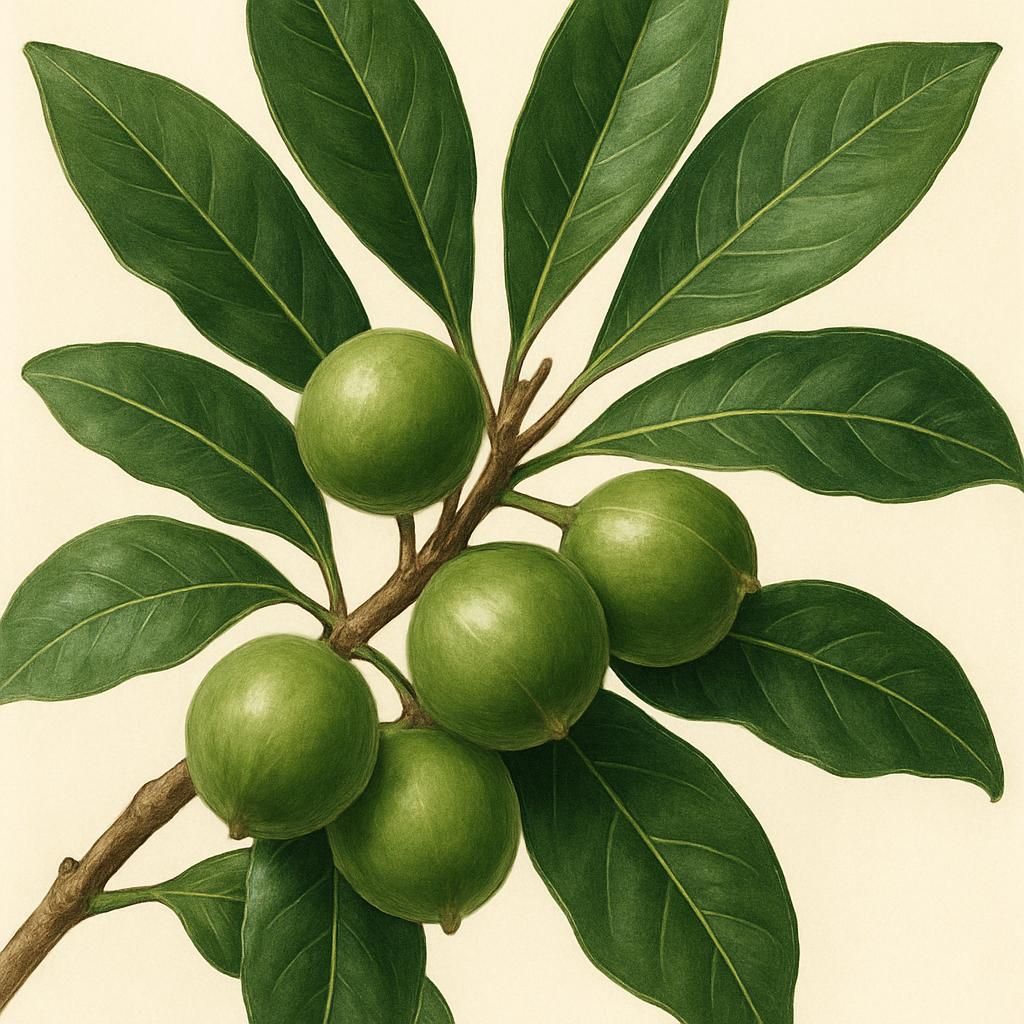
Introduction to Macadamia (Beaumont)
Macadamia (Beaumont) is a hybrid cultivar developed from Macadamia parentage that combines the smooth-shell traits of M. integrifolia with the cold tolerance and vigorous growth of M. tetraphylla. It is widely planted in Australia, South Africa, Hawaii, and parts of California because of its high kernel recovery (often 40-45%), self-fertility, and consistent cropping. The tree produces large, round nuts with excellent flavor and a thin shell that reduces processing losses. Beaumont is considered a benchmark cultivar for both commercial orchards and serious home growers seeking reliable yields in subtropical climates.
Botanical Profile of Macadamia (Beaumont)
Beaumont trees are evergreen, reaching 8–12 meters at maturity with a spreading canopy that benefits from annual pruning to maintain light penetration. Leaves are dark green, lanceolate, and arranged in whorls of three to four. Flowers are creamy-white to pale pink racemes that appear in late winter through spring. The cultivar is partially self-fertile, though cross-pollination with compatible varieties such as Hass Avocado windbreaks or other macadamia cultivars improves set. Nuts mature 6–7 months after flowering and drop naturally when ripe.
Soil, pH, and Climate Requirements for Macadamia (Beaumont)
Beaumont performs best on well-drained, fertile soils with good organic matter. It tolerates a wide pH range but shows optimal uptake of micronutrients between 5.5 and 6.5. The tree requires protection from strong winds and frost below −2 °C.
| Parameter | Ideal Range | Notes |
|---|---|---|
| Soil Type | Sandy loam to clay loam | Must be well-drained; avoid waterlogging |
| Soil pH | 5.5 – 6.5 | Adjust with lime or sulfur as needed |
| Temperature Range | 15 – 30 °C daytime | Protect from frost below −2 °C |
| Annual Rainfall | 1000 – 2000 mm | Supplemental irrigation required in dry periods |
| Relative Humidity | 60 – 80 % | High humidity favors flowering and set |
| Elevation | 0 – 800 m | Higher elevations may need wind protection |
| Spacing (mature) | 7 × 7 m or 8 × 6 m | Hedgerow planting possible at higher density |
Step-by-Step Planting & Propagation
- Select certified disease-free Beaumont scions grafted onto vigorous rootstocks such as M. integrifolia seedlings.
- Prepare planting holes 60 cm wide × 60 cm deep; incorporate 10–15 kg well-rotted compost and 200 g rock phosphate.
- Plant at the same depth as the nursery container; backfill and firm soil to eliminate air pockets.
- Water thoroughly and apply 5–7 cm organic mulch, keeping mulch 10 cm from the trunk.
- Stake young trees in windy areas and install windbreaks using Gliricidia or tall grasses.
- Irrigate every 3–4 days for the first 8 weeks until new growth appears.
Care & Maintenance regimes for Macadamia (Beaumont)
Consistent water, balanced nutrition, and timely pruning are essential for sustained high yields. The following table outlines seasonal schedules.
| Season | Watering Schedule | Fertilizer Program | Pruning Schedule |
|---|---|---|---|
| Spring | 20–25 L/week per mature tree | 1.5 kg 15-5-12 NPK + 50 g zinc sulfate per tree | Light tip pruning after harvest |
| Summer | 30–40 L/week; increase during heat waves | 1 kg 15-5-12 + 30 g magnesium sulfate | Remove water shoots and crossing branches |
| Autumn | Reduce to 15–20 L/week | 0.75 kg 8-4-12 NPK; apply boron foliar spray | Structural pruning of lower limbs |
| Winter | 10–15 L/week if rainfall <15 mm | Maintenance only; avoid high nitrogen | Remove deadwood; shape canopy for light |
Monitor leaf nutrient levels annually and adjust programs accordingly. Mulch with 10–15 cm wood chips or macadamia husks to conserve moisture and suppress weeds.
Pests, Diseases & Organic Management
Key threats include Macadamia nut borer, Macadamia nut borer, Scale insects, and Phytophthora root rot. Implement an integrated approach:
- Monitor with pheromone traps for nut borer from flowering through nut drop.
- Release predatory mites and lacewings for Spider mites and soft scales.
- Apply neem oil or horticultural oil during dormancy to reduce overwintering scale.
- Improve drainage and avoid over-irrigation to prevent Phytophthora and Root rot.
- Use copper-based sprays only when leaf spot diseases exceed economic thresholds.
Harvesting, Curing & Optimal Storage
Nuts are mature when they drop naturally; collect daily during peak drop to minimize ground pests. Remove husk within 24 hours using a dehusker. Dry nuts at 30–35 °C with forced air until moisture reaches 10 % (approximately 7–10 days). Store in sealed containers at 5–10 °C and 60 % RH for up to 12 months. For longer storage, vacuum-pack kernels at 3–5 % moisture.
Companion Planting for Macadamia (Beaumont)
Plant nitrogen-fixing Pigeon pea or Gliricidia between rows to improve soil fertility and provide wind protection. Low-growing Clover or Marigold beneath the canopy suppress weeds and attract beneficial insects. Avoid planting heavy feeders such as Corn or Tomato within the root zone.