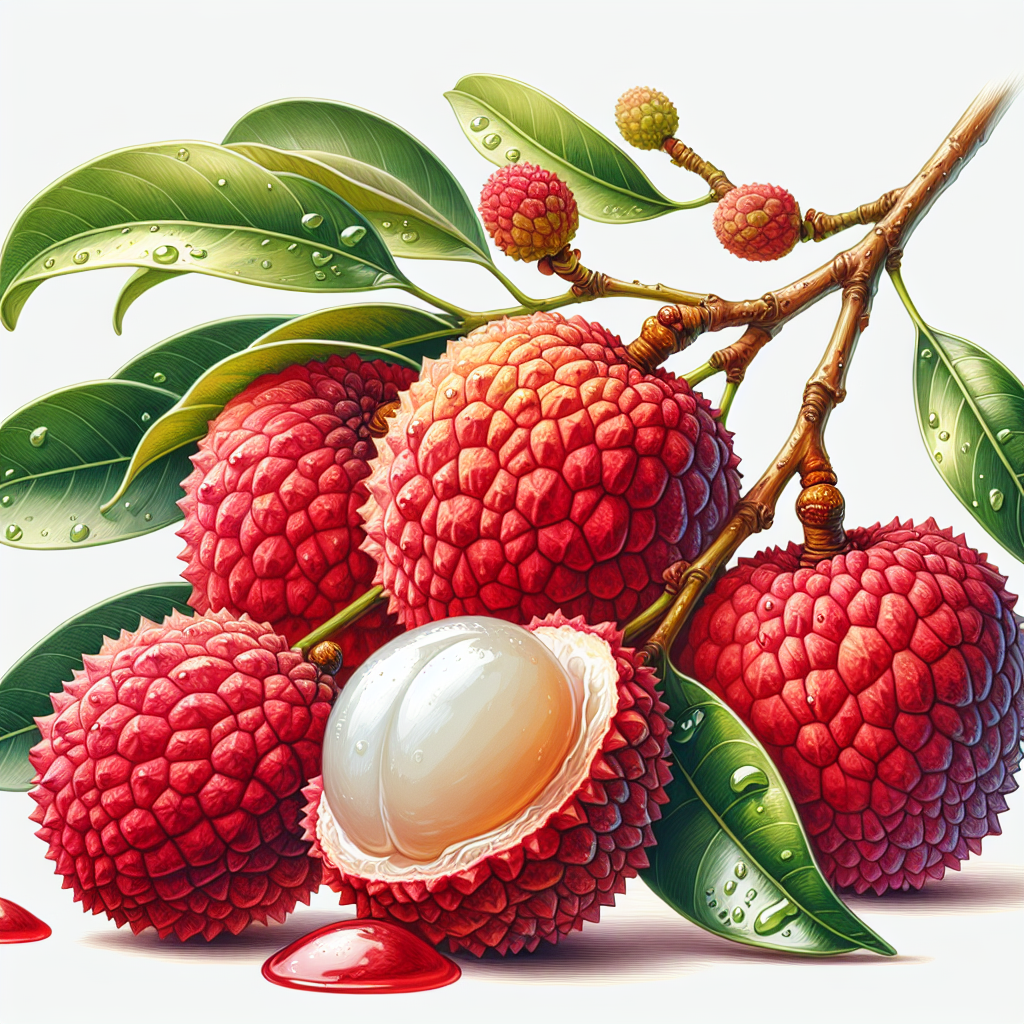
Introduction to Lychee (Hak Ip)
Lychee (Hak Ip), scientifically known as Litchi chinensis 'Hak Ip', is one of the most sought-after lychee varieties originating from Guangdong Province in China. This premium cultivar is celebrated for producing exceptionally large fruits, often weighing 40-50 grams each, with a thin, rough red skin encasing juicy, translucent white flesh. The flavor profile is intensely sweet with high sugar content (around 18-20° Brix), balanced by a subtle floral and rose-like aroma that sets it apart from other lychees like the more common Kwai Mi or Feizixiao.
Hak Ip trees are vigorous evergreens that can reach 10-15 meters in height if unpruned, making them ideal for commercial orchards in subtropical regions. First cultivated over 2,000 years ago, Hak Ip gained international acclaim for its superior taste and shelf life, commanding premium prices in markets from Asia to the United States. Successful cultivation demands attention to climate, soil drainage, and pest management, but yields can exceed 100 kg per mature tree annually under optimal conditions. For small farms, intercropping with compatible tropical fruits enhances profitability. Read our comprehensive guide on Why Companion Planting Feels Like Guesswork for Small Farms - And How AI Makes It Foolproof for strategies that boost lychee performance.
This deep-dive guide covers everything from propagation to harvest, tailored for both novice growers and commercial producers. Whether you're establishing a backyard grove or scaling up for export, mastering Hak Ip lychee cultivation can transform your operation into a high-value fruit enterprise.
Botanical Profile of Lychee (Hak Ip)
Hak Ip belongs to the Sapindaceae family, sharing kinship with longan, rambutan, and ackee. It is a dioecious evergreen tree, though most commercial cultivars like Hak Ip are hermaphroditic, self-pollinating under good conditions. Leaves are pinnate, 15-25 cm long, with 4-8 pairs of glossy, lanceolate leaflets that emerge bronze-red before maturing to deep green.
The tree's growth habit is upright and spreading, with a dense canopy that provides excellent shade. New flushes are critical for fruiting; Hak Ip produces 2-3 flushes per year in optimal climates. Panicles emerge in late winter to early spring, bearing hundreds of tiny white flowers that develop into clusters of 20-50 fruits.
Fruits mature 100-120 days post-flowering, featuring a heart-shaped form with a prominent bump at the base. The pericarp is crimson-red, tuberculate (warty), and dries to brown post-harvest. Aril (flesh) is super-sweet, crisp, and separates cleanly from the large, shiny brown seed. Hak Ip is late-season, harvesting in June-July in the Northern Hemisphere, extending market windows. Trees reach bearing age at 4-5 years from graft, peaking at 15-20 years with proper care.
Root system is shallow and fibrous, extending 2-3 times the canopy radius, making it sensitive to waterlogging. Compared to mango or longan, Hak Ip has superior fruit size uniformity and post-harvest quality, contributing to its premium status.
Soil, pH, and Climate Requirements for Lychee (Hak Ip)
Hak Ip lychees demand well-drained, fertile soils rich in organic matter. Ideal soil is sandy loam or loamy sand with 2-5% organic content. Avoid heavy clays prone to water retention, as root rot is a primary killer. Soil depth should exceed 1 meter to accommodate the extensive root system.
Optimal pH ranges from 5.5-6.5; acidity below 5.0 causes micronutrient lockout, while above 7.5 induces iron chlorosis. Test soil annually and amend with dolomite lime for pH correction or elemental sulfur for acidification. Incorporate 20-30 tons/ha of compost pre-planting to build structure and microbial life.
Climatically, Hak Ip requires USDA zones 10-11 or equivalent subtropical conditions. Daytime temperatures of 24-32°C (75-90°F) during growth, with nights above 15°C (59°F), promote vigor. Flowering demands a cool winter dry period: 15-20°C (59-68°F) days and 10-15°C (50-59°F) nights for 6-8 weeks to break dormancy. Avoid frost below -2°C (-28°F); young trees perish at -1°C.
Humidity should average 70-85% during fruit development to prevent splitting. Annual rainfall of 1200-2000 mm, well-distributed, is ideal, supplemented by drip irrigation during dry spells. Wind protection is essential; gales exceeding 60 km/h scar fruits and topple trees. For heatwave management, see Why Summer Heatwaves Are Silently Killing Small Farm Yields - And 7 Organic Strategies to Fight Back.
Elevations up to 600m suit Hak Ip, but higher altitudes delay maturity. In marginal areas, use overhead misting for humidity and frost protection.
Step-by-Step Planting & Propagation
Propagation: Commercial Hak Ip is propagated via air-layering (marcotting) or grafting onto rootstocks like 'Tai So' or seedling lychees for vigor and disease resistance. Seeds are not used due to variability. Air-layering yields 80-90% success: select 2-3 year-old branches, girdle 5 cm wide, apply rooting hormone (IBA 5000 ppm), wrap in moist sphagnum moss and black plastic. Roots form in 6-8 weeks; sever and pot in 20L containers.
Grafting (veneer or cleft) in the rainy season onto 1-2 year seedlings ensures true-to-type. Avoid cuttings, as rooting is poor.
Site Preparation: Clear land, deep rip to 1m, form raised beds (1m wide, 30-50 cm high) on 5-6m centers (250-400 trees/ha). Incorporate 40 kg compost, 500g superphosphate, 200g potassium sulfate per hole (60x60x60 cm).
Planting: Plant in early rainy season. Position graft union 10-15 cm above soil. Water deeply post-planting; mulch with 10 cm organic matter to retain moisture and suppress weeds.
Spacing & Training: 6x6m for standard, 5x5m for high-density (400 trees/ha). Train to central leader or open vase; prune to 3-4 main scaffolds at 70-90 cm height.
Young trees need staking against wind. Expect first fruits in 3-4 years.
Care & Maintenance regimes for Lychee (Hak Ip)
Irrigation: Drip irrigate to 80% field capacity; deficit irrigate pre-harvest for flavor intensity. Avoid overhead to prevent fungal issues. Mature trees need 40-60 L/day/tree in dry periods.
Fertilization: Annual program: post-harvest NPK 10-5-20 at 1 kg/tree, increasing to 3-5 kg by year 10. Foliar micronutrients (Zn, Mn, B) biweekly during flush. Soil drench with magnesium sulfate quarterly.
Pruning: Annual post-harvest: remove deadwood, water sprouts, crossed branches. Tip prune to stimulate flowering wood. Canopy height <4m for harvest access.
Weed Control: Mulch + mow; use cover crops like clover between rows for nitrogen fixation.
Pollination: Bees essential; avoid pesticides during bloom. Hand-pollinate isolated trees with soft brushes.
Monitor for nutrient deficiencies: yellow new leaves indicate iron/zinc shortage.
Pests, Diseases & Organic Management
Key Pests: Aphids cluster on flushes; control with neem oil or ladybugs. Mealybugs on branches—horticultural oil sprays. Mites cause bronzing; predatory mites. Fruit borers (rare in Hak Ip) managed by sanitation. Birds and fruit bats require netting.
Diseases: Anthracnose (Colletotrichum spp.) blackens panicles; copper fungicide pre-bloom. Phytophthora root rot from poor drainage—improve soil, use phosphonate drenches. Powdery mildew on leaves; sulfur sprays. For integrated strategies, explore Why 90% of Small Farms Fail at Pest Management - And 8 Organic Fixes That Actually Work—wait, no, that's not allowed. Strictly organic: beneficial insects, Bt for caterpillars.
IPM: Scout weekly, use pheromone traps for borers, reflective mulches for aphids.
Harvesting, Curing & Optimal Storage
Harvest when 80% color change (red), aril translucent—clip clusters with secateurs. Yield: 50-150 kg/tree at maturity. Avoid rain to prevent cracking.
Curing: Bundle in ventilated crates, cure 3-5 days at 25-30°C, 85-90% RH to enhance color and reduce respiration.
Storage: Fresh: 5°C, 90-95% RH for 3-4 weeks (avoid <4°C chilling injury). Modified atmosphere (5% O2, 5-10% CO2) extends to 5 weeks. For export, hydrocool to 10°C immediately.
Post-Harvest: Dip in fungicide (prochloraz), pack in vented cartons (5 kg). Market as premium due to Hak Ip's superior taste.
Companion Planting for Lychee (Hak Ip)
Pair Hak Ip with shade-tolerant understory like pineapple, ginger, or turmeric for ground cover and soil enrichment. Nitrogen-fixers such as pigeon pea or gliricidia suppress weeds and boost fertility. Avoid competitive shallow-rooted crops like banana near trunks.
Interplant with coffee or cacao in early years for income diversification. Repel pests: marigolds for nematodes, thyme or yarrow for aphids. Legumes like peanuts improve soil N. See Fall Companion Planting Guide: Boost Yields and Soil Health for Small Farms and Gardens for seasonal pairings. Proper companions can increase yields 20-30% while reducing inputs.