Introduction to Lotus Root (Nelumbo nucifera)
Nelumbo nucifera, widely known as lotus root, is a perennial aquatic plant cultivated primarily for its edible rhizomes. The crop has been a dietary staple across Asia for thousands of years and is increasingly valued worldwide for its crunchy texture, mild flavor, and impressive nutritional profile. Lotus root is rich in dietary fiber, vitamin C, potassium, and antioxidants, making it a sought-after ingredient in stir-fries, soups, and salads.
Commercial growers appreciate lotus root for its relatively high market value and suitability for wetland or marginal land that cannot support conventional upland crops. Home gardeners often grow it in ponds, barrels, or lined beds, enjoying both the harvest and the striking ornamental flowers that emerge above the water.
Successful lotus root production hinges on understanding its unique aquatic requirements, maintaining consistent water depth, and managing fertility without disturbing the delicate rhizome system. This guide provides detailed, actionable steps for establishing and maintaining a productive lotus root planting.
Botanical Profile of Lotus Root (Nelumbo nucifera)
Nelumbo nucifera belongs to the Nelumbonaceae family and is native to Asia and parts of Australia. The plant produces large, round, peltate leaves that float on or rise above the water surface, supported by long petioles. Showy pink or white flowers appear in summer, followed by distinctive seed pods.
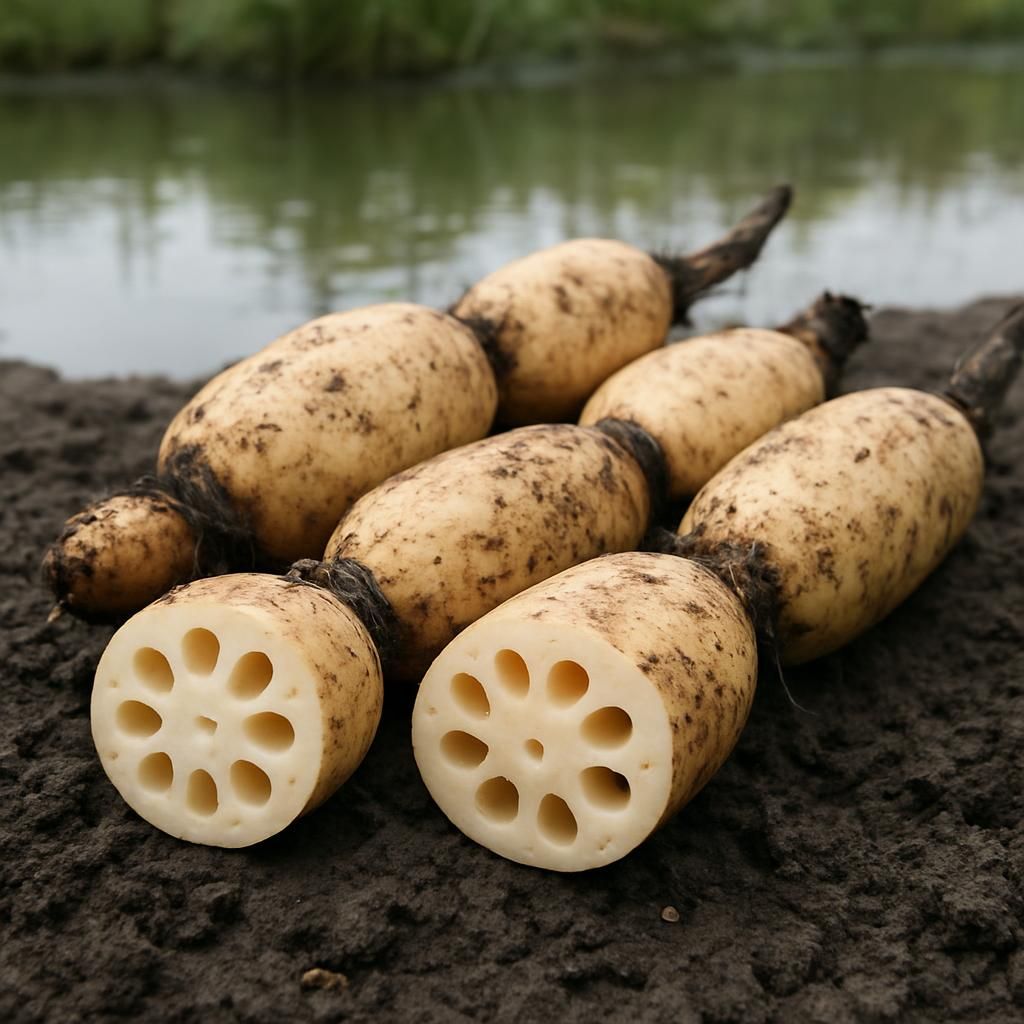
The edible portion consists of horizontal rhizomes that develop in mud beneath 15–60 cm of water. These rhizomes are segmented, with characteristic air channels that give the familiar wheel-like cross-section when sliced. Each plant can spread 1–2 meters in a single season under optimal conditions.
Lotus root is propagated vegetatively from rhizome segments containing at least two nodes. The crop exhibits strong apical dominance; therefore, planting whole, undamaged sections is essential for uniform emergence.
Soil, pH, and Climate Requirements for Lotus Root (Nelumbo nucifera)
Lotus root demands heavy, fertile, clay-loam or silty soils that retain water and nutrients. The soil must remain submerged for the majority of the growing season. Organic matter content should be 4–8 % to support microbial activity and nutrient release.
| Parameter | Ideal Range | Notes |
|---|---|---|
| Soil Type | Clay loam / Silty clay | High water-holding capacity essential |
| Soil pH | 6.0 – 7.5 | Slightly acidic to neutral; avoid saline soils |
| Water Depth | 15 – 60 cm | Maintain constant level; deeper water delays flowering |
| Temperature (Air) | 20 – 35 °C | Frost kills foliage; optimum growth above 25 °C |
| Temperature (Water) | 18 – 32 °C | Below 15 °C slows rhizome expansion |
| Sunlight | Full sun (≥ 6 h direct) | Essential for photosynthesis and flowering |
| Organic Matter | 4 – 8 % | Improves fertility and structure |
| Salinity Tolerance | < 2 dS/m | Sensitive; avoid brackish water |
Site selection should prioritize areas with reliable irrigation or natural water sources. Wind protection reduces leaf damage and evaporation.
Step-by-Step Planting & Propagation
- Select healthy, disease-free rhizomes from the previous season’s crop or certified stock. Each planting piece must contain at least two nodes and an intact growing tip.
- Prepare the planting bed or container by removing weeds and incorporating well-rotted compost or aged manure at 5–8 kg per square meter.
- Flood the bed to 10 cm depth 48 hours before planting to settle the soil.
- Plant rhizomes horizontally, 10–15 cm deep, with the growing tip pointing upward at a 30° angle. Space plants 60–90 cm apart in rows 1.2–1.5 m apart.
- Gradually raise water depth to 20–30 cm over the next 7–10 days as shoots emerge.
- In cooler climates, start rhizomes in nursery tubs and transplant once water temperatures exceed 18 °C.
Care & Maintenance regimes for Lotus Root (Nelumbo nucifera)
Consistent water management is the single most important factor. Avoid sudden fluctuations that stress plants or expose rhizomes. Fertilizer applications should be split to prevent nutrient leaching into surrounding waterways.
| Growth Stage | Water Depth (cm) | Fertilizer Schedule | Pruning / Maintenance |
|---|---|---|---|
| Establishment (0–4 weeks) | 15–25 | 50 kg/ha NPK 10-20-20 at planting | Remove floating debris weekly |
| Vegetative (5–10 weeks) | 25–40 | 40 kg/ha urea at week 6 | Thin overcrowded leaves if >70 % coverage |
| Flowering (11–16 weeks) | 30–50 | 30 kg/ha potassium sulfate at first bloom | Deadhead spent flowers to redirect energy |
| Rhizome Bulking (17–24 weeks) | 40–60 | Optional light top-dress of compost tea | Minimal; avoid root disturbance |
| Pre-Harvest (25+ weeks) | 30–40 | Cease nitrogen 4 weeks before harvest | Lower water gradually to firm rhizomes |
Monitor dissolved oxygen levels if using recirculating systems; maintain >4 mg/L to prevent root stress.
Pests, Diseases & Organic Management
Common pests include Aphids, Spider Mites, and Root-knot nematodes. Aphid colonies on leaf undersides can be dislodged with strong water jets or controlled with insecticidal soap. Spider mites appear during hot, dry spells; increasing humidity and releasing predatory mites provides effective suppression.
Diseases such as Rhizoctonia crown rot and Pythium root rot occur when water is stagnant or temperatures drop below 18 °C. Preventive measures include using clean planting stock, maintaining aerobic water conditions, and rotating planting areas every 3–4 years. Copper-based bactericides may be applied at label rates for bacterial leaf spots if incidence exceeds 5 % of foliage.
Harvesting, Curing & Optimal Storage
Lotus root reaches harvest maturity 180–240 days after planting, when leaves begin to yellow and water can be drained. Use a blunt digging fork or water-jet harvester to lift rhizomes without breakage. Rinse thoroughly in clean water and trim damaged sections.
Cure rhizomes for 24–48 hours in a shaded, well-ventilated area at 20–25 °C to heal minor wounds. Store at 4–7 °C and 85–90 % relative humidity; under these conditions, quality is maintained for 4–6 weeks. For longer storage, slice and freeze or process into pickles.
Companion Planting for Lotus Root (Nelumbo nucifera)
Lotus root pairs well with other aquatic or semi-aquatic species that share similar water and nutrient needs. Rice can be intercropped in the same flooded field during the first 60 days, providing early ground cover and additional income. Water Spinach (not in wiki list) and Taro are compatible neighbors that occupy different vertical strata.
Avoid planting near heavy feeders such as Corn or Tomato that compete aggressively for nutrients when water levels are lowered. Marigold borders deter aphids and enhance biodiversity without competing for space.