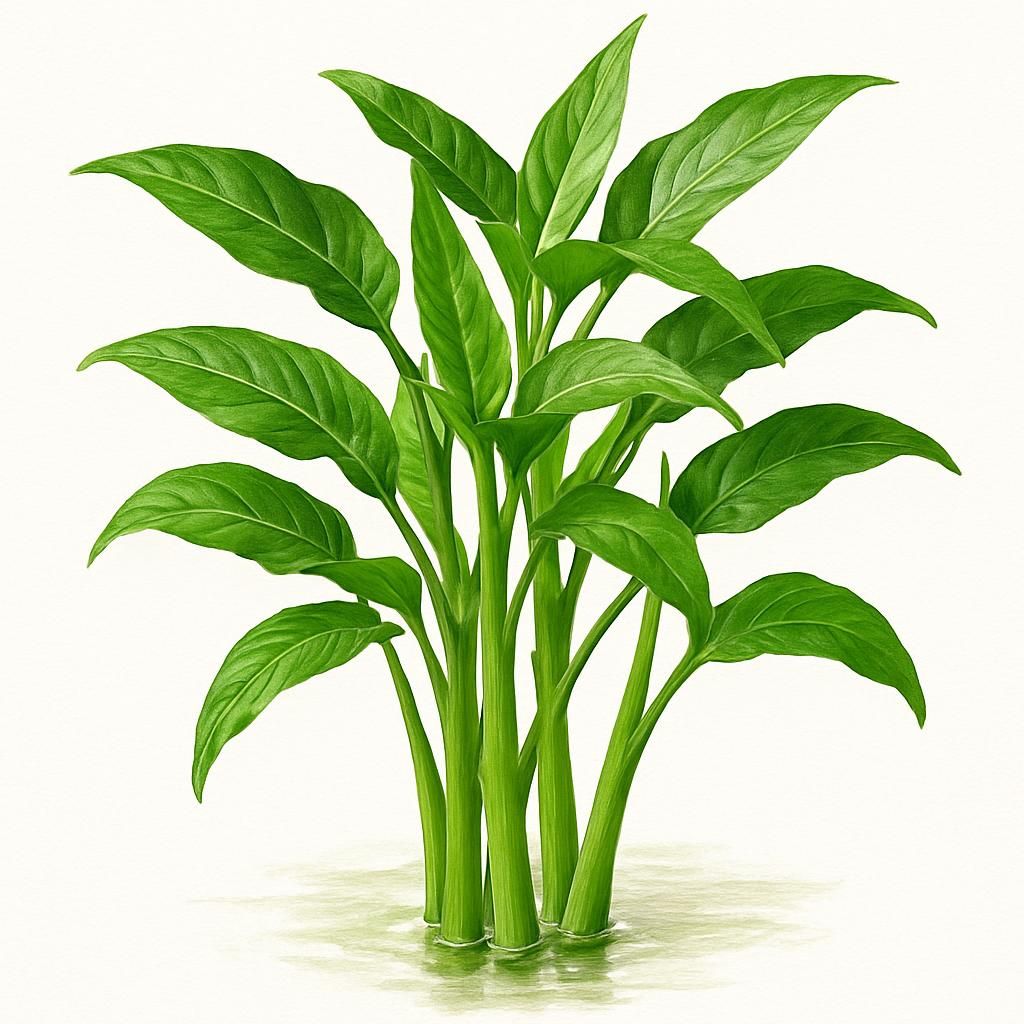
Introduction to Water Spinach
Water spinach (Ipomoea aquatica), also called kangkong, ong choy, or swamp spinach, is a staple leafy vegetable throughout Southeast Asia, southern China, and parts of India. Its crisp stems and mild-flavored leaves are used in stir-fries, soups, and salads. Because it grows rapidly in flooded or moist conditions, it is ideal for small farms, home gardens, and hydroponic systems in warm climates.
Botanical Profile of Water Spinach
Water spinach belongs to the Convolvulaceae family and is closely related to sweet potato. It is a herbaceous perennial that behaves as an annual in temperate zones. The plant produces long, hollow stems that root readily at nodes and broad, arrow-shaped to heart-shaped leaves. Flowers are typically white or pale purple and appear under long-day conditions, though most commercial production focuses on vegetative growth.
Soil, pH, and Climate Requirements for Water Spinach
Water spinach prefers fertile, moisture-retentive soils with good organic matter. It tolerates a wide pH range but performs best in slightly acidic to neutral conditions. Consistent warmth and high humidity are essential; it stops growing below 15 °C (59 °F).
| Parameter | Ideal Range | Notes |
|---|---|---|
| Soil Type | Loamy to clay loam | High organic matter improves water retention |
| Soil pH | 5.5 – 7.0 | Slightly acidic to neutral |
| Temperature | 20 – 35 °C (68 – 95 °F) | Minimum 15 °C; frost kills plants |
| Water Regime | Saturated to 5 cm standing water | Can be grown in flooded beds or containers |
| Sunlight | Full sun (6+ hours) | Tolerates light shade in extreme heat |
| Spacing | 15 – 20 cm between plants | Rows 30 – 40 cm apart |
Step-by-Step Planting & Propagation
- Choose healthy tip cuttings 15–20 cm long from vigorous mother plants or purchase certified seed.
- Prepare raised beds or shallow trenches lined with plastic if drainage is poor; incorporate 5–8 cm of well-rotted compost.
- Insert cuttings at a 45° angle so two nodes are buried; space 15 cm apart in rows 30–40 cm wide.
- For seed propagation, soak seeds 24 hours, sow 1 cm deep, and thin seedlings to 15 cm spacing once they reach 10 cm tall.
- Maintain constant moisture; water twice daily until roots establish (5–7 days).
- In cooler climates start plants indoors 4 weeks before last frost and transplant after soil warms.
Care & Maintenance regimes for Water Spinach
Consistent moisture and moderate fertility drive rapid regrowth. Avoid over-fertilizing with nitrogen alone, which can cause soft, pest-prone growth.
| Task | Frequency | Details |
|---|---|---|
| Watering | Daily in dry weather; maintain 2–5 cm water in beds | Use clean, non-saline water; drip irrigation prevents disease spread |
| Fertilizer | Every 10–14 days after first harvest | Apply balanced NPK (e.g., 10-10-10) at 2 g/L or fish emulsion; alternate with compost tea |
| Pruning/Harvesting | Begin 25–30 days after planting; repeat every 7–10 days | Cut 5 cm above soil or water line; leave at least two nodes for regrowth |
Pests, Diseases & Organic Management
Common issues include aphids, leaf miners, and fungal leaf spots in humid conditions. Monitor weekly and act early.
- Aphids: Spray underside of leaves with insecticidal soap or neem oil every 5–7 days.
- Leaf miners: Remove affected leaves and introduce parasitic wasps.
- Fungal leaf spots: Improve air circulation, avoid overhead watering, and apply copper-based fungicides if needed.
- Slugs and snails: Hand-pick at dusk or use iron-phosphate baits.
Rotate beds with lettuce or onion to break pest cycles and incorporate marigold borders for natural repellence.
Harvesting, Curing & Optimal Storage
Harvest when stems reach 30–40 cm and leaves are tender. Use sharp scissors to cut above the second node; plants will produce 4–6 additional flushes. Rinse in cool water, remove damaged leaves, and bundle for market. Store at 4–7 °C in perforated plastic bags for up to 5 days. For longer preservation, blanch 30 seconds and freeze.
Companion Planting for Water Spinach
Water spinach pairs well with moisture-loving crops and beneficial insect attractors. Plant alongside Thai Basil to repel aphids and improve flavor. Interplant with cucumber on trellises to maximize vertical space while the leafy canopy shades soil and reduces evaporation. Avoid planting near alliums if harvesting leaves frequently, as strong sulfur compounds may taint flavor. Use nasturtium as a trap crop for aphids at bed edges.