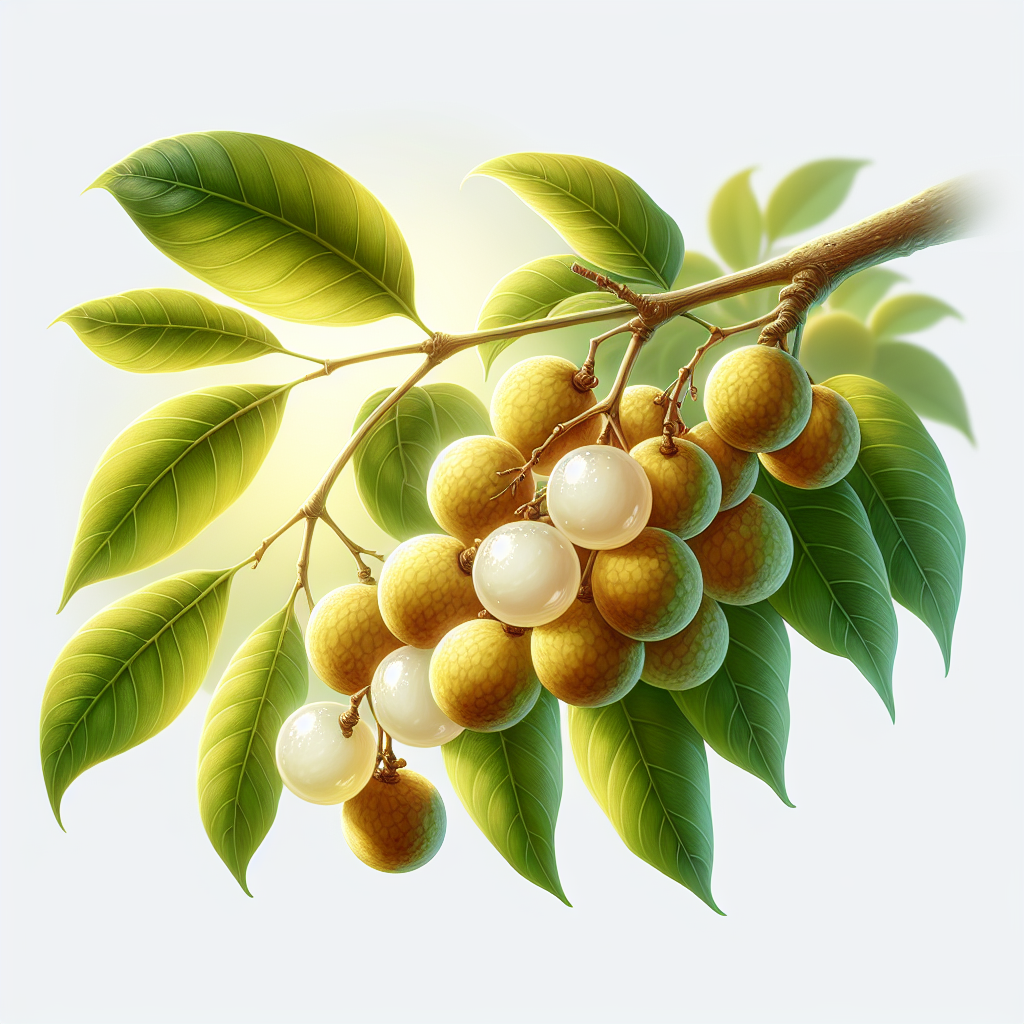
Introduction to Longan (Diamond River)
Longan (Diamond River), known scientifically as Dimocarpus longan 'Diamond River', represents a standout cultivar in the Sapindaceae family, originating from selective breeding programs in Southeast Asia and refined for modern orchards. This variety earns its name from the fruit's uniquely translucent, jewel-like flesh that sparkles like diamonds when ripe, combined with an intensely sweet, honeyed flavor that surpasses standard longans. Native to regions like southern China, Thailand, and Vietnam, Diamond River longan has gained global acclaim for its large fruit size (up to 3 cm diameter), thin skin, and minimal seed, making it a favorite for fresh markets, drying, and export.
Farmers appreciate Diamond River for its vigorous growth, heavy bearing (up to 100 kg per mature tree), and resistance to splitting under humid conditions. Unlike wild longans, this cultivar fruits reliably every year without the biennial bearing common in others, thriving in USDA zones 9-11. With proper management, trees reach 8-12 meters tall, producing clusters of 30-50 fruits from June to August in the Northern Hemisphere. This comprehensive guide equips growers with professional strategies to maximize yields, combat subtropical challenges, and achieve premium quality. For more on tropical fruit companions, see our Mango (crop) page.
Investing in Diamond River longan offers strong ROI due to its premium pricing—often 20-50% above generic longans. Small farms can intercrop with short-term crops during establishment, scaling to commercial orchards with yields of 10-15 tons per hectare after 5 years. Success hinges on site selection, precise irrigation, and organic pest protocols, all detailed below.
Botanical Profile of Longan (Diamond River)
Dimocarpus longan 'Diamond River' is an evergreen tree with a dense, pyramidal canopy reaching 10-15 meters at maturity. Leaves are pinnate, 20-50 cm long, with 6-10 pairs of glossy, lanceolate leaflets (10-20 cm) that emerge bronze-red before turning deep green. New growth is attractive, rust-colored flushes that harden to leathery texture, providing year-round shade.
Flowers appear in dense panicles (15-40 cm) from April to May, with male and female structures on the same tree (polygamous). Diamond River is partially self-fertile but benefits from cross-pollination with other longan varieties like Kohala or Biew Kiew for 20-30% higher set. Fruits develop in branched clusters, ripening synchronously over 3-4 weeks. Each drupe is round-oblong, 2-3 cm, with yellow-brown, rough skin enclosing creamy-white, translucent aril (flesh) that's juicy, muscat-like in flavor, and low-fiber. The central seed is black, round, and shiny, smaller than in wild types.
Root system is shallow, fleshy, and wide-spreading (up to 12 m radius), sensitive to waterlogging but efficient in nutrient uptake. Diamond River exhibits moderate vigor, with trunk girth increasing 2-3 cm/year. Wood is lightweight, suitable for grafting stock. Phenologically, it requires 400-600 chill hours below 20°C for optimal flowering, distinguishing it from heat-loving lychees. Why Companion Planting Feels Like Guesswork for Small Farms - And How AI Makes It Foolproof offers insights into integrating longans with understory plants.
Soil, pH, and Climate Requirements for Longan (Diamond River)
Diamond River longan demands well-drained, fertile soils rich in organic matter—loamy sands or clay loams ideal, avoiding heavy clays prone to root rot. Soil depth should exceed 1.2 meters to accommodate shallow roots. Optimal pH is 5.5-7.0; test and amend with dolomite lime if below 5.5, or sulfur if above 7.5. Conduct soil analysis for N-P-K, micronutrients (Zn, Fe, Mn), and CEC >15 meq/100g.
Climate-wise, thrive in subtropical/tropical zones with average temperatures 22-30°C, no frost tolerance below -2°C. Annual rainfall 1200-2500 mm, evenly distributed, or supplement with drip irrigation. Humidity 60-85% during fruit set prevents cracking; avoid prolonged dry spells >2 months. Full sun (6-8 hours/day) essential; windbreaks protect young trees from salt-laden winds in coastal areas. Elevation 0-800 m suits best.
Mulch with 10-15 cm organic matter (coconut husk, rice hulls) to retain moisture, suppress weeds, and moderate soil temps. For marginal sites, raised beds (60 cm) improve drainage. Monitor groundwater; table >1.5 m depth. Pair with Guava (crop) in mixed orchards for soil synergy.
Step-by-Step Planting & Propagation
Propagation: Diamond River is primarily grafted (veneer or cleft) onto Omai or local rootstocks for vigor and disease resistance. Seeds viable 10-14 days, but seedlings vary; air-layering (marcotting) yields 90% success in 2-3 months. Collect semi-ripe branches (1-2 cm dia), girdle, apply rooting hormone (IBA 2000 ppm), wrap in moist sphagnum.
Site Prep: Clear site, plow 60 cm deep, incorporate 20-30 kg FYM/m² + 0.5 kg TSP. Space trees 8-10 m apart (100-150 trees/ha) in hexagonal pattern for light penetration.
Planting: Best in early spring post-frost. Dig 60x60x60 cm pits, fill with topsoil + 5 kg compost + 200g superphosphate. Plant grafts 5-10 cm above soil line; stake. Water deeply (50 L/tree), mulch. Initial pruning: head back to 70 cm.
Young Tree Care: Irrigate weekly (30-50 L), fertilize monthly (NPK 10-30-10 at 50g/tree). Train to central leader with 4-6 scaffolds at 60-90 cm.
Care & Maintenance regimes for Longan (Diamond River)
Irrigation: Drip system delivers 20-40 L/tree/day during dry periods; deficit irrigate pre-harvest for sugar accumulation. Avoid overhead to prevent fungal issues.
Fertilization: Annual program: post-harvest 1-2 kg NPK 16-16-16/tree + 50g MgSO4; pre-bloom 0.5 kg urea + 1 kg SOP; fruit set 1 kg NPK 8-3-26. Foliar Zn (0.5%) twice/year. Mature trees: 2-3 kg N/year.
Pruning: Annual post-harvest: remove deadwood, watersprouts, thin canopy for 30% light interception. Tip bearing; avoid over-pruning.
Weed Control: Mulch + mow; organic herbicides like vinegar for edges.
Pollination: Plant 10% pollinizers; bees enhance set by 25%.
Pests, Diseases & Organic Management
Pests: Monitor for mealybugs (cluster leaves), ants (farm pests), fruit borers. Organic: neem oil (2%) weekly, introduce ladybugs, yellow sticky traps.
Diseases: Anthracnose (fruit rot), Phytophthora (root rot). Prevent: copper fungicide pre-monsoon, improve drainage, biofungicides (Trichoderma). Learn more in Why 90% of Small Farms Fail at Pest Management - And 8 Organic Fixes That Actually Work. Avoid scale insects via pruning.
Integrated Approach: Scout weekly, thresholds: 5% infested panicles. Beneficials: predatory mites, parasitic wasps.
Harvesting, Curing & Optimal Storage
Harvest at full yellow-brown, 16-20% SSC (brix). Clip clusters, yield 50-100 kg/tree at 7-10 years. Field cure 3-5 days shade; sort, hydrocool to 10°C.
Storage: Fresh: 5°C, 85-90% RH, 4-6 weeks. Dried: solar dry 2-3 days, store 5°C vacuum 6 months.
Postharvest: Dip in 500 ppm benomyl, pack ventilated cartons.
Companion Planting for Longan (Diamond River)
Intercrop young orchards with pineapple (ground cover, suppress weeds), thai basil (pest repellent). Understory: legumes like pigeon pea fix N. Avoid root competitors. Benefits: 20% soil fertility boost, biodiversity. See Fall Companion Planting Guide: Boost Yields and Soil Health for Small Farms and Gardens.