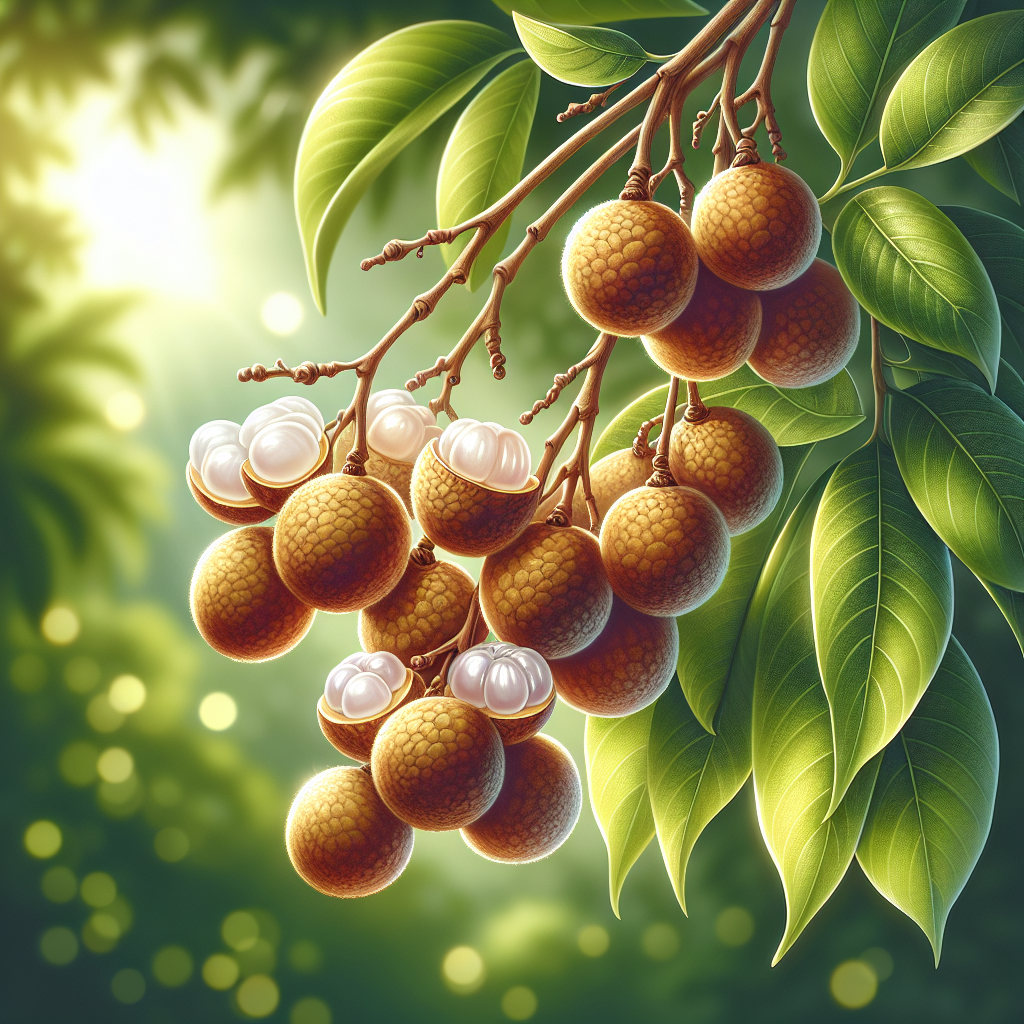
Introduction to Longan (Biew Kiew)
Longan, scientifically known as Dimocarpus longan, is a subtropical evergreen tree celebrated for its delicious, lychee-like fruit, particularly the prized Thai cultivar 'Biew Kiew' (also spelled 'Biew Kiao'). Native to Southeast Asia, especially Thailand, Vietnam, and China, Biew Kiew longan stands out for its exceptionally sweet, crisp arils with a subtle floral aroma, making it a favorite in fresh markets, desserts, and traditional medicines. The tree grows 20-40 feet tall, with dense, glossy green foliage providing year-round shade and ornamental appeal.
Cultivating Longan (Biew Kiew) rewards patient growers with heavy-bearing crops starting 4-6 years after planting, yielding up to 100-200 pounds per mature tree annually under ideal conditions. Its fruit clusters resemble small, round grapes encased in rough, brownish skin, harvested in summer. Beyond its culinary value—rich in vitamin C, antioxidants, and minerals—Biew Kiew longan supports agroforestry systems, offering windbreaks and soil stabilization. For small farms, it's a profitable crop due to high demand in ethnic markets and growing popularity in fusion cuisine. Successful cultivation hinges on mimicking its tropical origins: warm, humid climates with well-drained soils. This comprehensive guide equips you with professional-grade techniques from propagation to post-harvest handling, ensuring thriving trees and premium fruit. Mango (crop) growers often transition successfully to longan for diversified tropical income.
Botanical Profile of Longan (Biew Kiew)
Longan (Biew Kiew) belongs to the Sapindaceae family, closely related to lychee and rambutan. The tree features pinnate leaves 4-10 inches long, composed of 4-8 pairs of glossy, lance-shaped leaflets that remain evergreen, providing consistent canopy cover. New growth flushes coppery-red before maturing to deep green, enhancing its aesthetic value in landscapes.
Biew Kiew produces small, creamy-white flowers in large panicles up to 12 inches long during spring. These are dioecious or polygamous, with male, female, and hermaphroditic types; Biew Kiew is typically hermaphroditic, promoting self-pollination, though cross-pollination with varieties like 'Kohala' or 'Chompoo' boosts yields. Fruit develops in dense clusters of 20-40 berries, each 1-1.5 inches in diameter, with thin, leathery, light brown skin. Inside, a single large seed is surrounded by translucent, whitish flesh that's juicy, sweet (18-22° Brix), and mildly musky—superior to many longan cultivars.
Mature trees develop a sturdy trunk with grayish-brown bark, branching low for easy harvesting. Root systems are shallow and spreading, sensitive to waterlogging but effective at nutrient uptake in loamy soils. Biew Kiew is precocious, bearing fruit young, and alternate-bearing, with heavy 'on' crops followed by lighter 'off' years. Phenologically, it aligns with USDA zones 9-11, tolerating brief dips to 28°F (-2°C). For deeper subtropical insights, see our Soil Health Mastery blog.
Soil, pH, and Climate Requirements for Longan (Biew Kiew)
Longan (Biew Kiew) demands well-drained, fertile soils rich in organic matter. Ideal texture is sandy loam or loamy sand with 2-4% organic content; heavy clays cause root rot. Soil depth should exceed 3 feet for anchorage, with pH 5.5-7.5—slightly acidic to neutral. Test and amend with lime if below 5.5 or sulfur if above 7.5. Incorporate 4-6 inches of compost pre-planting to enhance microbial activity and cation exchange.
Climate-wise, Biew Kiew flourishes in 70-95°F (21-35°C) averages, with high humidity (60-80%) and 40-60 inches annual rainfall, well-distributed. It requires 200-400 chill hours (below 68°F) for floral induction, making it suited to subtropical regions like Florida, Hawaii, or southern California. Protect from winds exceeding 30 mph, which desiccate flowers. Full sun (8+ hours) is essential; partial shade reduces yields by 30-50%. Drought tolerance improves with age, but irrigate young trees weekly at 1-2 inches water. Frost protection via covers or micro-sprinklers is critical below 32°F. Mulch 4-6 inches deep with organic material to regulate soil temperature and moisture.
Step-by-Step Planting & Propagation
Propagation: Air-layering (marcotting) is preferred for Biew Kiew, yielding 90% success. Select 1-2-year-old pencil-thick branches in late spring. Girdle 1-2 inches wide, apply rooting hormone (IBA 0.2%), wrap with moist sphagnum moss and plastic. Roots form in 6-8 weeks; sever and pot in 1:1:1 sand:perlite:compost. Seed propagation is viable but leads to variable offspring; stratify fresh seeds 2-4 weeks at 50°F, germinate in 70% shade at 77-86°F in 2-3 weeks.
Site Preparation: Choose elevated sites with southern exposure. Dig 3x3x3 ft holes, mix native soil 50:50 with compost. Space trees 20-25 ft apart (15 ft dwarfs). Plant in early spring post-frost.
Planting Steps: 1. Soak air-layers overnight in water. 2. Position graft union 4-6 inches above soil. 3. Backfill, tamp firmly, stake if needed. 4. Water deeply, mulch 6 ft radius. 5. Apply balanced fertilizer (10-10-10) at 1 lb/tree. Initial pruning shapes to open center, removing 20-30% canopy.
Care & Maintenance regimes for Longan (Biew Kiew)
Watering: Young trees need 2-3 gallons daily first year, tapering to weekly deep soaks. Mature trees: 1-2 inches/week via drip, avoiding trunk wetting. Deficit irrigation during 'off' years promotes flowering.
Fertilization: Annual regime: February (pre-bloom) 6-6-6 + Mg at 1-2 lbs/tree; May (fruit set) 8-3-9 at 2-3 lbs; August (hull split) 0-0-50 K at 1 lb. Foliar micronutrients (Zn, Mn, Fe) quarterly. Soil drench with micronutrient mix yearly.
Pruning: Annual post-harvest: Remove deadwood, watersprouts, crowded branches for light penetration. Tip prune to stimulate buds. Mature trees: Selective thinning every 2-3 years.
Training: Develop strong scaffold with 4-6 primary limbs at 45° angles. Dwarf rootstocks like 'Poh Sua' control height to 15 ft.
Pests, Diseases & Organic Management
Pests: Aphids, mealybugs, and scale insects suck sap; control with neem oil (2% weekly) or ladybugs. Fruit-piercing moths target ripe arils—use kaolin clay barriers. Thrips scar flush; spinosad sprays. Birds and fruit bats: Netting from fruit set.
Diseases: Phytophthora root rot from poor drainage—improve aeration, use phosphonate drenches. Anthracnose causes flower blight; copper fungicide pre-bloom. Powdery mildew: Sulfur sprays, prune for airflow.
Organic IPM: Monitor weekly, release predatory mites/beetles, reflective mulches. Sanitation: Remove mummies. For advanced tactics, check Why 90% of Small Farms Fail at Pest Management—adaptable to longan.
Harvesting, Curing & Optimal Storage
Harvest Biew Kiew when 80% clusters show full brown skin, aril translucent (July-August). Clip clusters with shears, avoiding stem wounds. Yield peaks at 10-15 years. Cool to 50-55°F immediately post-harvest to retain sweetness.
Curing: Air-dry clusters 1-2 days shaded for natural wax bloom, enhancing shelf life. Do not refrigerate green fruit.
Storage: Fresh: 32-41°F, 85-90% RH, 3-4 weeks. Controlled atmosphere (3% O2, 5% CO2) extends to 6 weeks. Dried: Dehydrate at 135°F 24-48 hours, store airtight cool/dark up to 1 year. Market as fresh, frozen, or 'longan honey' preserves.
Companion Planting for Longan (Biew Kiew)
Pair Biew Kiew with guava for pest diversion and nitrogen via legumes like pigeon pea. Understory: Thai basil, ginger for soil health and repelling root-knot nematodes. Avoid water-hungry banana. Marigolds suppress nematodes; yarrow attracts pollinators. Interplant young trees with clover for green manure. This polyculture boosts biodiversity, reduces phytophthora incidence by 40%.