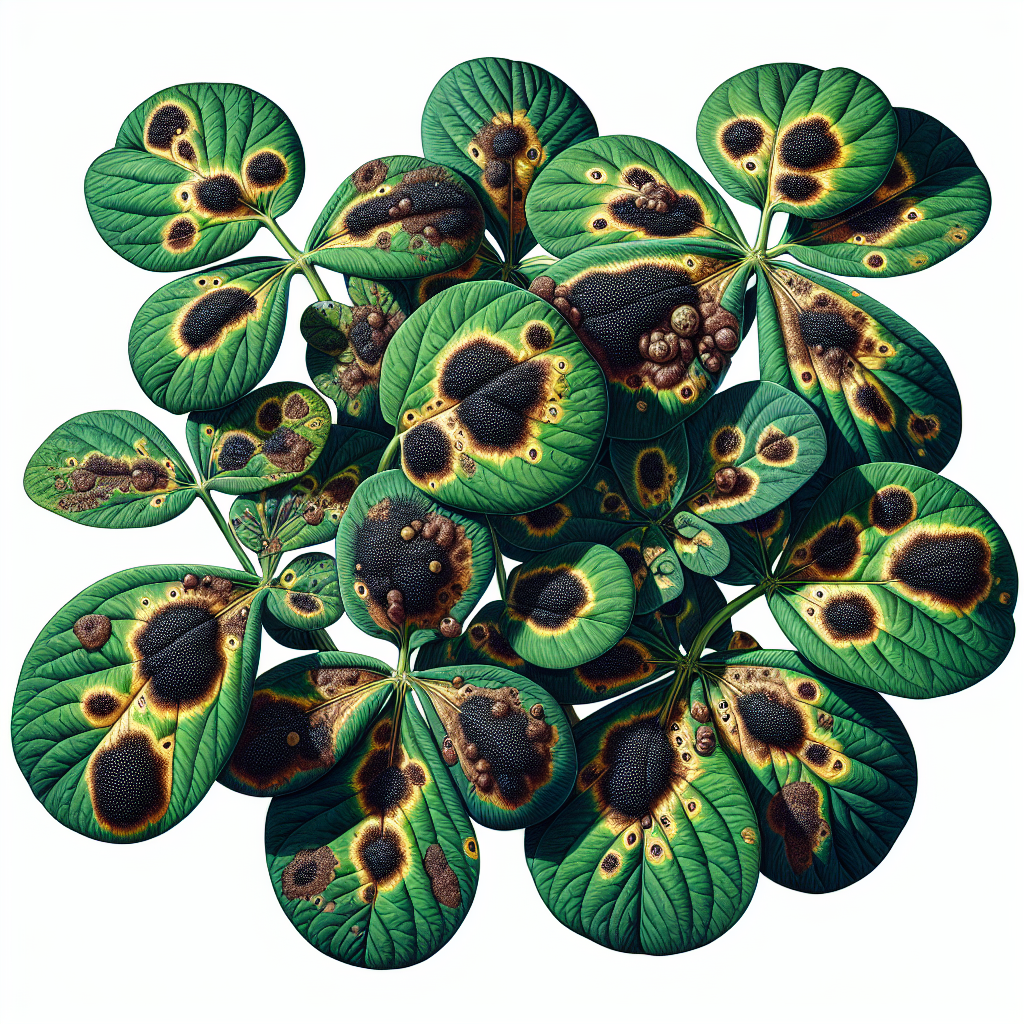
Introduction to Late leaf spot
Late leaf spot, scientifically known as Cercosporidium personatum (formerly Cercospora personata), stands as one of the most destructive foliar diseases in peanut production worldwide. This fungal pathogen targets peanut crops during critical growth stages, causing widespread defoliation that directly impacts pod fill, yield quality, and overall farm profitability. First identified in the early 20th century, late leaf spot has become a persistent challenge for growers in humid subtropical regions, where it can reduce yields by 20-50% without intervention.
Unlike its counterpart, early leaf spot, late leaf spot emerges later in the season, often coinciding with pegging and pod development. The disease's hallmark is its ability to spread rapidly under favorable conditions, producing spores that infect new tissues and perpetuate cycles of damage. In commercial peanut fields, managing late leaf spot requires an integrated approach, blending scouting, cultural controls, and fungicide timing to safeguard harvests. For small-scale and commercial growers alike, understanding this disease's nuances is essential to minimizing economic losses and sustaining long-term productivity.
This guide provides professional-grade diagnostic tools, lifecycle insights, and actionable management strategies tailored for peanut farmers. By implementing these recommendations, producers can protect their peanuts and maintain healthy canopies through pod maturation.
Identifying Symptoms & Damage
Accurate identification of late leaf spot is crucial for timely intervention, as symptoms can mimic other leaf spot diseases. Initial signs appear on lower, older leaves as small, circular spots measuring 1-2 mm in diameter. These lesions start as pale green or yellowish areas, evolving into dark brown to black centers surrounded by a lighter yellow halo.
A defining feature is the lesion's darker pigmentation compared to early leaf spot—late leaf spot spots often exhibit a velvety, spore-covered surface under humid conditions, appearing almost sooty. As the disease progresses, lesions coalesce, forming irregular blotches that cover entire leaves, leading to chlorosis (yellowing) and necrosis (tissue death). Defoliation begins from the bottom up, with severely affected leaves dropping prematurely.
On peanut foliage, symptoms typically manifest 40-60 days after planting, accelerating during reproductive stages. Underside lesion examination reveals abundant fungal sporulation—dark, olive-green conidia in chains, confirming C. personatum. Secondary symptoms include stunted runner growth and reduced pod fill due to diminished photosynthesis. Yield impacts are profound: even 10-20% defoliation can slash yields by 10%, while severe epidemics (>50% defoliation) cause 30-70% losses.
Damage extends beyond leaves; infected debris harbors overwintering inoculum, perpetuating annual outbreaks. Differentiate from Alternaria leaf spot by lesion color (late leaf spot is darker) and sporulation patterns. Use a 10x hand lens for confirmation, or submit samples for lab diagnosis via culturing or PCR. Early detection through weekly scouting—focusing on field edges and low-lying areas—enables proactive management, preserving canopy integrity.
Lifecycle and Progression of Late leaf spot
Cercosporidium personatum follows a polycyclic lifecycle, with multiple infection cycles per season driven by abundant spore production. Primary inoculum survives in peanut debris as stromata (compact fungal structures) on leaves and pegs, persisting 12-18 months in soil. Rain splash or wind disperses conidia to lower leaves during early canopy closure (30-50 days post-planting).
Germination requires free moisture (dew or rain >6 hours) and temperatures of 77-86°F (25-30°C). Hyphae penetrate stomata or wounds within 4-6 hours, with incubation lasting 7-14 days. Symptoms emerge as spots, maturing into sporulating lesions in 3-5 days under wet conditions. Each lesion produces 10,000-100,000 conidia, dispersed by wind, rain, or overhead irrigation up to 300 feet.
Peak activity occurs mid-to-late season (60-120 days), aligning with high humidity in dense canopies. A single cycle yields new infections every 10-14 days, amplifying epidemics. Disease progression follows an S-curve: slow initial spread, exponential mid-season growth, plateauing at defoliation. Factors like leaf wetness duration (>12 hours) and minimum temperature (>68°F) dictate severity.
Infected plants produce fewer pegs and smaller pods due to photosynthetic loss. Post-harvest, debris decomposition releases pseudothecia, sustaining inoculum. Breaking this cycle demands residue management and rotation. For detailed peanut lifecycle integration, see our comprehensive Peanuts wiki page.
Environmental Triggers & Risk Factors
Late leaf spot epidemics hinge on specific environmental triggers: prolonged leaf wetness (>10 hours), temperatures 75-88°F (24-31°C), and relative humidity >90%. Warm nights (>70°F) exacerbate spore germination, common in the Southeast U.S., India, and Africa. Overhead irrigation or frequent rains create ideal microclimates within dense peanut canopies.
Risk factors include narrow-row spacing (<30 inches), delaying canopy drying and boosting humidity. Susceptible varieties like florunner peanuts amplify vulnerability. Continuous peanut monoculture builds inoculum loads, with debris contributing 90% of primary infections. Poor air circulation in low-lying fields or near woods heightens spread.
Soil types influence progression; sandy soils retain less moisture, reducing splash dispersal, while clay soils prolong wetness. High nitrogen rates promote lush foliage, ideal for fungal colonization. Companion stressors like drought stress or aphids weaken plants, increasing susceptibility. Predictive models like TOMCAST use leaf wetness hours and temperature to forecast spray timings, reducing applications by 30-50%.
Climate change extends humid periods, intensifying outbreaks. Monitor with weather stations tracking leaf wetness, temperature, and RH. Thresholds: initiate fungicides at 5 lesions/leaf in lower canopy.
Organic Control & Treatment Plans
Organic management emphasizes prevention and cultural tactics, as permitted fungicides are limited. Start with resistant varieties like Tifrunner or Georgia-06G, offering 20-40% tolerance. Crop rotation with non-hosts (cotton or corn) for 3-4 years reduces inoculum by 80%.
Destroy residue post-harvest via disking or flaming to eliminate overwintering stromata. Enhance airflow with 36-inch rows and timely desiccation. For active infections, OMRI-listed options include potassium bicarbonate (2-3 lbs/100 gal, 7-day intervals) and sulfur (3-5 lbs/A, temperatures <90°F). Bacillus subtilis (Serenade) suppresses sporulation via antagonism.
Check out our blog on Spring Pest Patrol: Organic AI Strategies to Shield Your Crops from Common Invaders for integrated approaches. Scout weekly; apply at first lesions. Neem oil (1-2%) deters sporulation but requires frequent applications. Biologicals like Trichoderma virens colonize debris, outcompeting C. personatum. Integrate with mulching to suppress splash.
Organic plans: Week 1-4 post-emergence: Scout. At R3 (peg): Apply bicarb + Serenade. R5-R6: Repeat every 14 days or post-rain. Yields improve 15-25% with vigilance. Compost teas boost plant immunity. Avoid overhead watering; use drip irrigation.
Preventing Late leaf spot in the Future
Long-term prevention hinges on integrated disease management (IDM). Select resistant cultivars: AP-4, Bailey—yield 10-20% more under pressure. Rotate with soybeans or sorghum (3+ years). Deep plow (>8 inches) buries debris, reducing viability 70%.
Optimize planting: Early dates (April-May) escape peak humidity. Wider rows (36-38 inches) and moderate N (80-100 lbs/A) limit lush growth. Fungicide resistance management rotates modes of action (FRAC groups 3, 11, 7). Calendar sprays unnecessary; use disease advisories.
Sanitation: Flail-mow vines pre-harvest, incorporate within 2 weeks. Cover crops (clover) suppress soil inoculum. Scout grids (1/10 acre) track thresholds: 15-20 lesions/leaf triggers sprays. Weather-based systems like PEANUT Rx forecast risk.
Future-proofing: Breed for multi-resistance, deploy biocontrol drones. Monitor powdery mildew synergies. Annual soil tests ensure balanced nutrition, bolstering resilience.
Crops Most Affected by Late leaf spot
Late leaf spot predominantly devastates peanuts (Arachis hypogaea), with global losses exceeding $100 million yearly. Runner, Virginia, and Spanish types suffer most; florunner varieties highly susceptible. In the U.S. Southeast (Georgia, Florida, Alabama), it affects 90% of acreage.
Minor hosts include tomato and wild Arachis species, but peanuts bear 99% economic impact. No significant issues on eggplant or squash. Tropical/subtropical peanuts under irrigation face highest risk. Yield hits: pods 20-50% smaller, grade 10-15% lower.