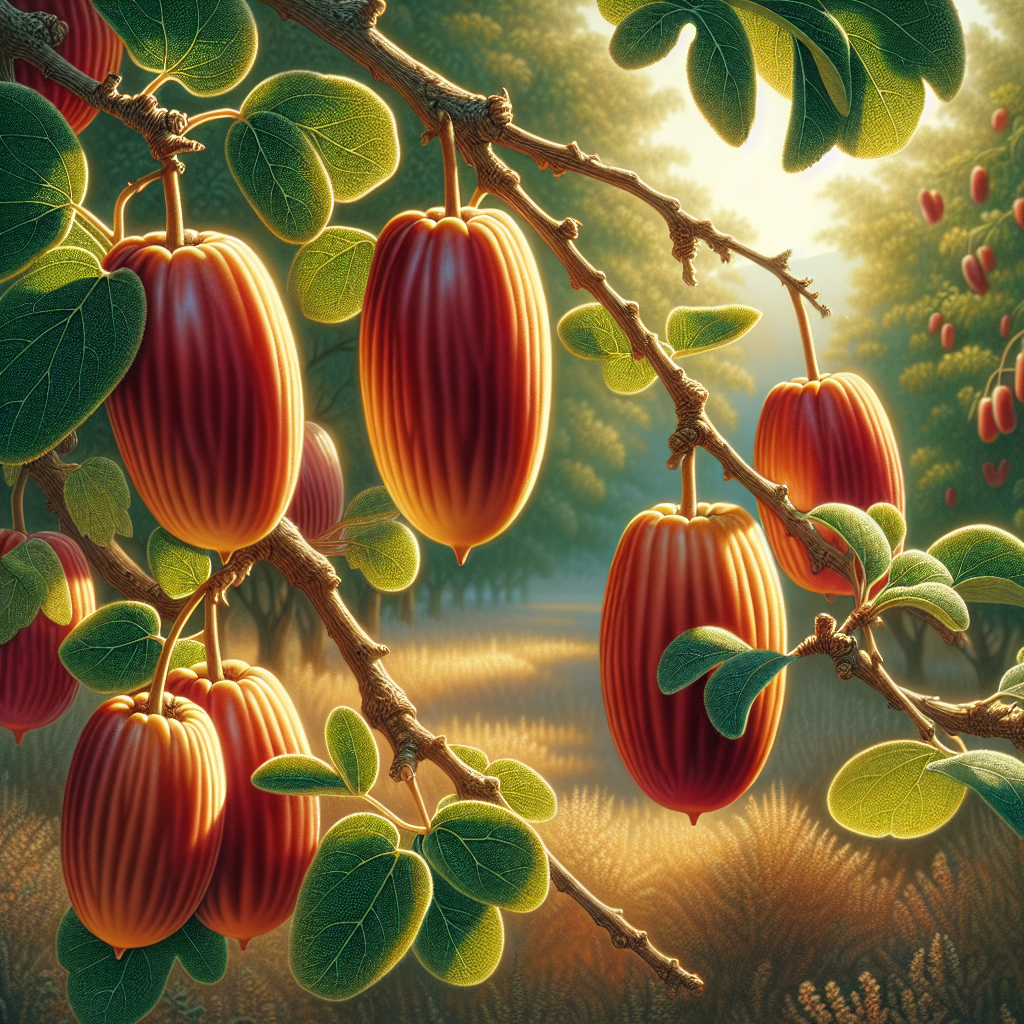
Introduction to Jujube (Lang)
Jujube (Lang), scientifically Ziziphus jujuba 'Lang', stands out as one of the premier cultivars among Chinese jujubes, originating from China's Hebei province. This deciduous tree produces massive fruits—often 5-7 cm long—weighing up to 20-30 grams each, far surpassing typical jujube sizes. The 'Lang' variety is celebrated for its crisp, apple-like texture when fresh and its exceptional drying quality, transforming into sweet, chewy candies that rival commercial dates.
Farmers and orchardists favor Lang jujube for its vigorous growth, reaching 5-8 meters tall with a spreading canopy, and its precocious bearing—often fruiting within 2-3 years from grafting. Yields can exceed 50-100 kg per mature tree annually, with fruits ripening in late summer to fall. Nutritionally, Lang jujubes boast high vitamin C (up to 500 mg/100g fresh weight), antioxidants, and minerals, supporting immune health and digestion. Fig (crop) shares similar drought tolerance and drying potential, making it a complementary orchard choice.
Adaptable to USDA zones 6-10, Lang thrives in neglected soils and extreme heat, positioning it as a low-maintenance cash crop for arid regions. Its thorns deter wildlife, and self-fruitful nature simplifies planting. This guide delivers professional cultivation strategies to maximize Lang jujube productivity.
Botanical Profile of Jujube (Lang)
Ziziphus jujuba 'Lang' belongs to the Rhamnaceae family, a genus encompassing over 100 species, though 'Lang' exemplifies elite Chinese domestication spanning 4,000 years. The tree develops a sturdy trunk with gray-brown bark, thorny branches (thorns up to 3 cm), and pinnate leaves 3-10 cm long, glossy green above and fuzzy beneath. New growth flushes reddish, hardening to olive green.
Flowers emerge in spring as small, greenish-yellow clusters, inconspicuous but highly fertile. 'Lang' is functionally parthenocarpic and self-fertile, though pollinators boost set. Fruits start green, turn yellow-brown to mahogany red at maturity, with a thin skin, firm white flesh, small seed, and sweet-tart flavor peaking at 20-30° Brix.
Root system is deep-tapering with lateral spread, conferring drought resistance. Growth habit is vase-shaped or rounded, ideal for mechanical harvest. Compared to Li jujube or Russian cultivars, 'Lang' excels in fruit size and dry matter (60-70% sugars post-drying). Phenology: leaf-out March-April, bloom May, harvest September-October in northern hemisphere.
Soil, pH, and Climate Requirements for Jujube (Lang)
Lang jujube demonstrates remarkable soil versatility, succeeding in sands, loams, clays—even saline or alkaline conditions up to pH 9.0. Optimal pH ranges 6.0-8.0; test and amend with gypsum for high sodium. Avoid heavy waterlogging; well-drained sites prevent root rot. Incorporate 5-10 tons/ha compost pre-planting to enhance microbial life and water retention.
Climate-wise, Lang endures -25°F (-32°C) winters (zone 6) and 115°F (46°C) summers, with low chill needs (under 500 hours). It flourishes in arid/semiarid zones receiving 300-1000 mm rainfall, tolerating prolonged drought via stomatal closure and deep roots accessing groundwater. Full sun (8+ hours) is essential; windbreaks mitigate thorn damage in gusty areas. For more on building resilient soils, see Soil Health Mastery: 5 Proven Strategies for Small Farms to Build Fertile Ground Without Breaking the Bank.
In humid tropics, ensure airflow to curb fungal issues. Frost pockets harm blooms; elevate plantings. Mulch with 10 cm organic matter conserves moisture, suppresses weeds, and moderates soil temps.
Step-by-Step Planting & Propagation
Propagation: Graft onto Z. jujuba rootstock (e.g., 'MH', 'SS') for vigor; whip-and-tongue or cleft grafts in late winter succeed 90%. Seed propagation yields variable offspring—avoid for 'Lang'. Root cuttings root 70% under mist. Tissue culture scales elite clones.
Site Prep: Select full-sun, well-drained slope. Test soil; adjust pH. Dig 60x60x60 cm pits, enrich with 20 kg compost, 500g superphosphate, 200g potassium sulfate. Space trees 5-6 m apart (hedgerow 4 m), 6-7 m between rows (400-600 trees/ha).
Planting: Bare-root or container trees in dormant season (Feb-March north, Aug south). Orient graft union 10 cm above soil. Stake loosely. Water deeply (50 L/tree), mulch 2 m radius. Initial pruning: head to 80 cm, select 4-6 scaffolds at 45°.
Establishment Year: Irrigate biweekly first summer (30-50 L/tree), withhold to induce deep roots. Fertilize NPK 10-10-10 at 100g/tree monthly. Monitor for aphids.
Care & Maintenance regimes for Jujube (Lang)
Irrigation: Deep, infrequent—20-40 L/tree weekly young trees, tapering to drought post-establishment. Drip systems optimal; deficit irrigation boosts sugars 15-20%.
Fertilization: Annual: 200-500g N, 100-300g P, 300-600g K/tree split spring-fall. Foliar micronutrients (Zn, Fe, B) if chlorosis. Soil test guides; over-N weakens wood.
Pruning: Winter: remove dead/crossing/thin interior for light penetration. Summer: pinch watersprouts, thin fruit clusters (1-2/spur) for size. Dwarfing to 4 m via heading.
Training: Central leader or open vase. Annual thinning sustains 40-50 kg yields. Pollination: plant 'Li' nearby for 20% yield bump.
Weed via mulch/shallow cultivation; cover crops like clover suppress without tillage.
Pests, Diseases & Organic Management
Lang's thick skin and phenology evade many pests. Key threats:
Pests: Scale insects, mealybugs—hort oil dormant sprays, ladybugs. Fruit flies—GF-120 baits, sanitation. Thorns deter birds; nets if severe. Aphids—neem, predatory wasps.
Diseases: Anthracnose, powdery mildew—copper pre-bloom, airflow. Phytophthora root rot—drainage, phosphite drenches. Avoid wet feet.
Organic IPM: monitoring, thresholds (5% infested), bio-controls. Kaolin clay repels borers. Learn more in Why 90% of Small Farms Fail at Pest Management - And 8 Organic Fixes That Actually Work. Resistant rootstocks minimize issues.
Harvesting, Curing & Optimal Storage
Harvest peaks 150-180 days post-bloom when skin wrinkles slightly, flavor peaks. Hand-pick into crates; mechanical shakers viable mature orchards. Yields: 50-80 kg/tree at 8-10 years.
Fresh: Cool to 10°C immediately; store 4-6 weeks at 0-5°C, 90% RH.
Drying: Solar tunnel (55-65°C, 24-48h) or shade-dry 5-7 days to 20% moisture. No sulfites needed—natural enzymes preserve color. Store dried in breathable bags, cool/dark up to 12 months.
Postharvest: Sort, grade (XL >25g premium). Value-add: powders, pastes. Process promptly to avoid fermentation.
Companion Planting for Jujube (Lang)
Lang's thorny canopy suits understory guilds. Beneficials:
Nitrogen-fixers: Pigeon pea, clover—soil fertility.
Pest repellents: Marigold, thyme—nematodes, aphids.
Pollinators: Nasturtium—bees boost set 15%.
Groundcovers: Yarrow—erosion control, predators.
Avoid grasses (water competition), legumes prone root-knot nematodes. Guilds enhance biodiversity, suppress weeds. See Why Companion Planting Feels Like Guesswork for Small Farms - And How AI Makes It Foolproof.