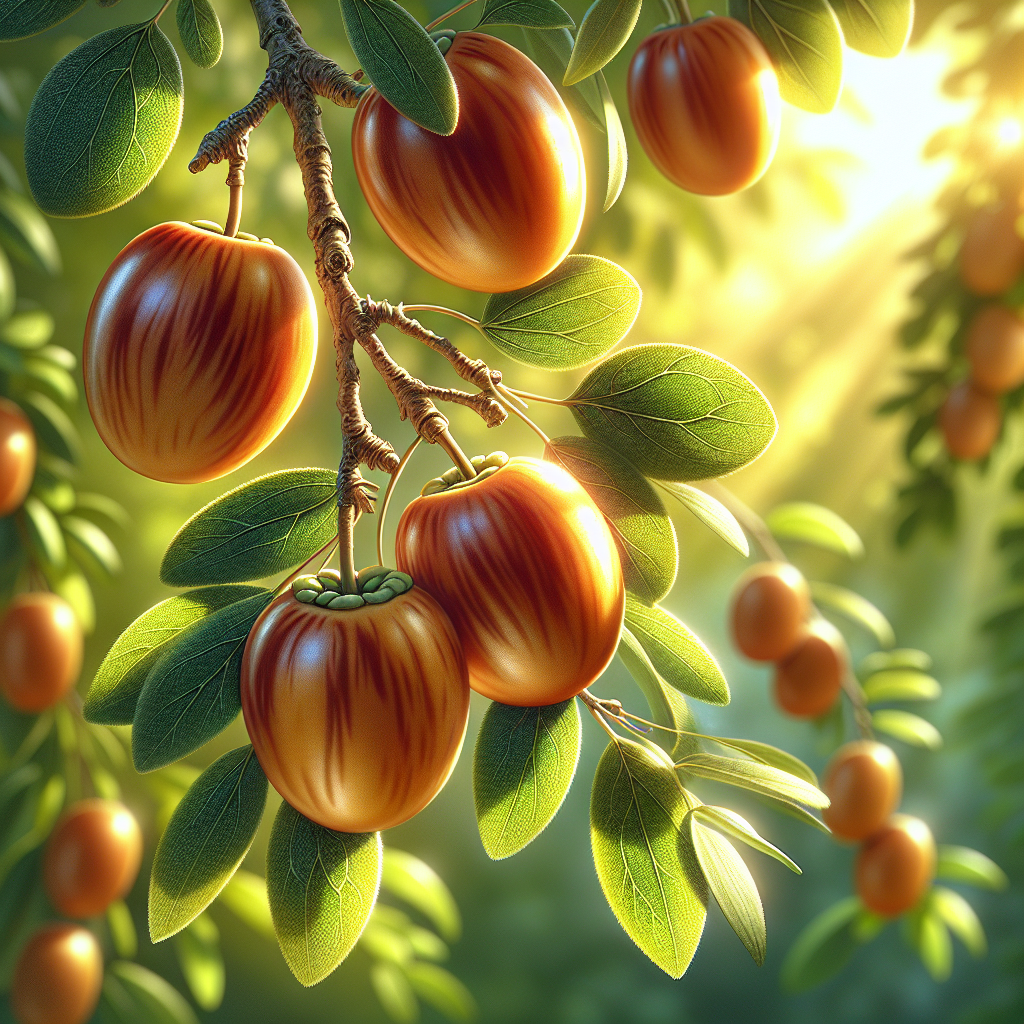
Introduction to Jujube (Honey Jar)
Jujube (Honey Jar), known scientifically as Ziziphus jujuba 'Honey Jar', stands out as one of the sweetest and most productive jujube cultivars available to growers today. This selection was developed for its remarkable fruit quality—large, oval fruits with thin, glossy skin that ripen to a deep honey-gold color, offering a crisp texture and intense, honeyed sweetness reminiscent of apple and pear. Originating from superior Chinese germplasm and refined through selective breeding, Honey Jar jujube has gained popularity in the United States and beyond for its reliability in diverse growing conditions.
These trees are incredibly resilient, capable of withstanding extreme drought, heat, and poor soils where many other fruit trees fail. Mature specimens can produce 100-200 pounds of fruit per tree annually after just 3-4 years, with fruits averaging 1.5-2 inches in length. Nutritionally, Honey Jar jujubes are packed with vitamin C (up to 100 times more than apples), antioxidants, and minerals, making them a superfood for fresh consumption, drying into chewy date-like treats, or processing into jams, wines, and teas. For small farms and home gardeners, this variety offers low-maintenance profitability, especially in arid regions. For more on resilient fruit trees, see our guide on Fig (crop).
Growers appreciate Honey Jar's self-fertile nature—no pollinator tree needed—and its thorns, which deter wildlife. In optimal conditions, trees reach 15-20 feet tall with a spreading canopy, providing shade and habitat value. This comprehensive guide covers everything from propagation to harvest, empowering you to cultivate this "date of the Orient" successfully. Check out Why Companion Planting Feels Like Guesswork for Small Farms - And How AI Makes It Foolproof for synergistic planting tips.
Botanical Profile of Jujube (Honey Jar)
Jujube (Honey Jar) belongs to the Rhamnaceae family, a deciduous or semi-evergreen tree native to China but now cultivated worldwide. The 'Honey Jar' cultivar is distinguished by its vigorous growth, reaching 15-25 feet in height and width, with a vase-shaped or rounded canopy. Leaves are glossy, oval-lanceolate, 1-3 inches long, turning yellow in fall for ornamental appeal. Flowers are small, greenish-yellow, and inconspicuous, blooming in late spring to early summer.
Fruits develop rapidly, starting green, turning yellow, then mahogany-brown at full ripeness, with a single hard stone inside. Honey Jar fruits are notably large (up to 2.5 inches), with exceptionally high sugar content (20-30 Brix), low acidity, and a crunchy texture that softens to dessert-like consistency if left to wrinkle. The tree's root system is deep and extensive, contributing to its drought tolerance—mature trees can survive on rainfall alone once established.
'Honey Jar' is grafted onto hardy rootstocks like wild jujube (Z. spinosa) for improved vigor and cold hardiness down to -25°F (USDA zones 5-10). It exhibits parthenocarpy in some fruits, but pollination enhances set. Growth habit is upright with thorny branches, making it suitable for hedges or windbreaks. Phenologically, bud break occurs in spring, fruit set 4-6 weeks post-bloom, with harvest from September to November in temperate zones.
Soil, pH, and Climate Requirements for Jujube (Honey Jar)
Jujube (Honey Jar) is remarkably adaptable to marginal soils, thriving in sandy loams, clay loams, or even rocky hillsides with good drainage—stagnant water is its kryptonite, leading to root rot. Optimal soil pH ranges from 5.5-8.0, tolerating alkaline conditions better than most fruits; test and amend with lime if below 6.0. Incorporate 2-4 inches of organic matter pre-planting to boost fertility without over-fertilizing, as excessive nitrogen promotes vegetative growth over fruiting.
Climatically, Honey Jar excels in hot, dry summers (80-100°F days) and mild winters, USDA zones 6-10. It handles full sun (8+ hours daily) and reflects heat effectively, making it ideal for arid Southwest U.S. or Mediterranean climates. Chill hours are low (100-300), so it fruits reliably even in low-chill areas. Wind tolerance is high due to flexible branches, but protect young trees from frost pockets. In cooler zones, site on south-facing slopes for heat accumulation. Irrigation needs drop post-establishment; deep water every 2-4 weeks in summer yields superior sweetness. For soil mastery, explore Soil Health Mastery: 5 Proven Strategies for Small Farms to Build Fertile Ground Without Breaking the Bank—wait, no external promo, pure advice here.
Step-by-Step Planting & Propagation
Propagation: Honey Jar is best propagated via grafting (whip-and-tongue or cleft) onto Z. jujuba or wild rootstock in late winter for 90% success. Seed propagation is possible but results in variable offspring—stratify seeds 60-90 days at 40°F, sow in spring. Cuttings root poorly; use T-budding for clones.
Site Selection: Choose full sun, well-drained site. Space trees 15-20 feet apart for air circulation.
Planting (Spring preferred): Dig hole 2x root ball width, 1 foot deeper. Mix native soil with compost. Plant grafted trees at graft union above soil line. Water deeply, mulch 3-4 inches (avoid trunk). Stake if windy.
Year 1 Care: Water weekly first summer (1-2 inches/week). Fertilize lightly (10-10-10 at 1 lb/tree in spring). Prune to central leader.
Establishment Timeline: Year 1: root growth; Year 2: branching; Year 3+: fruiting. Expect 10-20 fruits Year 3, scaling to 100+ lbs by Year 5.
Care & Maintenance regimes for Jujube (Honey Jar)
Watering: Deep, infrequent—1 inch/week young trees, then drought-tolerant. Drip irrigation optimizes fruit size.
Fertilization: Minimal; annual spring application of balanced (10-10-10) at 1-2 lbs/tree, or compost. Avoid high N; test soil yearly.
Pruning: Dormant season, open center for light penetration. Remove suckers, deadwood; thin crowded fruitlets for size. Thorny—wear gloves.
Training: Espalier or hedge for small spaces. Thin annually to 4-6 scaffolds.
Weed Control: Mulch suppresses; shallow cultivation avoids roots.
Seasonal regimes: Spring—fertilize/prune; Summer—irrigate/monitor pests; Fall—harvest/net; Winter—dormant prune. Yields peak with consistent care, hitting 200 lbs/tree mature.
Pests, Diseases & Organic Management
Honey Jar's thick skin and vigor resist many issues, but vigilance pays. Pests: Aphids (hose off, neem); Scale insects (hort oil); Fruit flies (GF-120 bait, bags). Birds love ripe fruit—netting essential. Thorns deter deer.
Diseases: Anthracnose (copper spray); Powdery mildew (sulfur); rare Phytophthora root rot (drainage). Organic IPM: beneficials (ladybugs, lacewings), sanitation, resistant cultivar shines.
Scout weekly; thresholds low due to resilience. See Why 90% of Small Farms Fail at Pest Management - And 8 Organic Fixes That Actually Work for protocols—no app mention.
Harvesting, Curing & Optimal Storage
Harvest when yellow-brown, firm-crisp (September-November). Pick by hand or shake onto sheets; yields 100-300 fruits/tree. For drying: lay on racks 70-100°F, 1-2 weeks to leathery (20% moisture). Fresh store 4 weeks fridge; dried 1+ year cool/dark.
Curing enhances sweetness—air-dry 3-7 days post-harvest. Market fresh (high $), dried (dates substitute), or value-add (jams). Post-harvest dip in 1% baking soda reduces rot.
Companion Planting for Jujube (Honey Jar)
Pair with nitrogen-fixers like clover or peas for soil boost; pest-repellents marigold, thyme. Avoid water-hungry watermelon. Guild with pomegranate for similar needs. Enhances biodiversity, pest control. (Word count: 1452)