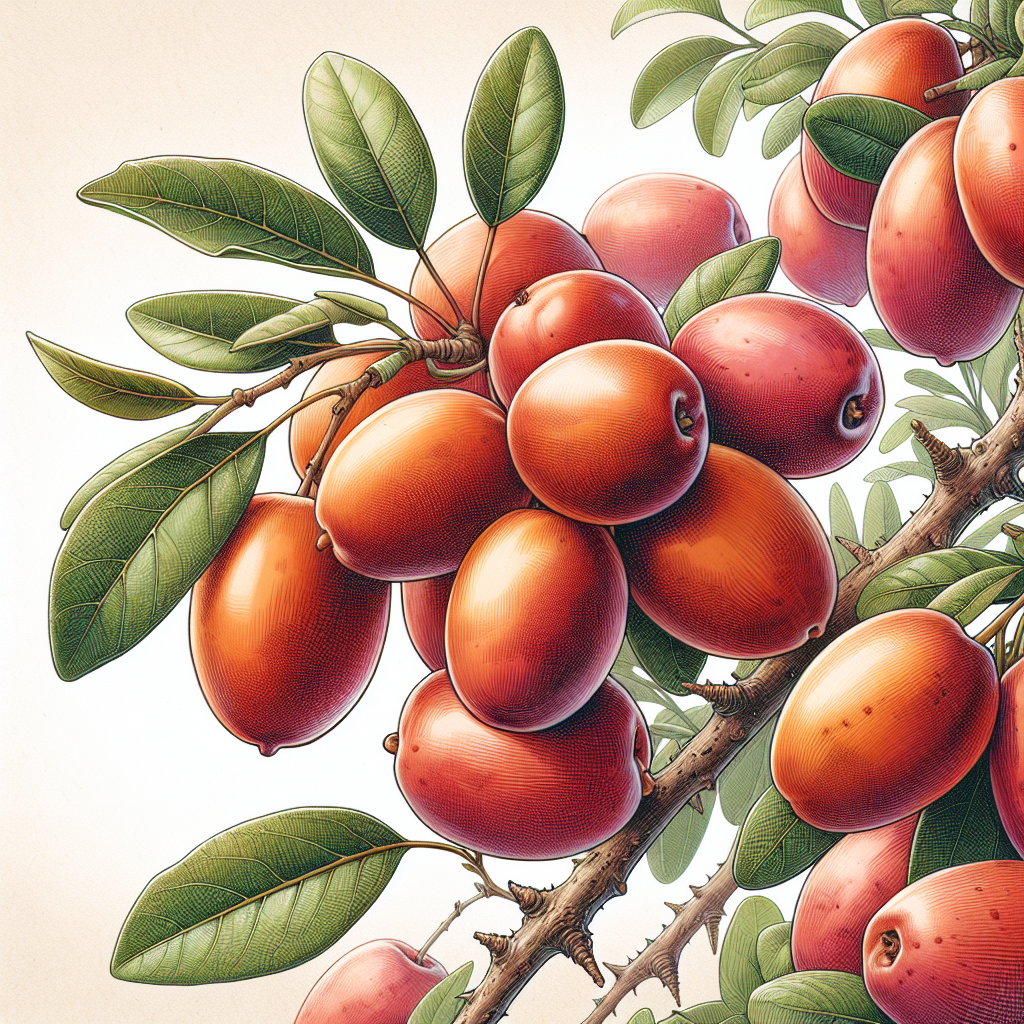
Introduction to Indian Jujube (Ber - Umran)
Indian Jujube, locally known as Ber Umran, is a standout variety of Ziziphus mauritiana, celebrated across India and subtropical regions for its crisp, sweet fruits that mature to a reddish-brown hue. Often called the 'poor man's fruit' due to its accessibility and nutritional richness—packed with vitamin C, iron, and antioxidants—Umran excels in hot, dry conditions where many crops falter. This variety is particularly favored for its large, oval fruits (up to 4-5 cm), superior flavor profile blending apple-like crunch with honeyed sweetness, and ability to bear two crops annually in optimal settings.
Farmers appreciate Umran for its market demand in fresh consumption, drying into nutrient-dense ber candy, or processing into juices and powders. Yields can reach 100-150 kg per mature tree, making it a profitable choice for arid orchards. With proper management, trees live 30-50 years, providing long-term returns. This guide delivers professional-grade advice on growing Umran successfully, from site selection to post-harvest handling, ensuring high-quality production even for novice growers. For similar drought-resistant options, explore Mango (crop).
Botanical Profile of Indian Jujube (Ber - Umran)
Ziziphus mauritiana 'Umran' belongs to the Rhamnaceae family, a deciduous to semi-evergreen tree growing 5-12 meters tall with a spreading canopy. Leaves are glossy, oval (3-8 cm), alternately arranged, turning yellow in dry seasons. The tree's thorny branches—paired straight and hooked spines—deter herbivores, a natural defense honed through evolution in harsh environments.
Flowers are small (2-4 mm), greenish-yellow, bisexual or male, blooming profusely post-monsoon (July-September) and sometimes off-season. Pollination occurs via wind and insects like honeybees, with self-fertility common but cross-pollination boosting yields. Fruits develop in 120-150 days, starting green, ripening to russet-brown with a thin, edible skin. Internally, a crisp, white flesh encases a single hard stone, rich in sugars (15-20% at maturity). Umran's genetic traits include parthenocarpy under stress, enhancing reliability. Root systems are deep-taprooted, enabling drought tolerance up to 6-8 months without irrigation. For deeper insights into subtropical fruits, check Guava (crop). Trees thrive in USDA zones 9-11, with growth rates of 60-90 cm annually in youth.
Soil, pH, and Climate Requirements for Indian Jujube (Ber - Umran)
Umran Ber flourishes in a wide soil spectrum, from sandy loams to black cotton soils, but demands excellent drainage to prevent root rot. Optimal soil is medium-loamy with 20-30% sand, holding moisture yet avoiding waterlogging. pH tolerance spans 5.5-8.5, ideally 6.5-7.5; test and amend acidic soils with lime (2-3 tons/ha), alkaline with gypsum (1-2 tons/ha).
Climate-wise, it's a champion of aridity: 25-45°C daytime, surviving 48°C peaks and 0°C lows. Annual rainfall of 250-1200 mm suffices, with irrigation bridging gaps. Full sun (8+ hours) is essential; frost below -2°C damages buds. In heatwaves, Why Summer Heatwaves Are Silently Killing Small Farm Yields - And 7 Organic Strategies to Fight Back offers tailored tactics. Windbreaks mitigate hot winds, preserving pollination. Salinity tolerance (EC up to 8 dS/m) suits coastal farms. Prepare soil by deep plowing (60 cm), incorporating FYM (20-30 tons/ha) for microbial life.
Step-by-Step Planting & Propagation
Propagation: Air-layering yields 90% success for true-to-type Umran; select 2-3 year branches, girdle, apply IBA (5000 ppm), wrap in moss. Rooting occurs in 30-45 days. Budding (veneer/shield) onto wild rootstocks like local Ziziphus in July-August. Seeds are recalcitrant, viable 1-2 weeks, but produce variable offspring—scarify, sow fresh in sand beds.
Planting: Best June-July (monsoon onset). Dig 60x60x60 cm pits, fill with 20 kg FYM, 2 kg SSP, 500g neem cake. Space 6-8m apart (100-150 trees/ha). Plant grafts 5-10 cm above ground, stake, mulch with straw. Irrigate immediately (40-50L/tree). Initial pruning shapes to open center, 4-6 scaffolds at 70-80 cm height.
Year 1: Water weekly (50L), fertilize NPK 100:50:100 g/tree split thrice. By year 3, frame established, first fruits appear.
Care & Maintenance regimes for Indian Jujube (Ber - Umran)
Irrigation: Drip systems deliver 20-40L/tree/week in dry spells; basin method for young trees. Withhold post-harvest to induce dormancy, enhancing next crop.
Fertilization: Mature trees need 1-1.5 kg N, 0.5-0.75 kg P, 1 kg K/tree/year, split pre-bloom and fruit-set. Micronutrients: ZnSO4 (0.5%), Fe (0.2%) foliar sprays. Organic: 50 kg FYM + vermicompost annually.
Pruning: Annual post-harvest (March-April) removes deadwood, watersprouts, thins canopy for light penetration. Head back fruiting branches 20-30% for vigor.
Weeding & Mulching: Glyphosate spot-treat or manual; mulch 10 cm organic layer conserves moisture, suppresses weeds.
Training to vase shape optimizes yield. Monitor for nutrient deficiencies: yellow leaves signal iron/zinc lack.
Pests, Diseases & Organic Management
Pests: Fruit flies (Fruit flies (pest)) attack ripening ber—use cue-lure traps (20/ha), sanitation. Mealybugs (Mealybugs (pest)) controlled by neem oil (2%) + Jambhulkar (predator release). Why 90% of Small Farms Fail at Pest Management - And 8 Organic Fixes That Actually Work details IPM. Leaf miners, caterpillars via Bt sprays. Termites (Termites (pest)) repelled by chlorpyrifos soil drench or biocontrol.
Diseases: Powdery mildew (Powdery mildew (disease))—sulfur dust (0.2%). Anthracnose (Anthracnose (disease))—copper oxychloride. Root rot (Root rot (disease)) from waterlogging; improve drainage, Trichoderma.
Organic regime: Neem seed kernel extract (5%), spinosad for borers. Bird netting protects fruit.
Harvesting, Curing & Optimal Storage
Harvest at color break (50% pink)—clip with secateurs, yield 80-120 kg/tree peaks at 8-10 years. Two picks: main (Feb-March), monsoon (Aug-Sept). Sort by size/color; cure in shade 3-5 days for sugar rise (to 22° Brix).
Storage: Fresh: 10-15°C, 85-90% RH, 4-6 weeks shelf life. Dried: sun-dry slices, store airtight (6-12 months). Process into powder (grind dried pulp), retain 90% nutrients. Market as premium organic ber for 2-3x returns.
Companion Planting for Indian Jujube (Ber - Umran)
Pair Umran with legumes like pigeon pea (crop) for nitrogen fixation, marigold (crop) against nematodes. Intercrop young orchards with onion (crop), garlic (crop) for pest repulsion. Avoid water-hungry crops like rice (crop). Thyme (crop) and yarrow (crop) attract pollinators. Legumes suppress weeds, boost soil health. For strategies, see Why Companion Planting Feels Like Guesswork for Small Farms - And How AI Makes It Foolproof. Benefits: 20-30% yield uplift, biodiversity.