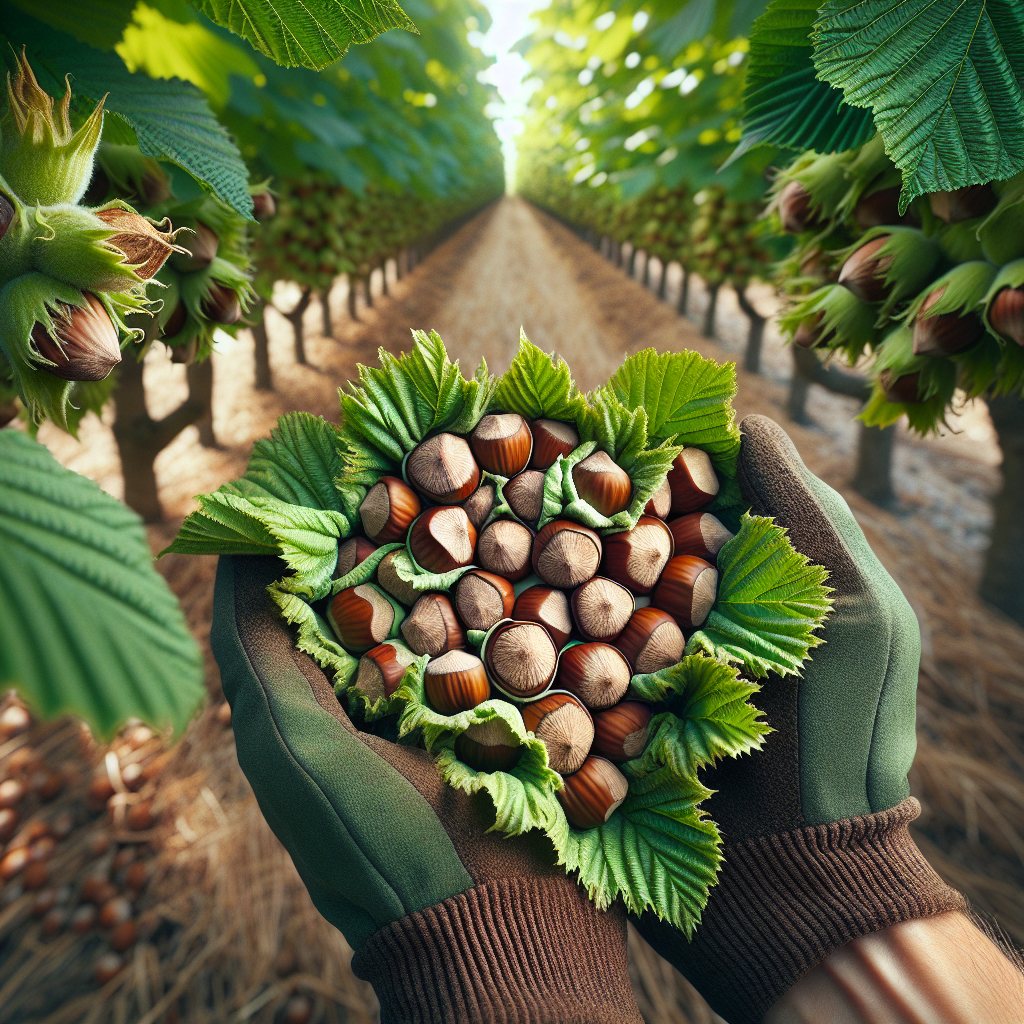
Introduction to Hazelnut (Butler)
A long-established cultivar from the Pacific Northwest hazelnut industry, 'Butler' has been grown primarily for its large, attractive nuts and strong tree vigor. It belongs to the European hazelnut species, which differs from wild American types by producing larger, more marketable kernels but often requiring more attentive orchard management.
Historically, 'Butler' has been appreciated as both a nut producer and as part of pollination planning in mixed orchards. In older plantings it was widely used because it breaks winter dormancy reliably, grows with a fairly upright to spreading habit, and can contribute abundant catkins for pollen shed. Nut quality is generally good, with kernels suited to fresh eating, roasting, and specialty markets. Compared with many modern resistant cultivars, however, its disease profile means growers must site it carefully and monitor closely.
For professional and serious home growers, the key to success is understanding that hazelnuts are neither true low-input hedgerow shrubs nor carefree orchard trees. 'Butler' rewards sound establishment, disciplined pruning, cross-pollination planning, moisture management, and sanitation. If you already grow tree nuts, compare its orchard needs with other nut crops such as Almond, but remember that hazelnut roots and flowering biology are quite different.
A mature planting can remain productive for decades. Trees typically begin bearing modestly in 3 to 5 years after planting, with meaningful production developing by years 6 to 8, depending on rootstock, training system, fertility, and pollination efficiency. Like most hazelnuts, production is strongly influenced by winter chilling, spring weather during bloom, and compatible pollen availability.
Botanical Profile of Hazelnut (Butler)
This cultivar is a selection of Corylus avellana, a deciduous, wind-pollinated nut-bearing shrub or small tree in the family Betulaceae. In orchard form it is usually trained either as a multi-stem bush or, more commonly in modern systems, as a single-trunk small tree with a rounded canopy.
'Butler' is known for vigorous vegetative growth, medium to large canopy development, and production of relatively large nuts. Nut clusters often contain fewer nuts than heavily clustered cultivars, but individual nut size is an advantage where in-shell appearance matters. Husks are moderately sized, and nuts generally release reasonably well at maturity, which helps mechanical harvest where orchard floors are properly prepared.
Leaves are alternate, rounded to broadly oval, doubly serrated, and softly textured. Like other hazelnuts, the plant is monoecious: it bears separate male and female flowers on the same plant. The male flowers are the familiar yellow-brown catkins formed the previous season, while the female flowers are tiny buds showing delicate red stigmas during bloom. Because flowering occurs in late winter to very early spring, reproductive success depends more on winter climate and pollen timing than on summer pollinator activity.
An important nuance for growers is self-incompatibility. 'Butler' cannot be relied upon to set a full crop with its own pollen, and orchards require compatible pollenizer cultivars with overlapping pollen shed and female bloom periods. In practice, this means planting pollinizer rows or interspersed trees rather than establishing a solid block of one cultivar.
Root growth is relatively shallow and fibrous compared with deep-taprooted nut trees. Most active feeder roots are concentrated in the upper soil profile, often the top 20 to 45 cm, which explains why hazelnuts respond quickly to mulch, organic matter, and water stress. It also explains their sensitivity to compaction, standing water, and cultivation damage near the base.
'Butler' may produce basal suckers, especially when young or when stressed. Suckering tendency varies with training system, pruning, and tree vigor, but regular sucker removal is part of standard management. If neglected, the plant can revert to a thicket-like form that reduces airflow, complicates harvest, and diverts energy from nut production.
Soil, pH, and Climate Requirements for Hazelnut (Butler)
This cultivar performs best in deep, fertile, well-drained loam or sandy loam with moderate water-holding capacity. Ideal soils combine oxygen availability with steady moisture. A practical target is a friable profile at least 90 to 120 cm deep, free of hardpans, with organic matter around 3 to 6%. Heavier clay soils can work if they are structured, tiled, or naturally sloped enough to prevent saturation, but poorly drained clay is one of the fastest ways to shorten orchard life.
Preferred soil pH is slightly acidic to neutral, roughly 6.0 to 7.0, with best nutrient balance often occurring around 6.2 to 6.8. At pH below 5.5, aluminum and manganese issues may emerge and calcium/magnesium availability can become limiting. At pH above 7.3, iron, zinc, and manganese deficiencies are more likely, especially in calcareous soils. Correct pH before planting whenever possible, since liming or acidification is much harder once trees are established.
Drainage is critical. Hazelnut roots require oxygen, and 'Butler' is notably less forgiving of wet feet than many growers assume. A soil that remains waterlogged for more than 48 hours after heavy rain creates conditions for root decline, weak shoot growth, chlorotic leaves, and eventual canopy thinning. In professional terms, avoid sites where the seasonal high water table rises into the top 60 cm of soil. If digging a test pit reveals gray mottling, sulfur smell, or persistent seepage, the site is risky unless drains or raised berms are installed.
Climatically, 'Butler' is best adapted to cool-temperate regions with mild to moderately cold winters and relatively dry late summers and harvest periods. It thrives where winter chilling is adequate for normal bloom and where spring temperatures are cool enough to avoid erratic flowering but not so cold that floral tissues are repeatedly damaged. Late-winter catkins can tolerate significant cold, but open female flowers and newly emerging vegetative tissues are more vulnerable to severe freeze events.
Summer heat tolerance is moderate. Trees can endure warm days, but sustained heat above 32 to 35b0C, especially when paired with dry wind and low humidity, increases water demand and may reduce kernel fill. Sunburn on exposed limbs can also occur in hot inland climates if canopies are opened too aggressively.
Annual water demand varies by soil and canopy size, but mature orchard trees commonly need the equivalent of 700 to 1000 mm of water annually from rainfall plus irrigation. The most sensitive periods are leaf expansion, nut sizing, and kernel fill. Soil moisture should be maintained in the moist-but-aerated range, not saturated. In practical terms, the upper 20 to 30 cm should feel cool and slightly cohesive when squeezed, not dusty and crumbly, but also not slick, sticky, or anaerobic.
Wind is another overlooked factor. Because hazelnuts are wind-pollinated, some airflow is helpful at bloom, yet exposed sites with abrasive prevailing winds can break shoots, desiccate catkins, and reduce establishment. Shelterbelts can help, but they should not cast dense shade or block orchard air drainage.
For orchard floor and soil-building ideas, review broader perennial fertility principles in Soil health strategies.
Step-by-Step Planting & Propagation
Start with certified, disease-free nursery stock. For 'Butler', this is especially important because latent disease problems, poor rooting, or mislabeled pollinizers can compromise an orchard before it begins. Most growers establish this cultivar from layered, rooted, or tissue-propagated nursery plants rather than from seed. Seed propagation does not preserve cultivar traits and is unsuitable for true-to-type production.
Choose a site with full sun, good cold-air drainage, and enough room for mowing, harvest, and pruning access. Avoid frost pockets, compacted former livestock lots, and low basins where winter moisture stands. Before planting, sample soil from multiple depths for pH, phosphorus, potassium, calcium, magnesium, boron, and organic matter. Correct major imbalances at least one season before establishment if possible.
Prepare the site by eliminating perennial weeds such as quackgrass, bindweed, blackberry, or dock. Hazelnuts establish slowly when they must compete with aggressive weeds for nitrogen and shallow soil moisture. A clean strip 1 to 1.5 m wide along the tree row is ideal at planting. In commercial systems, between-row sod is common, but the tree row itself should be protected from weed competition for at least the first 3 to 5 years.
Plant during dormancy, usually late fall in mild-winter regions or late winter to early spring where soils freeze hard. Container plants can be planted over a wider window, but dormant bare-root stock often establishes best if roots are kept moist and planted before budbreak. Do not allow roots to dry even briefly in sun or wind.
Dig a planting hole wide enough to spread roots naturally without J-rooting. Depth matters more than width: place the root collar at the same depth it grew in the nursery, or slightly high in heavy soils to allow settling. Deep planting can encourage crown problems and weak establishment. Backfill with native soil rather than a rich amended pocket, which can discourage outward root exploration.
Water immediately after planting to settle soil around roots. A typical first watering is 10 to 15 liters per plant for bare-root stock, more for larger container plants, depending on soil texture. Apply 5 to 10 cm of organic mulch, keeping it 8 to 10 cm away from the trunk to prevent crown rot and vole damage. Wood chips are especially useful because they moderate moisture and temperature while gradually feeding soil biology.
Spacing depends on training system and equipment. Traditional bush systems may use roughly 4 to 5 m between plants and 5 to 6 m between rows. Single-trunk orchard systems often range from 4.5 x 5.5 m to 5 x 6 m. In fertile soils, wider spacing improves light penetration and reduces long-term pruning pressure.
Pollination planning is essential. Include compatible pollenizers within effective wind range, usually by planting every third row or every eighth to tenth tree depending on orchard layout and bloom overlap. Because female bloom and pollen shed timing can shift with weather, many growers prefer more than one pollenizer cultivar for insurance.
Initial training should begin in the first dormant season. If growing as a single trunk, select the strongest upright stem and remove competing basal shoots. Stake lightly if needed in windy sites, but avoid rigid ties that abrade bark. If using a bush system, retain 3 to 5 strong basal stems and remove weak, inward, or crowded shoots.
Propagation at the farm scale is usually by stool layering or rooted suckers taken from true-to-type mother plants, but this should only be attempted where disease status is known. Commercial nursery propagation remains the safer route.
Care & Maintenance regimes for Hazelnut (Butler)
Irrigation must be matched to root depth, soil texture, and stage of growth. In the first year, water often enough to keep the root zone uniformly moist to a depth of roughly 20 to 30 cm. In sandy soils this may mean 1 to 2 deep irrigations per week during dry periods; in loams, every 7 to 10 days may suffice. By year three and beyond, mature trees should be watered deeply enough to moisten 45 to 60 cm of soil, then allowed slight surface drying between irrigations.
The goal is not constant wetness. Overwatered 'Butler' trees often show pale leaves, soft succulent growth, weak extension growth late in the season, and reduced soil smell from healthy earthiness to sour anaerobic odor. At the surface, mossy crusting, persistent mud around emitters, fungus gnat activity, or blackened feeder roots are warning signs. Underwatering, by contrast, appears as dull foliage, leaf edge scorch during summer, reduced shoot growth, small nuts, poor kernel fill, and early leaf drop.
Drip or micro-sprinkler systems are preferred. Drip allows precise moisture control and drier canopies, while micro-sprinklers can support broader root-zone development in coarse soils. Use soil moisture checks rather than guesswork. A practical benchmark is to avoid letting tensiometer readings in the main root zone climb into severe stress levels during nut fill. In non-instrumented plantings, a hand-dug inspection hole is still one of the best tools.
Fertilization should be based on leaf tissue and soil tests, but young trees generally benefit from modest nitrogen split into spring applications once active growth begins. Excess nitrogen is a common mistake: it promotes overly vigorous, disease-prone wood and delays hardening before winter. As a guide, young nonbearing trees may receive light annual nitrogen doses, while mature bearing trees require higher total amounts adjusted for vigor and crop load. Phosphorus and potassium should be corrected according to test results, not applied blindly.
Boron deserves special attention because hazelnuts can be sensitive to deficiency, which may impair nut set and kernel development. However, the margin between deficiency and excess is narrow, so use tissue analysis before application. Zinc may also be needed in high-pH soils.
Pruning aims to maintain light distribution, airflow, and renewal wood without triggering excessive regrowth. In single-trunk systems, remove suckers several times during the growing season and thin crowded interior branches during dormancy. Mature trees benefit from periodic removal of low, shaded, or crossing limbs. The best canopy admits dappled light through the center but is not opened so severely that scaffold limbs become sunburned.
Sucker management is especially important in 'Butler'. Remove basal shoots while still small, ideally by hand or with clean cutting tools before they lignify. Large, repeatedly cut suckers stimulate more regrowth and create rough crowns. Keep cuts close and clean, but do not gouge the crown tissue.
Orchard floor management influences both vigor and harvest quality. Maintain a firm, smooth surface under the canopy if nuts will be mechanically swept or vacuumed. Control weeds in the tree row, mow alleys regularly, and prevent ruts. Living groundcovers can improve infiltration and trafficability, but overly competitive grasses near the trunk reduce growth and nut size.
During the juvenile years, remove nuts if a very young tree attempts to carry a heavy crop before framework establishment. This is rarely necessary in moderate plantings but can help weak trees invest in structure rather than early yield.
Pests, Diseases & Organic Management
The most important disease consideration for 'Butler' is Eastern Filbert Blight, caused by Anisogramma anomala. In regions where the pathogen is present, this cultivar is generally considered vulnerable, and that vulnerability strongly influences whether it is suitable at all. The disease causes elongated cankers on branches, often with rows of raised black stromata. Over time, infected limbs die back, canopy productivity declines, and unmanaged trees may become uneconomical.
Organic management begins with prevention: start with clean stock, avoid planting in known high-pressure sites, and scout during dormancy when cankers are easiest to see. Prune infected wood well below visible symptoms, disinfect tools between suspect trees, and destroy prunings. Good airflow and moderate vigor help, but sanitation alone may not fully protect susceptible orchards in severe blight regions.
Bacterial Blight can also damage hazelnuts, especially after cold, wet weather and excess nitrogen. It appears as dead buds, shoot dieback, cankers, and blighted young tissue. Avoid late-season nitrogen, reduce mechanical injury, and prune out affected material during dry weather.
Root Rots and crown disorders are usually site-related. Trees in wet depressions may decline gradually, showing sparse leaves, weak growth, and branch dieback. Once root systems are badly compromised, correction is difficult; prevention through drainage and irrigation discipline is the real cure.
Common insect pests vary by region but may include Aphids, Filbertworm, Stink Bugs, Scale Insects, Leafrollers, and Mites. Aphids can reduce vigor and promote honeydew accumulation, though natural predators often keep them in check if broad-spectrum sprays are avoided. Filbertworm is a direct nut pest whose larvae feed within developing nuts, reducing marketability. Stink Bugs can cause blank nuts or kernel defects through feeding injury.
Organic control depends on integrated timing. Monitor catkins, leaves, and nuts regularly. Use pheromone or species-specific trapping where available for timing, encourage beneficial habitat, and maintain orchard sanitation by removing mummy nuts and dropped debris that harbor pests. Border weeds that host bug populations should be managed, but not in a way that eliminates all flowering insectary plants at once.
Birds and squirrels can become major preharvest thieves. In small plantings, trunk guards, exclusion netting, and prompt harvest are the most practical tactics. In larger orchards, habitat management and rapid nut pickup reduce losses.
For beneficial insect support, flowering companions such as Yarrow and Clover can be valuable in adjacent strips or alley edges, provided they are managed to avoid excessive competition at the trunk line. Thyme also works well in drier borders where low-growing aromatic habitat is desired.
Harvesting, Curing & Optimal Storage
Harvest timing is determined by nut maturity, husk drying, and natural nut drop. 'Butler' is typically harvested when the involucre begins to brown and dry and nuts fall readily to the orchard floor or can be shaken free with minimal force. Harvesting too early reduces kernel fill and storage life; too late increases losses to wildlife, rain, mold, and soil staining.
In small plantings, gather nuts every few days during drop. In orchard systems, nuts are usually swept into windrows and collected mechanically once enough have fallen. A clean, short orchard floor is essential. Wet, muddy ground contaminates nuts and encourages spoilage.
After harvest, remove leaves, twigs, empty husks, and visibly damaged nuts. Sound nuts should then be cured promptly. Spread them in a thin layer no more than a few nuts deep in a warm, shaded, well-ventilated place. Ideal curing conditions are roughly 20 to 30b0C with strong airflow and low ambient humidity. Stir daily for even drying. Depending on conditions, curing may take 2 to 4 weeks.
Properly cured in-shell hazelnuts should feel lighter, and kernels should be crisp rather than rubbery. If you crack test samples and the kernel membrane seems damp or the nutmeat bends instead of snapping cleanly, drying is incomplete. Excessive curing heat should be avoided because it degrades flavor and oils.
Long-term storage hinges on reducing moisture and keeping nuts cool. In-shell nuts store best at low humidity and temperatures near 0 to 5b0C. Shelled kernels are more perishable because their oils oxidize faster; refrigerate or freeze them in airtight containers. Rancidity is accelerated by warmth, light, and oxygen exposure. Any musty odor suggests mold risk, and nuts with off flavors should be discarded.
Commercial growers should also separate lots by quality: premium in-shell, shelling grade, damaged nuts, and culls. This improves market consistency and helps identify field blocks with recurring problems such as poor fill or pest injury.
Companion Planting for Hazelnut (Butler)
The best companions are not those that crowd the root zone, but those that support soil structure, beneficial insects, and orchard access. Hazelnut roots are shallow and responsive, so companion species should usually occupy alleyways, pollinator strips, or outer dripline zones rather than the trunk base itself.
Clover is one of the most useful companions because it functions as a low-growing living mulch, moderates erosion, and contributes biologically fixed nitrogen when managed properly. It is especially effective in alley systems where traffic is moderate. Keep it mowed and prevent dense growth from creeping into the immediate trunk zone of young trees.
Yarrow is excellent in insectary strips. Its umbels attract hoverflies, parasitic wasps, and other beneficial insects that help regulate Aphids and small caterpillars. It is drought-tolerant once established and does not usually become as aggressively competitive as taller meadow plants.
Thyme works best in warm, well-drained edge plantings, rock borders, or row ends. Its low canopy reduces weed pressure in narrow spaces and its flowers support pollinators and predatory insects. It is less suitable as a full orchard-floor cover in cool, wet soils but useful in designed agroecological margins.
Other compatible support species can include annual insectary strips and grass-legume mixes, but avoid tall, dense species that shade the lower canopy or create rodent habitat near trunks. Also avoid heavy-feeding vegetables directly under hazelnuts, where root competition and irrigation conflicts are common. Companion planting in orchards is most successful when it complements mowing, harvest equipment, and disease airflow rather than simply maximizing plant diversity.