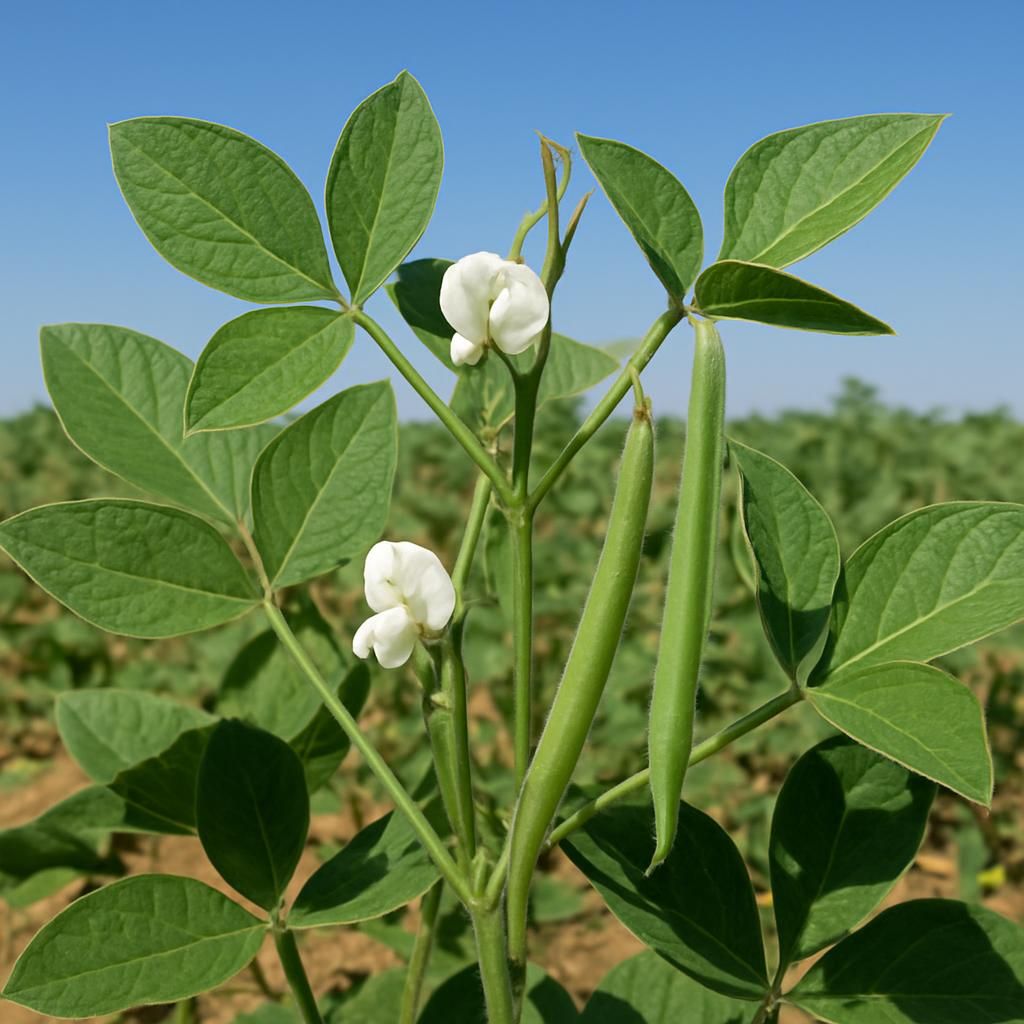
Introduction to Guar Gum
Guar Gum, derived from the seeds of Cyamopsis tetragonoloba, serves as a versatile industrial hydrocolloid and food additive valued for its exceptional thickening, stabilizing, and emulsifying properties. Originally domesticated in the Indian subcontinent, the crop now supports global supply chains for dairy alternatives, gluten-free baking, drilling fluids, textiles, and pharmaceuticals. Its resilience in hot, dry climates and ability to fix atmospheric nitrogen make it an attractive rotation crop for sustainable dryland farming systems.
Commercial cultivation centers on semi-arid zones where annual rainfall ranges from 300–500 mm, supplemented by residual soil moisture. Farmers appreciate guar’s short 90–120 day cycle and low external input requirements, which translate to favorable cost-to-benefit ratios in marginal lands. The crop’s deep taproot system improves soil structure and moisture infiltration for subsequent plantings.
Botanical Profile of Guar Gum
Cyamopsis tetragonoloba belongs to the Fabaceae family and exhibits an erect, bushy growth habit reaching 60–150 cm in height. The plant produces trifoliate leaves with serrated margins and small, white-to-purple papilionaceous flowers borne on axillary racemes. Following pollination, long, slender pods develop, each containing 5–12 hard, light-brown seeds rich in endosperm galactomannan gum.
The seeds comprise approximately 30–35% endosperm, 25–30% protein, and 35–40% fiber and other constituents. The endosperm fraction yields 80–85% pure guar gum upon mechanical separation and purification. Root nodules formed in symbiosis with Rhizobium species enable biological nitrogen fixation rates of 30–60 kg N ha⁻¹, reducing synthetic fertilizer dependency in rotations with Wheat or Sorghum.
Soil, pH, and Climate Requirements for Guar Gum
Guar thrives on well-drained sandy-loam to loam soils with good aeration and moderate fertility. Heavy clay soils impede root development and increase disease risk, while saline or waterlogged conditions severely limit stand establishment. Optimal soil organic matter content lies between 0.8–1.5%.
| Parameter | Ideal Range | Notes |
|---|---|---|
| Soil Type | Sandy loam to loam | Avoid heavy clays and compacted soils |
| Soil pH | 7.0–8.5 | Slightly alkaline conditions preferred |
| Temperature (Day) | 25–35 °C | Optimal vegetative growth |
| Temperature (Night) | 15–22 °C | Supports flowering and pod set |
| Annual Rainfall | 300–500 mm | Supplemental irrigation if <250 mm |
| Relative Humidity | 40–60% | Low humidity reduces disease pressure |
| Altitude | 0–1,000 m | Performs well up to 1,200 m in tropics |
Step-by-Step Planting & Propagation
Seed Selection and Treatment: Choose certified seed of high-germination varieties such as RGC-1002 or HG-365. Treat seeds with Rhizobium inoculant specific to guar at 5 g kg⁻¹ seed plus 2 g kg⁻¹ Trichoderma viride for early disease suppression.
Land Preparation: Perform two to three cross-ploughings followed by harrowing to achieve a fine, firm seedbed. Incorporate well-decomposed farmyard manure at 5–8 t ha⁻¹ during the final ploughing.
Sowing Time: In India and similar subtropical zones, sow with the onset of monsoon rains between June and July. In arid regions with irrigation, a second window exists in February–March.
Method and Spacing: Use a seed drill or behind-the-plough sowing at 3–4 cm depth. Maintain row spacing of 30–45 cm and plant-to-plant distance of 10–15 cm, achieving a plant population of 250,000–300,000 plants ha⁻¹.
Seed Rate: Apply 15–20 kg ha⁻¹ of good-quality seed. Increase rate to 25 kg ha⁻¹ under broadcast sowing to compensate for uneven distribution.
Care & Maintenance regimes for Guar Gum
Guar requires minimal intervention once established. Early weed competition can reduce yields by 30–40%, necessitating timely intercultural operations. Irrigation should be scheduled carefully to avoid waterlogging.
| Growth Stage | Irrigation Schedule | Fertilizer Application | Pruning / Other Operations |
|---|---|---|---|
| Pre-sowing | None; ensure field capacity at sowing | Basal: 20 kg N, 40 kg P₂O₅, 20 kg K₂O ha⁻¹ | Incorporate FYM; level field |
| Vegetative (0–30 DAS) | One light irrigation at 20–25 DAS if dry spell occurs | Top-dress 10–15 kg N ha⁻¹ at 25 DAS | First weeding/hand hoeing at 20–25 DAS |
| Flowering (30–50 DAS) | Second irrigation at 40–45 DAS | Foliar spray of 2% DAP + micronutrients | Second weeding at 40 DAS; monitor for pests |
| Pod Development (50–90 DAS) | Withhold irrigation 15 days before harvest | None | No pruning required; avoid mechanical damage |
Pests, Diseases & Organic Management
Key insect pests include Jassids, Aphids, and Pod borers. Early infestations of jassids cause leaf yellowing and stunted growth; weekly scouting and neem-based sprays (Azadirachtin 0.03% at 3 ml L⁻¹) provide effective control. Pod borers can be managed with pheromone traps at 8–10 traps ha⁻¹ combined with HaNPV sprays.
Major diseases encompass Alternaria leaf spot, Fusarium wilt, and charcoal rot. Crop rotation with non-host cereals every 2–3 seasons, seed treatment with Trichoderma, and removal of crop residues reduce inoculum levels. Resistant varieties and timely sowing further mitigate losses.
Harvesting, Curing & Optimal Storage
Harvest when 80–90% of pods turn brown and seeds rattle inside. Use sickles for manual harvesting or combine harvesters fitted with reel attachments for larger fields. Thresh immediately and sun-dry seeds to 8–10% moisture content.
Store cleaned seeds in jute or polypropylene bags elevated on wooden pallets inside well-ventilated godowns. Maintain ambient temperature below 30 °C and relative humidity under 65% to preserve germination and gum quality. Periodic fumigation with aluminum phosphide prevents storage pests such as Bruchids.
Companion Planting for Guar Gum
Guar integrates well with cereals and oilseeds in intercropping systems. Pairing with Pearl Millet or Sorghum in 2:1 or 4:2 row ratios boosts land-use efficiency and provides early cash flow from millet grain. Intercropping with Sesame or Sunflower suppresses weeds and diversifies income.
Border plantings of Marigold deter nematodes and attract beneficial insects, while under-sowing Clover after guar harvest improves soil nitrogen for the next season. Avoid planting near solanaceous crops to limit shared disease cycles.