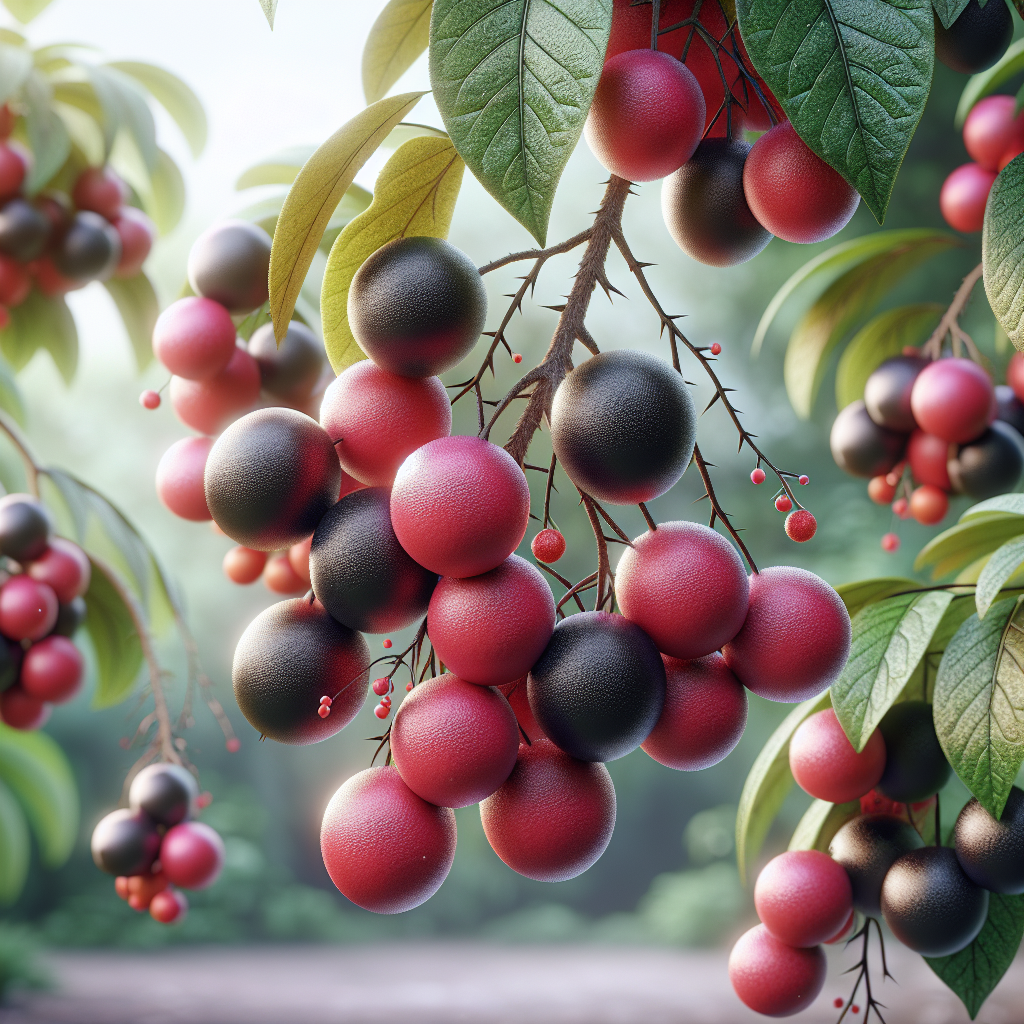
Introduction to Governor’s Plum (Flacourtia indica)
Governor’s Plum (Flacourtia indica), a resilient member of the Salicaceae family, stands out as a tropical powerhouse for small farms and home gardens. Native to India, Madagascar, and Southeast Asia, this thorny shrub or small tree reaches 3-10 meters tall, producing clusters of cherry-sized fruits that ripen from green to deep red or purple-black. With a sweet-tart flavor reminiscent of Plum (crop), these fruits are packed with antioxidants, vitamin C, and minerals, making them ideal for fresh consumption, juices, jams, jellies, and even wines.
What sets Governor’s Plum apart is its extraordinary adaptability. It flourishes in neglected soils where other crops fail, tolerating drought, heat, and poor fertility while serving as a living fence due to its sharp spines. Yields begin in 2-3 years from seed, with mature plants producing 20-50 kg of fruit annually per tree. For small-scale growers, it represents low-maintenance income: fruits fetch premium prices in niche markets, and the plant’s nitrogen-fixing tendencies enhance soil health. Discover more in Why Companion Planting Feels Like Guesswork for Small Farms - And How AI Makes It Foolproof, which touches on integrating hardy species like this.
This deep-dive guide equips you with professional-grade techniques for propagation, care, pest management, and harvest, ensuring bountiful crops even in challenging conditions. Whether establishing a hedgerow or orchard, Governor’s Plum delivers reliable returns with minimal inputs.
Botanical Profile of Governor’s Plum (Flacourtia indica)
Flacourtia indica is an evergreen to semi-deciduous shrub or small tree classified in the Salicaceae (formerly Flacourtiaceae) family. It features a dense canopy of glossy, elliptical leaves (5-15 cm long) arranged alternately, with prominent veins and serrated margins. Young branches bear 1-2 cm spines, ideal for natural barriers, while older wood becomes less thorny.
Flowers emerge year-round in small axillary clusters: male and female on separate plants (dioecious), though hermaphroditic forms exist. Tiny (3-5 mm), greenish-white blooms attract pollinators like bees and flies. Fruits develop post-pollination, maturing in 2-3 months into globose drupes (1-2 cm diameter) with 4-12 seeds embedded in juicy, edible pulp. Skin turns crimson to black when ripe, with a single pit-like stone.
Growth habits vary: in fertile soils, it forms a spreading tree up to 10 m; in dry areas, a compact shrub of 3-5 m. Root systems are deep and extensive, aiding drought resistance. Phenologically, it fruits 2-3 times yearly in tropics, with peak seasons tied to monsoons. Nutritionally, 100g fresh fruit provides 50-70 kcal, 1-2g protein, 10-15g carbs, and exceptional vitamin C (up to 50mg). Leaves and bark offer medicinal uses in traditional systems for treating diarrhea and inflammation.
Soil, pH, and Climate Requirements for Governor’s Plum (Flacourtia indica)
Governor’s Plum epitomizes toughness, thriving in USDA zones 9b-11, with daytime temperatures of 25-40°C (77-104°F) and minimal frost tolerance (down to -2°C briefly). Ideal climates feature 800-2000 mm annual rainfall, but it endures prolonged dry spells via deep roots accessing groundwater. Full sun (6-8+ hours) is essential; partial shade reduces yields by 30-50%.
Soil preferences lean toward well-drained loams or sandy loams, but it pioneers red laterites, gravels, and even saline patches where Mango (crop) struggles. pH tolerance spans 5.0-8.5, with optima at 6.0-7.5; acidic soils enhance fruit acidity, alkaline ones boost size. Avoid waterlogging—heavy clays need raised beds or mounding (30-50 cm high).
Soil prep: Test for nematodes and amend with 5-10 kg FYM (farmyard manure) per pit. Mulch with dry leaves or straw (10 cm thick) to conserve moisture and suppress weeds. In arid zones, integrate with drip irrigation for establishment. Heatwaves? Refer to strategies in Why Summer Heatwaves Are Silently Killing Small Farm Yields - And 7 Organic Strategies to Fight Back—Governor’s Plum’s resilience shines here.
Step-by-Step Planting & Propagation
Propagation Methods:
- Seeds (Easiest, 70-90% germination): Extract from ripe fruits, wash off pulp, dry 2-3 days. Sow in 1:1:1 sand-soil-FYM mix, 1 cm deep, at 25-30°C. Germinate in 10-20 days. Transplant at 15-20 cm height (3-4 months).
- Cuttings (Faster fruiting): Semi-hardwood 15-20 cm cuttings (June-July), dip in 0.1% IBA, plant in sand-perlite under mist. Root in 4-6 weeks (60% success).
- Grafting (Uniformity): Approach-graft onto seedling rootstock; veneer grafting works in rainy season.
- Air-layering: For instant trees; girdle branches, apply rooting hormone, bag with moist moss—ready in 6-8 weeks.
Planting Steps:
- Site prep: Pits 60x60x60 cm, 4-5 m apart (hedge: 2-3 m). Fill with topsoil + 10 kg FYM + 100g SSP + 50g neem cake.
- Plant at onset of monsoon; stake young trees.
- Initial water: 20-30 L/week until established (6 months).
- Density: 200-400 trees/ha orchard; 1000+/ha hedge. Expect first fruits in 18-24 months from cuttings.
Care & Maintenance regimes for Governor’s Plum (Flacourtia indica)
Irrigation: Deep, infrequent—weekly 40-50 L mature tree in dry season; drought-hardy post-year 2. Fertilization: Year 1: NPK 200:150:200 g/tree split 3x. Mature: 500g urea + 300g SSP + 200g MOP annually. Foliar CaNO3 boosts fruit set. Pruning: Annual post-harvest: Remove deadwood, water sprouts; train to single trunk or coppice for bush form. Thin canopy for light penetration. Weeding/Mulching: Hand-weed quarterly; organic mulch retains 30% more soil moisture. Training: Espalier for small spaces; pollard for hedges.
Seasonal calendar: Monsoon—growth flush; dry—fruit swell; winter—minimal dormancy. Intercrop with legumes year 1 for nitrogen. Yields peak at 5-7 years, sustainable 20+ years.
Pests, Diseases & Organic Management
Key Pests: Aphids (pest) cluster on new growth—blast with water, neem oil (0.5%). Fruit flies pierce ripening drupes—bagging clusters or pheromone traps. Leafhoppers (pest) cause stippling—yellow sticky traps + kaolin clay. Mealybugs on stems—alcohol swabs, ladybugs.
Diseases: Anthracnose (disease) in humid areas: copper oxychloride sprays. Powdery mildew (disease)—sulfur dust. Root rot in wet soils—improve drainage, Trichoderma drench.
Organic IPM: Monitor weekly; release predatory beetles. For details, see Why 90% of Small Farms Fail at Pest Management - And 8 Organic Fixes That Actually Work—adapt for thorns. Neem seed kernel extract (5%) every 15 days preventatively.
Harvesting, Curing & Optimal Storage
Harvest when fruits soften, color fully develops (2-3 months post-bloom). Pick clusters by hand, avoiding spine pricks; yield 10-20 fruits/cluster. Optimal Brix: 12-18°.
Post-Harvest: Sort, grade; hydrocool to 10°C. For jams, destone via pulper. Storage: Fresh: 7-10 days at 8-12°C, 85-90% RH (lose 5% weight/week). Processed: Jams shelf-stable 12 months; dried slices last 6 months vacuum-sealed. Market Tips: Sell fresh locally; value-add as pickles or syrup. Minimal curing needed—immediate use preserves vitamin C.
Companion Planting for Governor’s Plum (Flacourtia indica)
Leverage Governor’s Plum’s hedge role: Pair with Guava (crop) for windbreaks, Thai Basil (crop) to deter flies. Underplant Clover (crop) for nitrogen, Marigold (crop) against nematodes. Avoid water-hungry crops like Watermelon (crop). Benefits: Pest repulsion (basil oils), soil enrichment, microclimate moderation. Intercrop Ginger (crop) in shade for dual yields. Read Fall Companion Planting Guide: Boost Yields and Soil Health for Small Farms and Gardens for seasonal synergies.