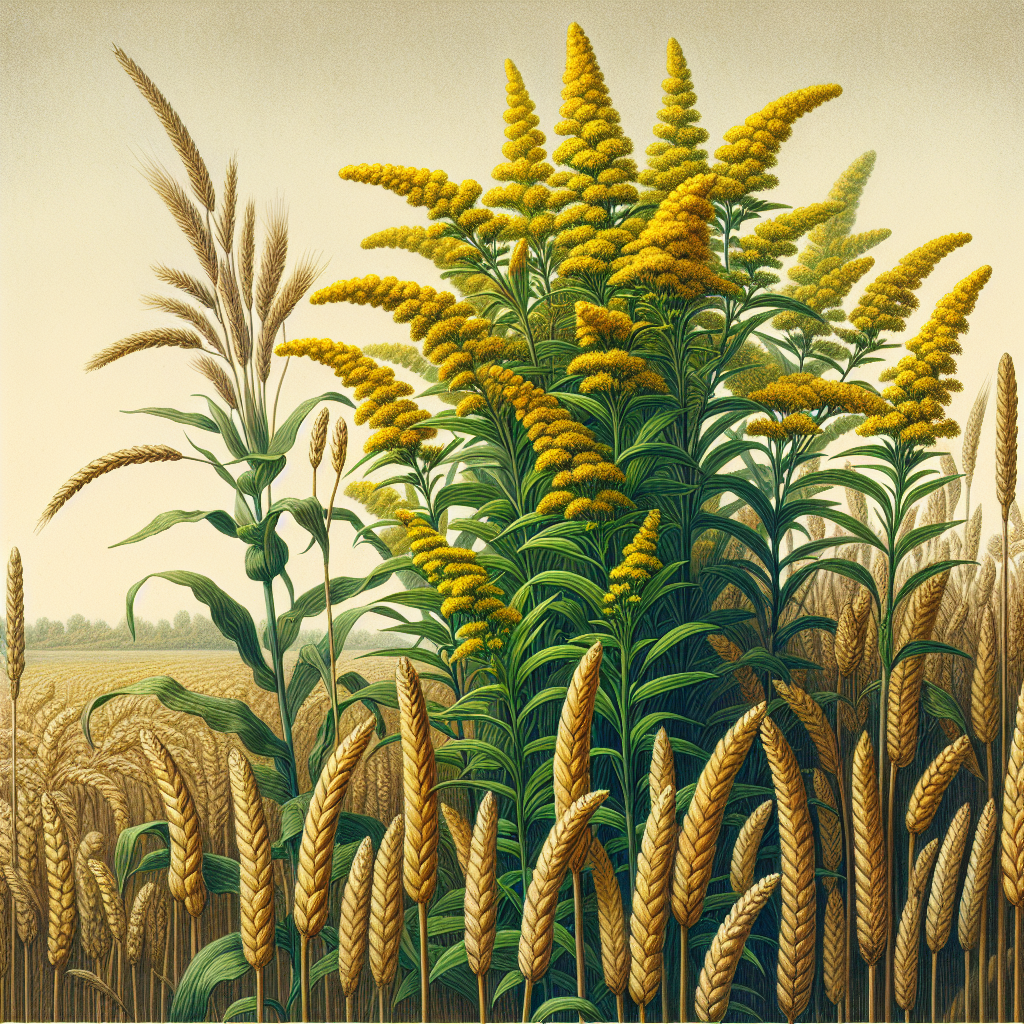
Introduction to goldenrod
Goldenrod represents one of the most pervasive weeds in temperate agricultural regions worldwide, belonging to the Solidago genus in the Asteraceae family. Native to North America and Europe, this perennial herb thrives in disturbed soils, rapidly colonizing fields, roadsides, pastures, and fallow lands. While admired in wildflower meadows for its golden blooms in late summer to fall, goldenrod poses severe threats to crop productivity as an invasive weed. It forms dense stands that smother desirable plants, compete aggressively for resources, and serve as hosts for pests like aphids and diseases such as leaf spot diseases.
In agricultural settings, goldenrod reduces forage quality in hayfields, contaminates grain harvests with its seeds, and lowers land values through infestation. Its deep rhizomatous root system makes it notoriously difficult to eradicate, often requiring integrated management over multiple seasons. Farmers report yield losses of 20-50% in heavily infested wheat and corn fields, underscoring the need for proactive control. This comprehensive guide equips growers with professional diagnostic tools, lifecycle understanding, and organic strategies proven effective across small farms and commercial operations. For small farms battling identification challenges, check out Why Misidentifying Plants Costs Small Farms Thousands - And How AI Camera Diagnosis Fixes It Fast to streamline your weed management.
Goldenrod's impact extends beyond direct competition; its pollen can trigger allergies in livestock, and its tough stems reduce hay palatability. Early detection and consistent management are critical, especially in organic systems where chemical options are limited. Understanding its biology empowers farmers to implement targeted controls that preserve soil health while restoring productivity.
Identifying Symptoms & Damage
Goldenrod infestation manifests through distinct visual and growth symptoms that savvy farmers can spot early. The plant grows 2-6 feet tall with erect, unbranched stems clothed in narrow, lance-shaped leaves arranged alternately. Leaves are typically 2-4 inches long, smooth or slightly toothed, with a characteristic three-veined pattern visible from the underside. Stems are green to reddish, often hairless, supporting dense clusters of small, bright yellow flowers in plume-like panicles from mid-August through October.
Damage symptoms include rapid canopy closure in fields, where goldenrod's height advantage shades out lower-growing crops like young soybeans or clover. Look for yellowing and stunted growth in surrounding vegetation, indicating nutrient competition. Rhizomes spread horizontally 3-10 feet annually, producing new shoots that form circular patches expanding 1-2 feet per year. Seed production is prolific—up to 3,000 seeds per plant—dispersing via wind to infest new areas.
In pastures, goldenrod reduces grazing quality; livestock avoid its bitter foliage, leading to uneven forage utilization. Harvested hay contaminated with goldenrod stems causes lower market value and potential digestive issues in animals. Root competition depletes soil nitrogen and moisture, exacerbating drought stress in crops like potato. Differentiate from look-alikes like ragweed (Ambrosia spp.), which has lobed leaves and green flowers—goldenrod's solid yellow plumes and rhizomatous growth are diagnostic. Scout fields weekly during summer, focusing on field edges, low spots, and previously disturbed areas. Early rosettes in spring appear as basal leaf clusters, providing the first control window.
Lifecycle and Progression of goldenrod
Goldenrod follows a classic perennial lifecycle optimized for persistence and spread. Overwintering as robust rhizomes and root crowns, it initiates growth in early spring (March-April in temperate zones) with basal rosettes of lanceolate leaves. Vegetative shoots emerge rapidly, reaching 1-2 feet by June, then bolting to full height by mid-July. Flowering commences in late summer, peaking August-October, with each plant producing 1,000-3,000 wind-dispersed seeds equipped with pappus for long-distance travel.
Rhizomes, the true survival mechanism, extend 6-12 inches deep and branch extensively, generating 20-50 new shoots per mature plant annually. Seeds germinate in fall or spring under disturbed, sunny conditions, but seedling establishment is low (<10%) compared to vegetative reproduction. Mature plants senesce post-seed set, with aboveground biomass dying back while roots persist through winter, even under snow cover.
Progression varies by species: Solidago canadensis (Canada goldenrod) spreads most aggressively via rhizomes, while S. gigantea favors wet soils. Multiple generations overlap in chronic infestations, with seed banks remaining viable 3-5 years. This lifecycle demands season-long management: spring rosette control, summer shoot suppression, fall rhizome targeting. Monitor progression with quadrat sampling—count stems per square meter; >5 indicates heavy infestation requiring immediate action.
Environmental Triggers & Risk Factors
Goldenrod exploits specific environmental cues for explosive growth. Disturbed soils from tillage, overgrazing, or construction provide ideal germination sites, as the plant thrives in pH 5.5-7.0 soils with medium fertility. Full sun (6+ hours daily) is essential; shaded areas limit spread. Drought-tolerant once established, it surges post-rainfall in summer, outcompeting shallow-rooted crops.
Risk factors include reduced tillage systems where rhizomes persist, field margins serving as seed sources, and windbreaks harboring infestations. Poor soil health—low organic matter (<2%) and compaction—favors goldenrod over crops. Climate shifts extend its range: warmer falls boost seed production, while mild winters enhance rhizome survival. Overgrazed pastures see 200% goldenrod increase within two years.
High-risk crops like wheat and corn face invasion during rotation gaps. Integrate cover crops like rye to suppress triggers. For small farms optimizing conditions, Soil Health Mastery: 5 Proven Strategies for Small Farms to Build Fertile Ground Without Breaking the Bank offers actionable steps.
Organic Control & Treatment Plans
Organic goldenrod management emphasizes integrated strategies targeting multiple lifecycle stages. Cultural Controls: Mow or graze at bud stage (pre-flower) every 2-3 weeks through fall to exhaust rhizome reserves—reduces shoot density 70% after three cuts. Plant competitive cover crops like clover or hairy vetch in fall to smother seedlings.
Mechanical: Hand-pull or dig small patches in spring when soil is moist, removing entire rhizomes (12+ inches deep). For larger areas, repeated tillage disrupts roots but risks erosion—use in rotation. Solarization with clear plastic (6-8 weeks summer) kills surface rhizomes via heat (>140°F).
Organic Herbicides: Vinegar (20% acetic acid) + citrus oil burns foliage; apply to rosettes/young shoots for 80% control. Clove oil or eugenol products provide contact kill. Combine with adjuvants for better penetration.
Biological: Release goldenrod gall-forming insects (Eurosta solidaginis) where legal; they weaken stems. Encourage natural enemies like leaf beetles.
Integrated Plan: Year 1: Mow + cover crop. Year 2: Solarize hotspots + spot-treat. Year 3: Rotate to smother crops. Monitor with Spring Pest Patrol: Organic AI Strategies to Shield Your Crops from Common Invaders. Expect 90% reduction in 2-3 years with consistency.
Preventing goldenrod in the Future
Prevention hinges on denying establishment opportunities. Maintain dense crop canopies through optimal planting density and fertility. Clean equipment to prevent rhizome/seed transport. Establish 3-5 year rotations with smother crops like sorghum or buckwheat. Perimeter barriers of mowed strips or dense hedges block seed rain.
Soil health builds resilience: Add organic matter to favor crops over weeds. Scout margins weekly, spot-treating escapes. Certified weed-free mulch suppresses seedlings in orchards. Long-term, diverse rotations reduce goldenrod 85% vs. monoculture. Integrate livestock grazing timed to stress goldenrod without crop damage.
Crops Most Affected by goldenrod
Goldenrod devastates pastures and hayfields first, contaminating forage for dairy/beef operations. Wheat, corn, soybeans, and potato suffer yield drops from shading/nutrient theft. Orchards like apple and grapes host goldenrod under trees, harboring aphids. Fallow fields become reservoirs, threatening rotations. Forage grasses decline 40%, small grains 25%, row crops 15-30%. Prioritize control in high-value wheat and corn.