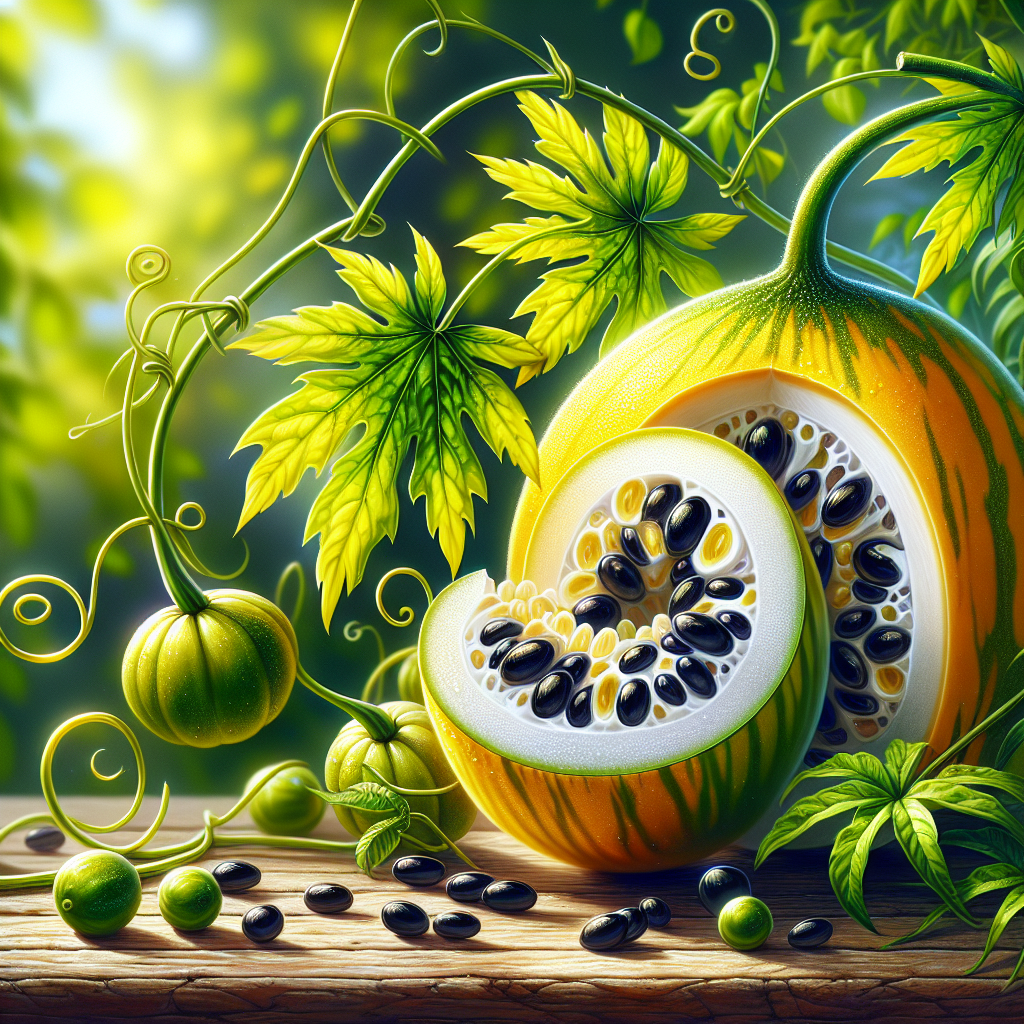
Introduction to Giant Granadilla (Passiflora quadrangularis)
Giant Granadilla (Passiflora quadrangularis) stands out as the largest passionfruit species, captivating growers with its massive, oblong fruits that can reach 12 inches (30 cm) in length and weigh up to 5 pounds (2.3 kg). Native to the Amazon basin and Central America, this perennial vine has become a staple in tropical agriculture worldwide, from Southeast Asia to the Caribbean and parts of Africa. The plant's exotic, intricate flowers—measuring 5-8 inches across with white petals, green bracts, and purple filaments—attract pollinators and add ornamental value to gardens.
The fruit's thick, waxy rind encases juicy, seed-filled arils bursting with sweet-tart flavor, rich in vitamins A and C, antioxidants, and fiber. Nutritionally, 100g of pulp provides about 97 calories, 23g carbohydrates, and significant potassium, making it a superfood for juices, smoothies, ice creams, and salads. Commercial yields can hit 20-30 tons per hectare under optimal conditions, with individual vines producing 50-100 fruits annually. For small farms, Giant Granadilla offers high value per plant due to its vigorous growth and minimal pruning needs. However, success demands precise climate matching, as frost sensitivity limits it to USDA zones 10-12. Why Companion Planting Feels Like Guesswork for Small Farms - And How AI Makes It Foolproof explores synergies that boost passionfruit health.
This deep-dive guide equips botanists, farmers, and enthusiasts with professional-grade protocols for propagation, care, pest management, and harvest, ensuring bountiful, high-quality yields.
Botanical Profile of Giant Granadilla (Passiflora quadrangularis)
Passiflora quadrangularis belongs to the Passifloraceae family, characterized by its square-angular stems (hence 'quadrangularis'), which distinguish it from round-stemmed relatives like purple passionfruit (Passiflora edulis). A fast-growing evergreen climber, it reaches 50-65 feet (15-20 m) in height with tendrils for support, featuring large, trilobed leaves up to 12 inches (30 cm) wide, often with domed glands at the base that secrete nectar to deter herbivores.
Flowers emerge year-round in warm climates, peaking in summer, with three-lobed bracts forming a green star around white sepals and petals. The corona of banded filaments creates a hypnotic pattern, luring carpenter bees and hummingbirds—key pollinators, as the flowers are too large for most insects. Self-incompatible, it requires cross-pollination from genetically distinct plants for fruit set; hand-pollination boosts yields by 30-50% in low-pollinator areas.
Fruits mature 2-3 months post-pollination, turning yellow-green when ripe, with a gelatinous, black-seeded pulp (arils) comprising 40-50% of weight. Seeds are viable for 1-2 years if dried properly. The vine's woodiness allows coppicing; roots are deep and extensive, aiding drought tolerance once established. Compared to Passionfruit or Dragon Fruit (crop), Giant Granadilla offers superior fruit size but demands stronger trellising due to 20-50 kg vine weight.
Growth is semi-perennial in tropics, with lifespans of 5-10 years; dieback occurs below 50°F (10°C). Hybrids with P. edulis enhance disease resistance and flavor.
Soil, pH, and Climate Requirements for Giant Granadilla (Passiflora quadrangularis)
Giant Granadilla flourishes in fertile, well-draining loamy soils with 20-30% organic matter, avoiding heavy clays prone to waterlogging. Ideal pH is 6.0-7.5; test annually and amend with dolomite lime for acidity below 5.8 or sulfur for alkalinity above 8.0. Incorporate 5-10 tons/ha compost or aged manure pre-planting to build humus, enhancing microbial activity and cation exchange capacity (CEC).
Climate-wise, it craves tropical/subtropical conditions: 75-95°F (24-35°C) daytime averages, never dipping below 59°F (15°C) long-term. Optimal rainfall is 60-100 inches (1500-2500 mm) evenly distributed, or supplement with drip irrigation (20-30 L/plant/week in dry spells). High humidity (70-90%) promotes flowering, but prolonged leaf wetness invites fungal issues. Full sun (6-8 hours) is essential; partial shade reduces yields by 40%. Windbreaks are critical in exposed sites, as gales snap tendrils.
Elevations up to 3000 ft (900 m) suit it, with mulching (6-8 inches organic) conserving moisture and suppressing weeds. Soil salinity tolerance is low (EC <1.5 dS/m); test irrigation water. For marginal zones, use high tunnels or frost cloth. Like Banana (crop), it benefits from Soil Health Mastery: 5 Proven Strategies for Small Farms to Build Fertile Ground Without Breaking the Bank.
Step-by-Step Planting & Propagation
Propagation Methods: Seeds are primary for mass production; scarify (sandpaper) and soak 24 hours in 100°F water, germinating in 2-4 weeks at 77-86°F on heat mats. Viability drops post-harvest, so sow fresh. Cuttings (6-8 inch semi-hardwood, IBA 1000 ppm) root in 4-6 weeks under mist; layering yields 90% success. Grafting onto P. edulis rootstock resists nematodes.
Site Prep: Select sunny, sheltered spots with sturdy T-posts or pergolas (12-16 ft high, 10x10 ft wire mesh). Space vines 10-15 ft apart (3x4 m grid for orchards). Dig 2x2x2 ft holes, fill with 50% compost-soil mix + 1 lb bonemeal + 0.5 lb potassium sulfate.
Planting: Spring post-frost; set seedlings/cuttings 6 inches deep, water deeply. Train leaders vertically, prune laterals to 4-6 nodes. Mulch heavily. Initial fertilizer: 10-10-10 at 1 oz/plant monthly x3.
Winter Sowing: In cooler climates, use the Winter Sowing Mastery technique for hardy starts.
Care & Maintenance regimes for Giant Granadilla (Passiflora quadrangularis)
Irrigation: Drip systems deliver 1-2 inches/week; deficit stress halves fruit size. Monitor tensiometers (20-40 cb).
Fertilization: NPK 8-3-9 monthly (1-2 lbs/vine/year), micronutrients (Zn, Fe, Mn) quarterly. Foliar sprays (2% urea + seaweed) boost vigor.
Pruning: Annual winter cutback to 6-10 ft encourages fruiting spurs. Remove 20-30% canopy for airflow.
Trellising: Reinforced cables withstand 50 kg loads. Pollinate manually if needed: transfer pollen with brush at dawn.
Weed Control: Mulch + shallow cultivation; cover crops like cowpeas.
Pests, Diseases & Organic Management
Pests: Aphids (pest), Mealybugs (pest), fruit flies—control with neem oil (2% weekly) or ladybugs. Borers: Bt kurstaki sprays. Use Why 90% of Small Farms Fail at Pest Management - And 8 Organic Fixes That Actually Work for protocols.
Diseases: Root rot (disease) (Phytophthora (disease)), powdery mildew—improve drainage, apply trichoderma. Anthracnose: copper fungicide, prune infected parts. Viruses: rogue plants.
Integrated strategies: beneficial insects, reflective mulches.
Harvesting, Curing & Optimal Storage
Harvest at color break (yellowing), 70-80 days post-bloom; clip with shears. Yields peak years 2-4. Cure at 68-77°F, 85-90% RH for 3-5 days to mellow flavor. Refrigerate fruits 41-50°F (5-10°C), 80% RH up to 4 weeks; pulp freezes 12 months. Process into puree for export.
Companion Planting for Giant Granadilla (Passiflora quadrangularis)
Pair with nitrogen-fixers like pigeon pea or Gliricidia (crop) for soil enrichment; Nasturtium (crop) repels aphids. Avoid water-hungry crops like Watermelon (crop). Marigold (crop) suppresses nematodes. See Fall Companion Planting Guide: Boost Yields and Soil Health for Small Farms and Gardens.