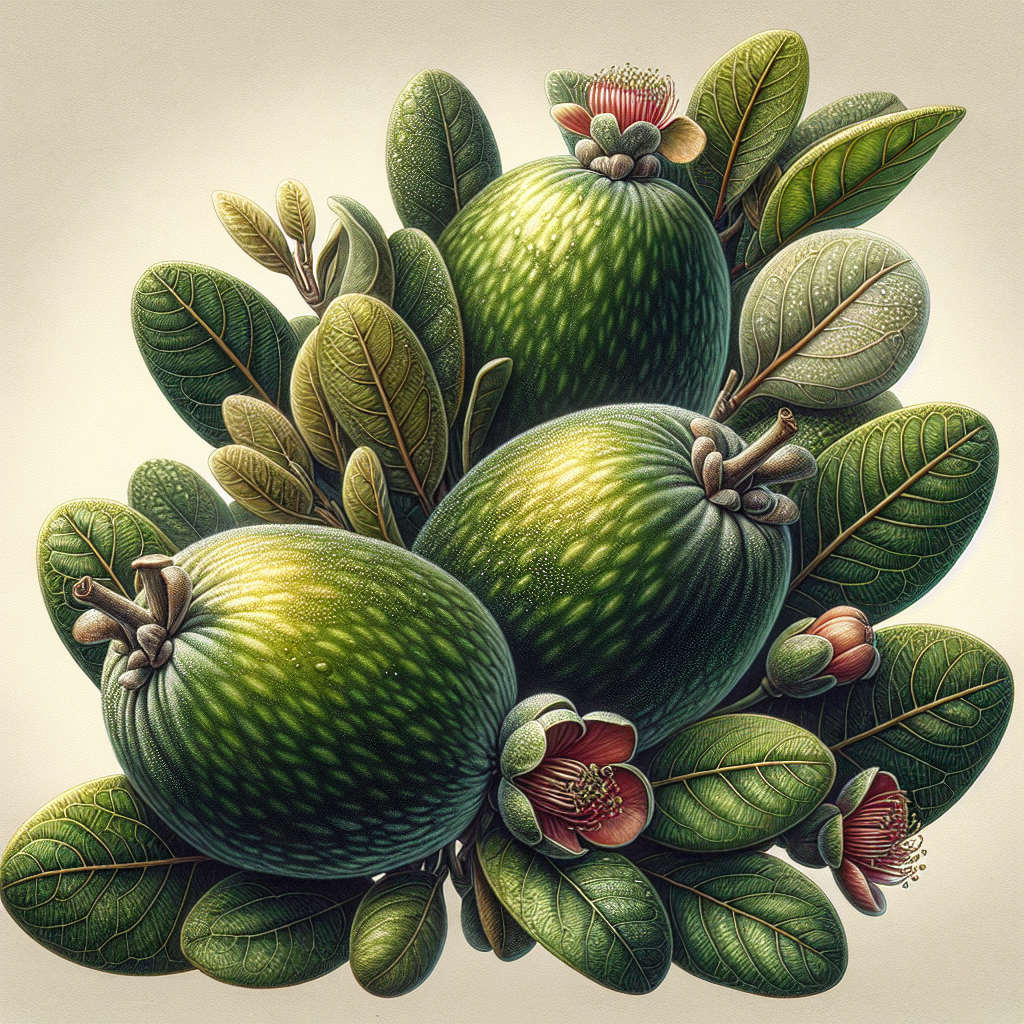
Introduction to Feijoa (Trask)
Feijoa (Trask), a standout cultivar of Acca sellowiana, represents the pinnacle of pineapple guava breeding for commercial and home growers. Selected for its massive fruit—often exceeding 100g per guava—Trask delivers a creamy, intensely flavored pulp that blends pineapple, strawberry, and guava notes with an edible, citrusy skin. Originating from New Zealand breeding programs, this variety outperforms standard feijoas in yield (up to 50kg per mature bush), self-fertility, and vigor, making it a top choice for Guava (crop) enthusiasts seeking subtropical flair in cooler climates.
Native to the highlands of southern Brazil, Uruguay, Paraguay, and Argentina, feijoa was introduced to New Zealand in the 19th century, where cultivars like Trask were developed for export markets. Trask's thick skin ensures excellent shelf life, while its flowers attract pollinators with crimson anthers and sweet nectar. Growers appreciate its wind tolerance, drought resistance once established, and ornamental value with glossy evergreen foliage. In permaculture systems, Feijoa (Trask) serves as a productive hedge or specimen tree, yielding harvests from October to December in the Southern Hemisphere. This guide provides professional-grade protocols for maximizing Trask's potential, from propagation to post-harvest handling, ensuring bountiful crops year after year.
Botanical Profile of Feijoa (Trask)
Feijoa (Trask) is an evergreen shrub or small tree in the Myrtaceae family, growing 3-6m tall and wide with a multi-stemmed, upright habit. Its oval, elliptical leaves (5-10cm long) are deep green above and silvery-tomentose beneath, providing year-round privacy screening. In spring (September-October in NZ), hermaphroditic flowers emerge terminally: 3-4cm wide with thick red petals and prominent crimson stamens, exuding a sweet, honey-like fragrance that draws bees and birds.
Fruit develops parthenocarpically in Trask (self-fertile), maturing in 120-150 days. Ellipsoid to ovoid guavas measure 5-8cm long, weighing 80-150g, with thick, green-to-yellow skin at maturity. The flesh is translucent, jelly-like, surrounding a central, seeded core; flavor peaks at Brix 12-15°. Trask's large size and productivity (20-50 fruits per terminal) distinguish it from smaller cultivars like Apollo. Botanically, it's a pseudocapsule (inferior ovary), with 100-200 seeds per fruit. Root system is fibrous and shallow, extending 2-3m laterally, sensitive to waterlogging but tolerant of poor soils. Phenology: vegetative flush post-harvest, flowering on previous season's wood.
Soil, pH, and Climate Requirements for Feijoa (Trask)
Feijoa (Trask) excels in well-drained, fertile soils with pH 5.5-7.5, tolerating clay loams, sands, and even heavy clays if drainage is ensured. Avoid waterlogged sites; raised beds or mounds (30-50cm high) are essential in high-rainfall areas. Incorporate 5-10kg compost per planting hole to boost organic matter to 4-6%, enhancing moisture retention without sogginess. Trask handles salinity (EC <4 dS/m) and moderate frost (-10°C once established), but young plants need protection below -5°C.
Optimal climate: USDA 8-11 (cool subtropical to temperate). Thrives at 15-25°C daytime, with chill hours (200-400) promoting flower initiation. Summer max 35°C tolerated; humidity 50-80% ideal, but windbreaks advised for pollination. In marginal zones (USDA 7), site against south walls for microclimate warmth. Irrigation: 20-40L/week in establishment (first 2 years), then drought-tolerant. Mulch 10cm thick with bark or straw to suppress weeds and regulate soil temperature. For more on heat management, see Why Summer Heatwaves Are Silently Killing Small Farm Yields - And 7 Organic Strategies to Fight Back. Annual rainfall 800-1500mm suits Trask perfectly.
Step-by-Step Planting & Propagation
Propagation: Trask roots readily from semi-hardwood cuttings (10-15cm, July-August). Dip basal end in 3000ppm IBA, plant in 1:1:1 perlite:peat:sand under mist (25°C bottom heat, 80% humidity). Rooting in 4-6 weeks; 70% success. Seed propagation yields variable offspring—stratify fresh seed 30 days at 4°C, germinate at 20-25°C in 14 days. Grafted Trask (cleft or whip-and-tongue onto seedling rootstock) ensures trueness, available commercially.
Planting: Select 1.5-2m specimens. Dig 60x60x60cm holes, amend with compost and gypsum (if sodic). Space 3-4m apart for bushes, 5m for trees. Plant at soil level, water deeply (50L), mulch immediately. Spring (post-frost) or autumn ideal. Stake if windy. For small farms, espalier against fences for space efficiency. Harden off container plants gradually. Expect first fruits year 2-3.
Care & Maintenance regimes for Feijoa (Trask)
Watering: Deep, infrequent—weekly first summer, then every 2-3 weeks. Deficit irrigation post-establishment boosts flavor. Drip systems (2-4L/hour) prevent wet foliage.
Fertilization: Balanced NPK 10-10-10 at 100g/tree annually in spring; micronutrients (Zn, Fe) via foliar every 3 months. Compost tea monthly enhances soil biology. Avoid excess N to prevent soft growth.
Pruning: Post-harvest (December-January): remove 20-30% crossing/dead wood, tip-prune to encourage bushiness. Maintain vase shape for light penetration. Thin crowded terminals for larger fruit.
Pollination: Self-fertile, but interplant with Coolidge or another feijoa for 20-30% yield boost. Hand-pollinate indoors: brush stamens to stigma.
Weed Control: Mulch + shallow cultivation. Organic pre-emergents like corn gluten.
Monitor for nutrient deficiencies: yellow leaves = Fe/Mn chelates.
Pests, Diseases & Organic Management
Pests: Aphids cluster on new growth—blast with water or neem oil (2ml/L weekly). Mealybugs in crotches: alcohol swabs or predatory ladybirds. Fruit flies pierce skin—bait traps with protein hydrolysate. Birds love flowers; net bushes. Scale insects rare on Trask; hort oil dormant spray.
Diseases: Root rot (Phytophthora) in wet soils—improve drainage, phosphite drenches (2L/ha). Powdery mildew in humid shade—prune for airflow, potassium bicarbonate (5g/L). Leaf spot (Alternaria) cosmetic; copper oxychloride if severe. Trask's vigor confers resistance. For expert tactics, explore Why 90% of Small Farms Fail at Pest Management - And 8 Organic Fixes That Actually Work.
Integrated management: beneficial insects (lacewings, hoverflies), reflective mulches, and sanitation.
Harvesting, Curing & Optimal Storage
Harvest when fruit drops naturally or thumb-pressure yields slightly (90% green, 10% yellow)—October-December. Pick daily to avoid bruising; yield 20-50kg/bush. Handle gently; fruits abscise cleanly.
Curing: Room temperature (20°C) 3-5 days ripens fully; ethylene from apples accelerates.
Storage: 0-5°C, 90-95% RH: 4-6 weeks. Modified atmosphere (5% O2, 5% CO2) extends to 12 weeks. Market fresh or process into jam, ice cream, wine. Brix peaks at 14-16° post-ripening.
Companion Planting for Feijoa (Trask)
Feijoa (Trask) pairs excellently with nitrogen-fixers like clover understory for soil enrichment. Plant Thyme or Nasturtium at base to deter pests and attract pollinators. Avoid root competitors like potato; instead, underplant with strawberry for groundcover. Marigold repels nematodes. Tall companions: avocado or citrus for wind protection. Guild example: feijoa central, comfrey chop-and-drop mulch, borage for bees. Enhances biodiversity, suppresses weeds, and boosts yields 15-20%.