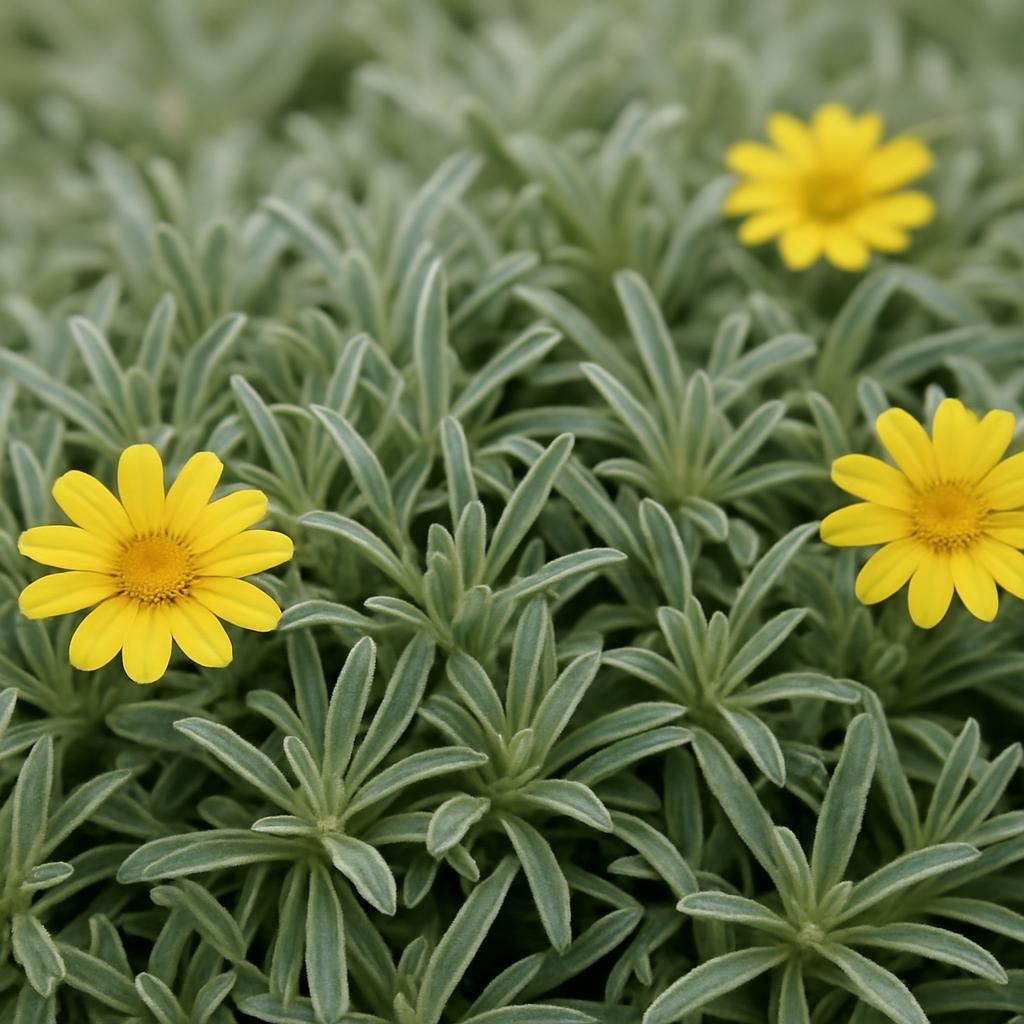
Introduction to Dymondia margaretae
Dymondia margaretae, commonly known as silver carpet, is a mat-forming perennial groundcover that has become a favorite in water-wise landscaping and sustainable agriculture. Originating from the coastal regions of South Africa, this plant delivers a striking silver-green carpet that stays low to the ground, rarely exceeding 2–3 inches in height. Its fine-textured foliage reflects sunlight, reducing soil temperatures and evaporation rates, making it an ideal choice for arid and semi-arid farming systems. In addition to its ornamental value, Dymondia margaretae stabilizes soil on slopes, suppresses weeds, and provides habitat for beneficial insects when allowed to flower.
Professional growers and landscapers value Dymondia margaretae for its ability to thrive in poor soils with little supplemental water once roots are established. The plant’s prostrate growth habit and rapid lateral spread make it an excellent living mulch in orchard rows, vineyard aisles, and between crop beds. Because it tolerates light foot traffic, it also serves as a low-maintenance alternative to traditional turf in pathways and around farm infrastructure. This guide provides detailed, field-tested recommendations for soil preparation, planting density, irrigation scheduling, and integrated pest management specific to commercial and home-scale production of Dymondia margaretae.
Botanical Profile of Dymondia margaretae
Dymondia margaretae belongs to the Asteraceae family and is the only species in its genus. The plant produces narrow, lance-shaped leaves that are dark green on top and densely covered with fine white hairs underneath, giving the foliage its signature silver sheen. The leaves are typically 1–2 inches long and arranged in tight rosettes that overlap to form a continuous mat. During the growing season, especially from late spring through early fall, the plant sends up short flower stalks bearing solitary, bright yellow daisy-like blooms approximately ½ inch across. These flowers attract pollinators and beneficial predatory insects, contributing to overall farm biodiversity.
The root system is fibrous and shallow, spreading horizontally rather than deeply. This characteristic allows Dymondia margaretae to colonize thin soils and rocky substrates where deeper-rooted crops struggle. The plant is evergreen in mild climates but may go dormant or turn bronze during prolonged cold or drought. Under optimal conditions, individual plants can spread 12–18 inches per year, eventually forming a seamless carpet that effectively excludes most annual weeds.
Soil, pH, and Climate Requirements for Dymondia margaretae (MUST INCLUDE A MARKDOWN TABLE OF IDEAL CONDITIONS)
Dymondia margaretae performs best in well-drained, sandy loam to gravelly soils with low to moderate fertility. It tolerates alkaline conditions and is highly sensitive to waterlogged roots. The plant is hardy in USDA zones 9–11 and can survive brief dips to 20 °F (-6 °C) once established, although young transplants require protection from hard freezes.
| Parameter | Ideal Range | Notes |
|---|---|---|
| Soil Type | Sandy loam to gravelly | Excellent drainage critical |
| Soil pH | 6.5–8.0 | Tolerates mildly alkaline conditions |
| Soil Salinity (EC) | < 4 dS/m | Sensitive to high salt levels |
| Temperature Range | 55–85 °F (13–29 °C) | Optimal growth; tolerates brief cold |
| Annual Rainfall | 10–25 inches (250–635 mm) | Supplemental irrigation needed in drier areas |
| Sun Exposure | Full sun to light shade | Best silver color in full sun |
| Frost Tolerance | Brief to 20 °F (-6 °C) | Protect new plantings from hard freezes |
Step-by-Step Planting & Propagation
Dymondia margaretae is most reliably established from plugs or divisions rather than seed. Begin site preparation by removing existing vegetation and loosening the top 4–6 inches of soil. Incorporate 1–2 inches of coarse sand or fine gravel if native soil is heavy clay to improve drainage. Lay out irrigation lines or drip emitters on 12-inch centers before planting.
Plant plugs 6–8 inches apart in a staggered grid for fastest coverage. Each plug should be set so the crown is level with the soil surface; deeper planting increases rot risk. Water thoroughly immediately after planting to settle soil around roots. Maintain consistent moisture for the first 4–6 weeks until new growth appears, then gradually reduce frequency. Division of established mats can be performed in early spring or fall by cutting 4-inch squares and replanting immediately.
Care & Maintenance regimes for Dymondia margaretae (MUST INCLUDE A MARKDOWN TABLE OF WATER, FERTILIZER, AND PRUNING SCHEDULES)
Once established, Dymondia margaretae is extremely low-maintenance. Fertilization is rarely needed; excessive nitrogen produces lush but weak growth that is more susceptible to pests. Light shearing after flowering keeps the mat tidy and encourages denser branching. The following schedule is designed for commercial-scale plantings in Mediterranean and arid climates.
| Season | Watering Schedule | Fertilizer Application | Pruning/Maintenance |
|---|---|---|---|
| Spring | Deep water every 10–14 days | None unless deficiency symptoms | Shear lightly after flowering |
| Summer | Deep water every 14–21 days | None; avoid high-nitrogen formulas | Remove spent blooms if desired |
| Fall | Deep water every 14–21 days | Light compost tea if growth stalls | Clean up debris; divide if needed |
| Winter | Water only during extended dry spells | None | Minimal; protect from hard freezes |
Pests, Diseases & Organic Management
Dymondia margaretae is generally resistant to most pests and diseases when grown in well-drained soil. Occasional infestations of Aphids or Spider mites may occur during hot, dry periods. These can be managed with strong water sprays or applications of insecticidal soap and neem oil. Root rot caused by Pythium or Phytophthora is the primary disease concern and is prevented by avoiding over-irrigation and ensuring excellent drainage. Slugs and snails may feed on young foliage in cool, moist springs; organic iron-phosphate baits provide effective control.
Harvesting, Curing & Optimal Storage
Dymondia margaretae is grown primarily as a living groundcover rather than a harvested crop. When divisions or plugs are needed for new plantings, sections can be lifted with a sharp spade, divided into 4-inch squares, and either transplanted immediately or held in trays with moist media for up to two weeks. If harvested plant material must be stored, keep divisions in a cool, shaded location with high humidity and good air circulation. Avoid prolonged storage; best results occur when divisions are replanted within 7–10 days.
Companion Planting for Dymondia margaretae
Dymondia margaretae pairs well with drought-tolerant perennials and low-growing herbs that share similar cultural requirements. Recommended companions include Thyme, Rosemary, and Yarrow. In orchard systems it serves as an effective living mulch beneath Dwarf Cavendish Banana and Hass Avocado trees, reducing weed pressure and moderating soil temperature. Avoid pairing with high-water-demand crops such as Rice or Lettuce that would require irrigation incompatible with Dymondia’s dry preferences.
For additional guidance on building resilient small-farm systems, see The Hidden Power of Mulching: 8 Organic Strategies to Transform Small Farm Soil.