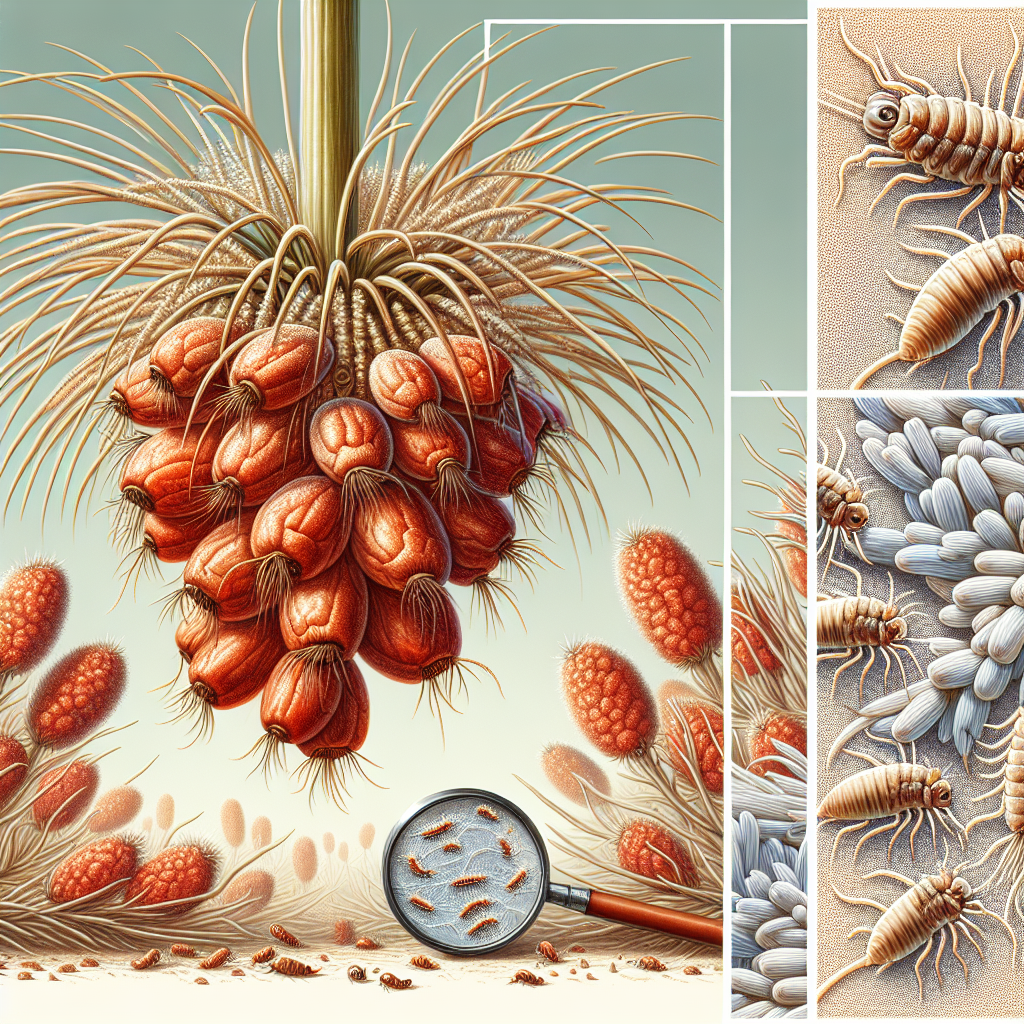
Comprehensive Diagnostic and Management Guide for Date Palm Mite (Oligonychus afrasiaticus)
Introduction to date
The date palm mite, scientifically known as Oligonychus afrasiaticus, represents one of the most devastating pests affecting commercial date palm (Phoenix dactylifera) orchards worldwide. First identified in North Africa, this microscopic eriophyid mite has rapidly expanded its range to the Middle East, California, Arizona, and emerging date production areas in Asia and Australia. Adult females measure just 0.2-0.3 mm, making them invisible to the naked eye, yet their populations can explode under hot, dry conditions, leading to catastrophic yield losses of 50-100% in unmanaged groves.
Date palm mites target the developing fruit bunches (strands), where they rasp epidermal cells and inject toxic saliva, causing bronzing, drying, and premature drop of entire bunches. Unlike spider mites, which produce visible webbing, date palm mites leave no such signs, complicating early detection. Global date production exceeds 9 million tons annually, with top producers like Egypt, Saudi Arabia, and Iran losing millions in revenue yearly to this pest. This guide provides professional growers with diagnostic tools, lifecycle insights, organic management protocols, and prevention strategies to safeguard orchards. Understanding environmental triggers is key, as infestations correlate strongly with prolonged heatwaves above 35°C (95°F) and low humidity below 30%.
Early intervention is critical: scouts report that bunches showing 10-20% bronzing can still be salvaged with prompt treatment, but delay beyond 30% damage leads to total loss. Integrated Pest Management (IPM) programs emphasizing biological controls have reduced chemical reliance by 70% in successful California date farms. For small-scale growers, regular monitoring with 20x hand lenses remains the cornerstone of defense.
Identifying Symptoms & Damage
Date palm mite damage manifests progressively on fruit bunches, starting subtly and escalating rapidly. Initial symptoms appear 2-4 weeks after mite colonization, typically during bunch growth stages (Kimri to Rutab).
Early Stage (Days 1-14): Fine stippling or silvery speckling on lower rachillae (fruit strands). Affected areas feel leathery to the touch. Use a 20x-40x hand lens to spot mites as tiny, worm-like creatures moving actively. No webbing present, distinguishing from eriophyid mites.
Mid Stage (Weeks 2-4): Bronzing or reddish-brown discoloration spreads upward from strand bases. Fruitlets shrink, dry out, and drop prematurely. Bunches curl inward, resembling drought stress. Yield impact: 20-40% loss per infested bunch.
Advanced Stage (Weeks 4+): Entire strands dry to brittle, black husks. Heavy drop leaves sparse, deformed bunches. Secondary issues like sooty mold or fruit flies may invade damaged tissue.
Diagnostic Confirmation:
- Shake Test: Tap infested strand over white paper; mites appear as moving pepper grains.
- Microscopy: Confirm O. afrasiaticus by legless, elongated body with feather-like hind legs.
- Differentiation: Rule out nutrient deficiencies (e.g., potassium shortage causes similar bronzing but uniformly across leaves) and fungal issues like anthracnose.
Economic threshold: Treat when 10% of strands show bronzing in 20% of palms. Damage reduces marketable dates by 30-80 kg per tree annually.
Lifecycle and Progression of date
Date palm mites complete their lifecycle in 10-14 days under optimal conditions (35-42°C, <30% RH), enabling 15-20 generations per season.
- Egg (1-2 days): Laid singly on fruitlet undersides; pearly white, 0.05 mm.
- Larva/Nymph I (2-3 days): Active feeding; pale yellow, developing leg stubs.
- Nymph II (3-4 days): Faster movement, increased rasping damage.
- Adult (7-10 days): Females (0.25 mm) disperse via wind; males rare. Parthenogenetic reproduction yields 20-40 eggs/female.
Overwintering occurs as diapausing deutonymphs in bunch cracks. Spring populations surge post-pollination, peaking June-August. Progression accelerates with heat: at 45°C, cycle shortens to 8 days. Monitoring tracks density: <5 mites/strand = low risk; >50 = outbreak.
Environmental Triggers & Risk Factors
Date palm mites thrive in arid, hot climates mirroring date palm native habitats.
Key Triggers:
- Temperature: Optimal 35-45°C; activity halts below 15°C or above 50°C.
- Humidity: Prefers <25% RH; irrigation reduces risk by 40%.
- Dust: Wind-blown soil particles carry mites between trees.
Risk Factors:
- Susceptible varieties: Medjool, Deglet Noor.
- Poor sanitation: Unpruned bunch skirts harbor overwinterers.
- Adjacent crops: Infestations spread from mango or banana groves.
- Climate change: Extended heat domes increase outbreaks by 25% per decade.
Scout during 'Hababook' stage (pre-Rutab); use Spring Pest Patrol for timing.
Organic Control & Treatment Plans
IPM prioritizes non-chemical tactics, achieving 80-95% control in certified organic date orchards.
Cultural Controls:
- Prune bunch skirts pre-infestation; destroy debris.
- Overhead irrigate to boost humidity >40% RH.
- Dust suppression: Apply kaolin clay barriers.
**Biological Controls:**n- Predatory mites (Amblyseius swirskii): Release 10,000/ha; 60% reduction in 14 days.
- Neem oil (azadirachtin 0.03%): Weekly sprays during Kimri; disrupts feeding.
- Insecticidal soaps: Potassium salts at 2%; contact kill on crawlers.
Treatment Plan:
- Scout weekly; hit threshold.
- Apply neem + soap at dusk (avoids bees).
- Release predators 7 days post-spray.
- Reassess in 10 days; repeat if >20 mites/strand.
Avoid broad-spectrum insecticides to preserve mites predators.
Preventing date in the Future
Prevention focuses on exclusion and resilience.
- Quarantine: Inspect nursery stock; hot-water dip culls (49°C, 15 min).
- Resistant Rootstocks: Trials show 30% lower infestation.
- Monitoring Tech: Sticky traps + apps for density tracking.
- Sanitation Calendar: Prune post-harvest; mulch to retain soil moisture.
- Biodiversity: Interplant marigold as repellent.
Annual IPM audits reduce incidence by 70%.
Crops Most Affected by date
Primary: Date palm (Phoenix dactylifera) – 90% of infestations. Secondary: Other Phoenix spp., coconut, fig. Rare on pomegranate. Global impact: 1.2M tons lost yearly.