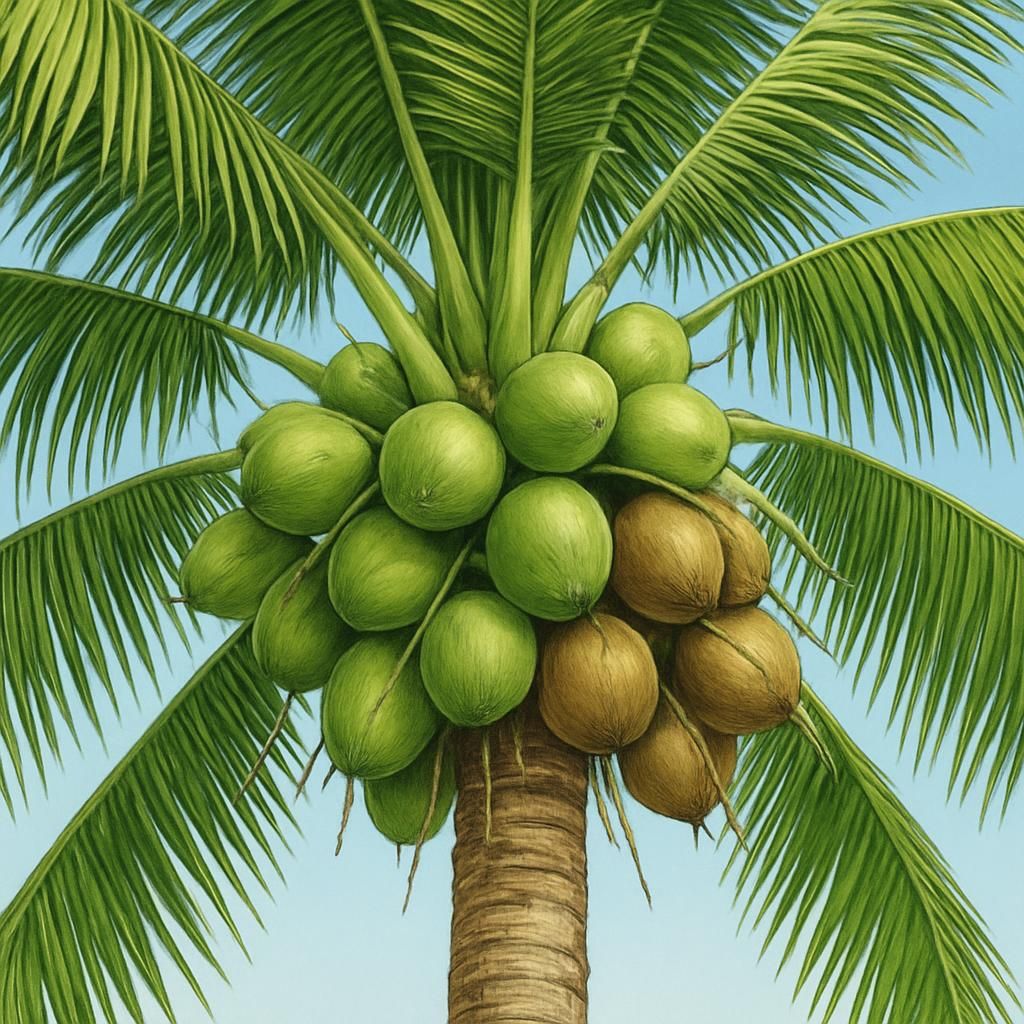
Introduction to Coconut (Malayan Dwarf)
The Malayan Dwarf coconut palm represents one of the most successful dwarf selections of Coconut, offering earlier fruiting, greater resistance to lethal yellowing, and a more manageable size compared to traditional tall varieties. Originally developed in Malaysia, this cultivar has become a staple across Southeast Asia, the Caribbean, and parts of Africa and the Pacific for both copra and fresh nut production.
Its compact stature (typically 30–50 feet at maturity) makes it ideal for smallholder farms and urban landscapes while still delivering commercial-grade yields of 100–150 nuts per palm annually once established. The variety is especially valued for its sweet water, tender meat, and adaptability to marginal soils when proper nutrition is provided.
Botanical Profile of Coconut (Malayan Dwarf)
The Malayan Dwarf belongs to the Arecaceae family and exhibits a single unbranched trunk with prominent leaf scars. It produces pinnate fronds up to 12–15 feet long with leaflets arranged in a single plane. Inflorescences emerge from leaf axils as branched spadices bearing both male and female flowers, with female flowers developing into the characteristic drupe.
Three color morphs exist—green, yellow, and red—each with slightly different growth rates and nut characteristics. The red morph tends to be the most vigorous. Unlike tall coconuts that begin fruiting after 6–10 years, Malayan Dwarfs typically start bearing within 3–5 years and maintain consistent production for decades.
Soil, pH, and Climate Requirements for Coconut (Malayan Dwarf)
Malayan Dwarf palms thrive in deep, well-drained sandy loam to clay loam soils with good organic matter. They tolerate a wide pH range but perform best in slightly acidic to neutral conditions. The following table summarizes ideal growing parameters:
| Parameter | Ideal Range | Notes |
|---|---|---|
| Soil Type | Sandy loam to clay loam | Requires excellent drainage; avoid waterlogging |
| Soil pH | 5.5 – 7.5 | Optimal around 6.0–6.5 |
| Temperature | 21–32 °C (70–90 °F) | Sensitive below 15 °C; frost intolerant |
| Annual Rainfall | 1,500–2,500 mm | Even distribution preferred; supplemental irrigation in dry seasons |
| Humidity | 70–90 % | High atmospheric humidity supports growth |
| Elevation | 0–600 m | Performs well in coastal lowlands |
| Sunlight | Full sun (6+ hours) | Partial shade reduces nut production |
Step-by-Step Planting & Propagation
Propagation is achieved exclusively through seed nuts because tissue culture remains commercially limited. Select mature, disease-free nuts from high-yielding mother palms. Soak selected nuts in water for 24–48 hours before planting to accelerate germination.
Prepare nursery beds or polybags with a 1:1:1 mix of sand, topsoil, and compost. Plant nuts horizontally with the widest part slightly covered. Germination occurs in 3–6 months under 25–30 °C temperatures. Seedlings are ready for field transplanting when they reach 1–1.5 m height with 6–8 leaves, usually 12–18 months after sowing.
Field spacing of 7–8 m between palms in a triangular pattern allows 140–160 palms per hectare. Dig planting holes 1 m × 1 m × 1 m and incorporate 20–30 kg well-rotted manure plus 500 g rock phosphate. Plant seedlings at the same depth as the nursery and provide temporary shade for the first 4–6 weeks.
Care & Maintenance regimes for Coconut (Malayan Dwarf)
Consistent irrigation, balanced fertilization, and timely removal of senescent fronds are essential for sustained productivity. Mulching with coconut husks or fronds conserves moisture and suppresses weeds. The following table outlines recommended schedules:
| Activity | Frequency | Details |
|---|---|---|
| Irrigation | Weekly in dry season | 20–40 L per palm; drip irrigation preferred |
| Fertilizer | 4 applications/year | 1.5–2 kg NPK 12-6-18 + micronutrients per palm; split doses |
| Pruning | Twice yearly | Remove dead and diseased fronds; avoid over-pruning live leaves |
| Mulching | Annual renewal | 10–15 cm layer of husks or fronds around base, keep 30 cm from trunk |
| Weeding | Quarterly | Manual or mechanical; maintain weed-free circle 1.5 m radius |
Pests, Diseases & Organic Management
Major threats include the Rhinoceros beetle, Red palm weevil, and Black-headed caterpillar. Regular monitoring of crown and trunk is critical. For rhinoceros beetles, maintain sanitation by removing decaying logs and use pheromone traps.
Lethal yellowing and Bud rot caused by Phytophthora palmivora are the primary diseases. Resistant Malayan Dwarf selections have significantly reduced lethal yellowing losses. Organic management includes copper-based sprays for bud rot, removal of infected tissues, and application of Trichoderma-based bio-fungicides to the crown.
Harvesting, Curing & Optimal Storage
Nuts reach maturity 11–12 months after flowering. Harvest when the husk begins to turn brown and the nut produces a sloshing sound when shaken. Use a pole with a sickle or trained climbers for safe collection.
For copra production, split nuts and sun-dry or smoke-dry kernels to 6–7 % moisture. Store copra in well-ventilated sacks off the ground. Fresh nuts for drinking water can be stored at 10–15 °C for up to 4 weeks. Dehusked mature nuts keep 2–3 months under cool, dry conditions.
Companion Planting for Coconut (Malayan Dwarf)
Intercropping with nitrogen-fixing legumes such as Pigeon pea or Gliricidia improves soil fertility and provides additional income during the first 3–4 years. Shade-tolerant crops like Cacao or Black Pepper can be grown under mature palms.
Short-term companions include pineapple, banana, and ginger during establishment. Avoid heavy feeders such as Corn directly under palms to prevent nutrient competition. Maintain at least 2 m distance between coconut trunks and companion plant rows to allow mechanical access and root expansion.