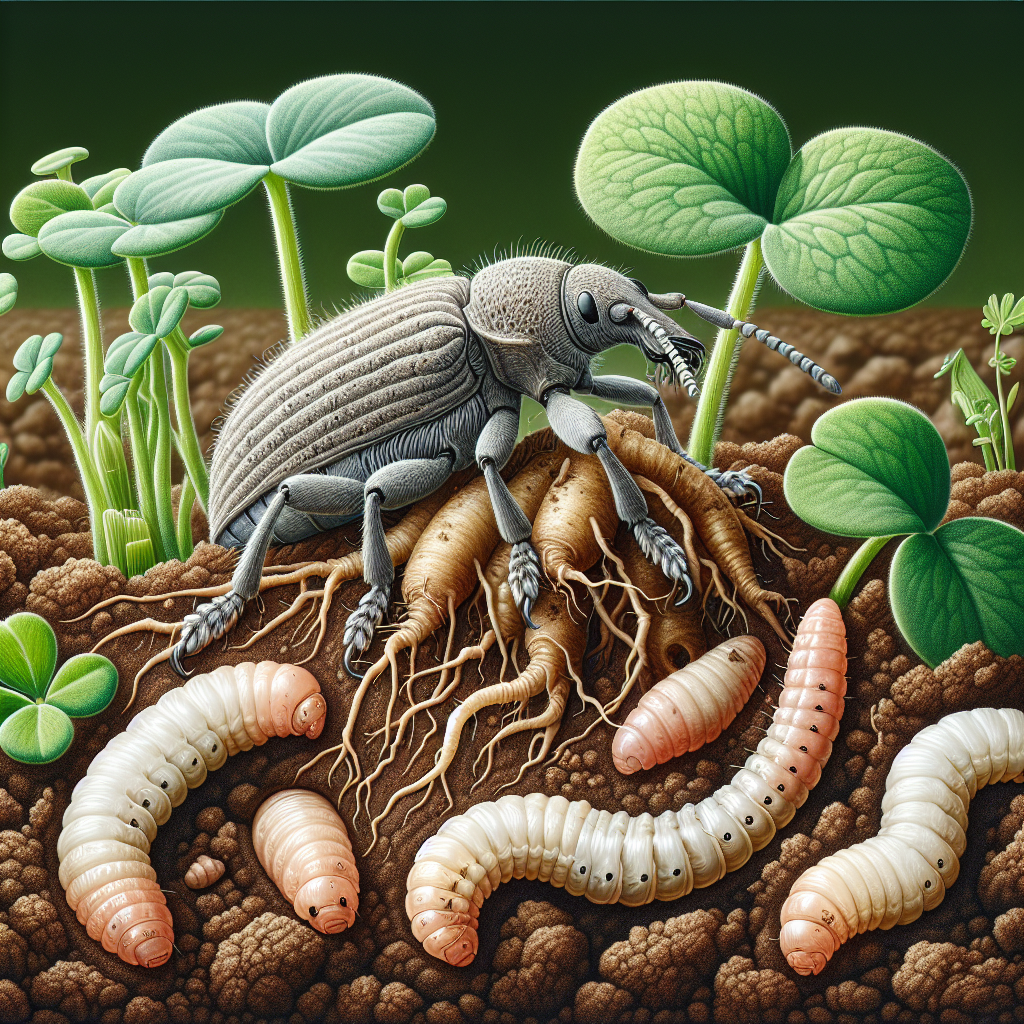
Introduction to clover root curculio
The clover root curculio, scientifically known as Sitona hispidulus, is a notorious pest in legume forage systems, particularly targeting clover and alfalfa. This small weevil, native to Europe but now widespread across North America, Australia, and parts of Asia, poses a serious threat to pasture productivity. Adults are grayish-brown, about 3-4 mm long, with a pronounced snout and scattered hairs giving them a rough appearance. The larvae, creamy-white legless grubs up to 7 mm long, feed voraciously on root nodules and fine roots, disrupting nitrogen fixation and plant vigor.
Farmers first notice issues in established stands where plants exhibit yellowing foliage, wilting, and thin stands. Infestations often build over years, with adults emerging in spring to feed on leaves before laying eggs at the soil surface. This pest thrives in cool, moist conditions, making it a persistent problem in rotational grazing systems and cover cropping. Economic impacts include 20-50% yield reductions in severe cases, compounded by secondary issues like root rots from damaged tissues. Early detection and integrated management are crucial for maintaining healthy legume crops. For more on legume health, check out our Spring Pest Patrol: Organic AI Strategies to Shield Your Crops from Common Invaders.
Identifying Symptoms & Damage
Recognizing clover root curculio damage starts above ground but confirms below. Adult feeding creates characteristic U-shaped notches on leaf margins, especially on new growth. These 'shot-hole' patterns distinguish it from general herbivores like aphids or leafhoppers. Plants show stunted growth, purplish discoloration on lower leaves, and reduced tillering, mimicking nutrient deficiencies or drought stress.
The real devastation occurs underground. Larvae target root nodules—key for nitrogen fixation in legumes—girdling fine roots and creating tunneling scars. Excavate affected plants to find C-shaped grubs clustered near nodules. Severely infested roots appear blackened and pruned, leading to poor regrowth after cutting or grazing. Stand thinning is evident in patches, with yellowing progressing to plant death. Yield losses correlate with larval density: over 10 grubs per plant can halve biomass.
Differentiate from similar pests like root-knot nematodes by the absence of galls and presence of chew marks. Soil sampling in early summer reveals pupae or adults overwintering. Monitor using sweep nets for adults (10-20 per 100 sweeps signals action) or root digs for larvae. Symptoms peak in second-year stands, emphasizing rotation importance.
Lifecycle and Progression of clover root curculio
Understanding the clover root curculio lifecycle enables precise timing of interventions. Adults overwinter in soil litter or plant debris, emerging in early spring (March-April in temperate zones) when soil temperatures hit 10-15°C. They feed on tender leaves, producing the notched damage, and mate within days. Females lay 500-1000 eggs singly or in clusters near the soil surface, often scarring leaf petioles as oviposition sites.
Eggs hatch in 5-10 days into tiny L1 larvae that burrow into soil, reaching roots within a week. Larvae progress through four instars over 3-4 weeks, peaking in May-June. Mature L4 larvae pupate 5-10 cm deep in soil, emerging as new adults by late June-July. These summer adults feed minimally, seek overwintering sites by fall, and repeat the cycle annually, sometimes bivoltine in warmer climates.
Generational overlap means multiple life stages coexist, complicating control. Peak larval damage coincides with first-cut forage harvest, weakening regrowth. Longevity exceeds one year for adults, with high fecundity driving population booms in undisturbed fields. Track progression via degree-day models (base 7°C): adults at 100 DD, eggs at 150 DD, larvae peak at 400 DD.
Environmental Triggers & Risk Factors
Clover root curculio flourishes under specific conditions. Cool, moist springs (soil moisture >20%, temps 15-20°C) trigger adult emergence and egg-laying synchrony with legume flush. Poor drainage, heavy soils, and neutral pH (6.5-7.5) favor larval survival, as do undisturbed pastures >2 years old. Continuous clover or alfalfa monocultures amplify risks, with populations exploding after 3-4 seasons.
Weedy fields provide adult refugia, while reduced tillage buries pupae safely. Nitrogen-rich soils from legume fixation indirectly boost weevil fitness via vigorous host growth. Climate shifts—milder winters—increase overwintering success, expanding ranges northward. Companion crops like grasses dilute damage but host weeds like vetch exacerbate it. Risk soars post-flooding or irrigation excess, mimicking nursery preferences.
Organic Control & Treatment Plans
Organic management hinges on integrated pest management (IPM), prioritizing cultural, biological, and mechanical tactics. Cultural: Rotate out of legumes every 2-3 years with corn or soybeans to starve larvae—essential for resetting populations. Graze or cut early (bud stage) to disrupt egg-laying timing. Tillage in fall exposes pupae to predators and desiccation.
Biological: Encourage natural enemies like ground beetles, birds, and parasitic wasps (e.g., Microctonus aethiopoides). Inoculate with commercial entomopathogenic nematodes (Heterorhabditis bacteriophora) at 10^6 IJ/m² in late spring targeting L3-L4 larvae—apply evenings with >15°C soil. Foliar sprays of Beauveria bassiana suppress adults (rates 10^9 spores/ml).
Mechanical: Use sweep nets for adults in spring evenings, drowning in soapy water. Boot drench with neem oil (0.5% azadirachtin) at peak emergence. Fall deep plowing (20 cm) buries adults fatally.
Monitoring & Thresholds: Scout weekly; treat if >15 adults/100 sweeps or 5 grubs/plant. Combine with trap crops like bird's-foot trefoil. Success metrics: 70-90% reduction via rotation + bioagents. Avoid broad-spectrum disruptions to beneficials.
Preventing clover root curculio in the Future
Prevention builds resilient systems. Select resistant varieties like Kura clover or endophyte-enhanced alfalfa, which deter oviposition. Establish mixed pastures with oats or brassicas to disrupt host-finding. Maintain soil health via cover cropping and compost—healthy roots resist larval feeding better.
Sanitation is key: destroy volunteers and edge weeds. Perimeter traps (yellow sticky cards + pheromone lures) intercept migrants. Hyper-local weather monitoring flags emergence risks. Long-term, diversify rotations (legume:non-legume 1:3) and foster biodiversity with hedgerows harboring predators. Scout new plantings monthly first year. Annual IPM audits sustain low populations indefinitely.
Crops Most Affected by clover root curculio
Primarily legumes, red clover suffers most, with 30-60% forage loss. White clover follows, then alfalfa (up to 40% stand reduction). Less common: alsike clover, sweetclover, vetch, lupins, and soybeans in cover roles. Grasses unaffected but impacted indirectly via yield drag. Pastures, hayfields, and seed production hit hardest; vegetable legumes like peas rarely economic.
Global incidence: Midwest US, Ontario, southern Australia, New Zealand. Yield impacts scale with stand age and density—pure stands worst.