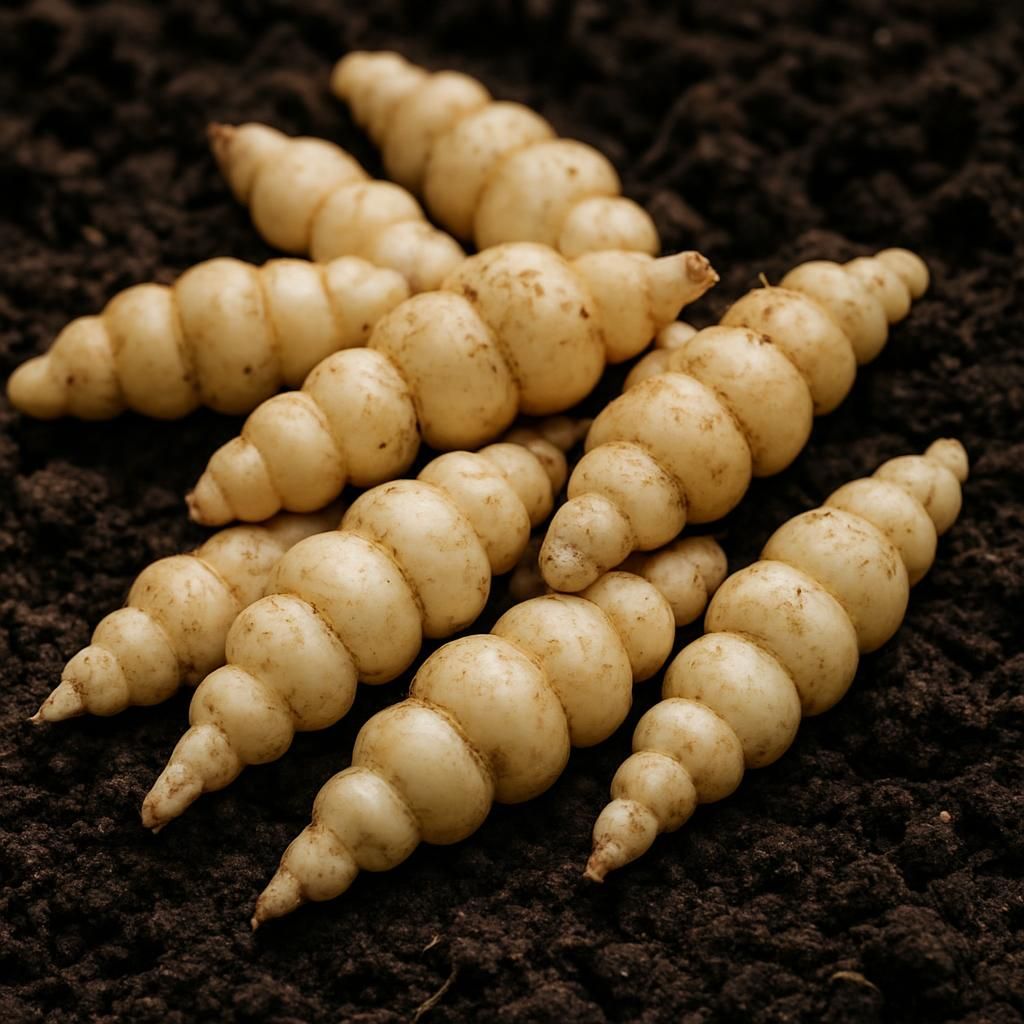
Introduction to Chinese Artichoke (Crosne)
Chinese Artichoke, also known as Crosne, is a lesser-known but highly rewarding root vegetable prized for its delicate, nutty flavor and distinctive spiral-shaped tubers. Native to China and Japan, this member of the mint family has been cultivated for centuries in East Asia and has gained popularity among chefs and specialty growers in Europe and North America for its gourmet appeal and extended harvest window.
The plant produces small, elongated white tubers that are crisp when raw and develop a subtle artichoke-like sweetness when cooked. Because the tubers store well and command premium prices in specialty markets, Chinese Artichoke offers excellent opportunities for diversified vegetable growers seeking high-value, low-competition crops.
Botanical Profile of Chinese Artichoke (Crosne)
Stachys affinis is a herbaceous perennial in the Lamiaceae family, growing 30–60 cm tall with square stems and opposite, ovate leaves. It spreads via underground stolons that terminate in edible tubers typically 3–8 cm long and 1–2 cm wide. The tubers are ivory-white, segmented, and possess a distinctive curled shape that resembles a small caterpillar or corkscrew.
The plant rarely flowers in cultivation, and propagation is almost exclusively vegetative through tubers. It enters dormancy in winter and resumes growth in early spring, making it well-suited to temperate climates with cool growing seasons.
Soil, pH, and Climate Requirements for Chinese Artichoke (Crosne)
Chinese Artichoke performs best in loose, fertile, well-drained loam or sandy loam soils. Heavy clay soils should be amended with organic matter to improve structure and drainage. The crop is sensitive to waterlogging, which can cause tuber rot.
| Parameter | Ideal Range | Notes |
|---|---|---|
| Soil Type | Loam / Sandy Loam | High organic matter content preferred |
| Soil pH | 6.0 – 7.0 | Slightly acidic to neutral |
| Temperature | 15–22 °C (day) | Cool-season crop; avoid prolonged heat |
| Frost Tolerance | Light frost tolerant | Tubers survive winter in ground |
| Spacing | 30 cm between plants | 45–60 cm between rows |
| Planting Depth | 5–8 cm | Cover with 2–3 cm of soil after planting |
Step-by-Step Planting & Propagation
- Select firm, disease-free tubers in late winter or early spring.
- Prepare beds by incorporating well-rotted compost and ensuring good drainage.
- Plant tubers 5–8 cm deep, 30 cm apart in rows 45–60 cm wide.
- Water thoroughly after planting to settle soil around tubers.
- Apply a 5 cm layer of organic mulch to suppress weeds and maintain consistent moisture.
- Mark rows clearly; shoots emerge in 2–4 weeks depending on soil temperature.
Care & Maintenance regimes for Chinese Artichoke (Crosne)
Consistent moisture and weed control are critical during the active growing period. Avoid over-fertilization, which can produce excessive foliage at the expense of tuber development.
| Task | Schedule | Details |
|---|---|---|
| Watering | Weekly or as needed | Maintain even moisture; 25–40 mm per week |
| Fertilizer | At planting and mid-season | Balanced organic fertilizer (NPK 5-5-5) |
| Pruning | Not required | Remove flower stalks if they appear |
| Mulching | Renew every 6–8 weeks | 5 cm organic mulch to retain moisture |
| Weeding | Every 2–3 weeks | Hand-weed or shallow cultivation |
Pests, Diseases & Organic Management
Chinese Artichoke is relatively pest-resistant but can be affected by slugs and snails, aphids, and wireworms. Root-knot nematodes may become problematic in sandy soils with poor rotation.
Organic management includes encouraging beneficial insects, using beer traps for slugs, and applying neem oil or insecticidal soap for aphids. Crop rotation with garlic or onion helps break nematode cycles. Good sanitation and removal of crop debris reduce overwintering disease inoculum.
Harvesting, Curing & Optimal Storage
Harvest begins in late autumn after foliage yellows, typically 120–150 days after planting. Carefully dig tubers with a garden fork to avoid bruising. Gently wash and air-dry for 1–2 hours before storage.
Store tubers in perforated plastic bags or damp sand at 2–5 °C with 85–90 % humidity. Properly stored crosne tubers remain crisp for 4–6 weeks. For longer storage, blanch and freeze or pickle in vinegar.
Companion Planting for Chinese Artichoke (Crosne)
Chinese Artichoke benefits from association with nitrogen-fixing legumes such as peas and beans. Aromatic herbs like thyme and rosemary help deter pests. Avoid planting near potato to reduce shared nematode pressure.
For additional strategies on organic soil management and companion planting systems, see Summer Companion Planting: 10 Organic Pairings to Boost Small Farm Resilience.