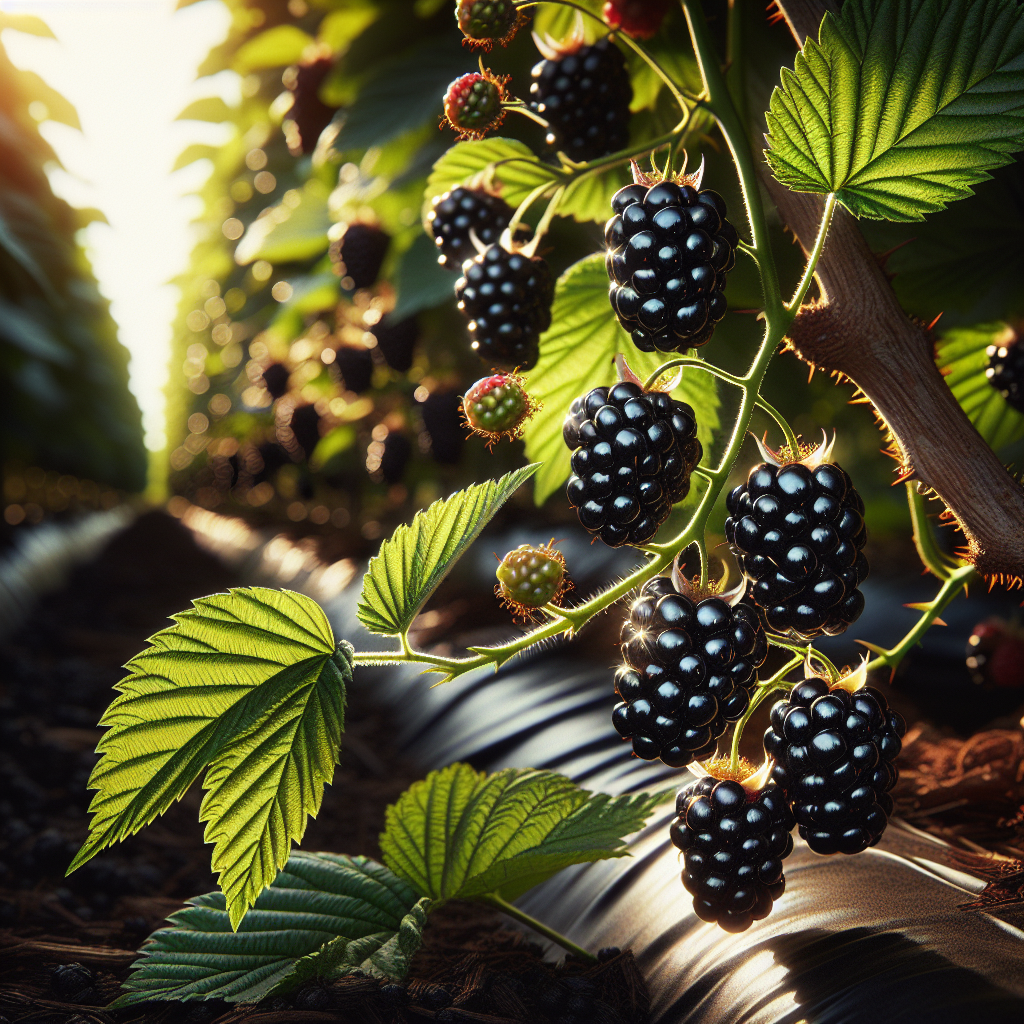
Introduction to Chester Blackberry
Chester Blackberry (Rubus fruticosus 'Chester') stands out as one of the most reliable and high-yielding thornless blackberry varieties available to growers today. Developed by the University of Arkansas Division of Agriculture and released in 1988, this semi-erect cultivar was specifically bred for its vigorous growth, disease resistance, and ability to produce two distinct crops annually: a floricane crop in early summer and a primocane crop in late summer to fall. What sets Chester apart from wild blackberries or older thorny varieties is its glossy, firm, sweet-tart berries that measure up to 10 grams each, with flavor profiles boasting high soluble solids (13-15% Brix) and excellent storage qualities. Historically, blackberries trace back to ancient European cultivation, but modern cultivars like Chester represent decades of selective breeding to eliminate thorns, enhance cold hardiness (to -20°F or USDA Zone 5), and boost productivity—often yielding 10-15 pounds per plant at maturity. For small farms or home orchards, Chester's low-maintenance profile and market demand for its machine-harvestable fruit make it a cornerstone crop. Whether trellised in rows or grown in containers, it thrives with proper care, delivering bountiful harvests for fresh eating, jams, pies, or commercial freezing.
Botanical Profile of Chester Blackberry
Chester Blackberry belongs to the Rosaceae family, genus Rubus, subgenus Eubatus, species fruticosus—a complex hybrid derived from Eastern upright blackberries crossed with wild dewberries and other Rubus species. As a semi-erect, primocane-fruiting cultivar, it produces two types of canes: primocanes (first-year canes) that fruit in late summer on their top portions, and floricanes (second-year canes) that bear the main early summer crop before dying back. Canes reach 4-6 feet in height and 1-2 inches in diameter, with a smooth, thornless bark that transitions from green to reddish-purple, armed only with sparse prickles at nodes. Leaves are trifoliate or pentafoliate, dark green, and doubly serrated, providing dense shade that suppresses weeds. Flowers are white, 1-1.5 inches wide, borne in clusters of 5-12, with a blooming period split between May-June (floricane) and August-September (primocane). Drupes aggregate into conical berries 1-1.5 inches long, turning glossy black at maturity, with a firm texture that resists shattering during harvest. Root systems are fibrous and shallow (top 12-18 inches), spreading 3-4 feet laterally via suckers, necessitating trellis support for optimal air circulation and light penetration. Genetically, Chester inherits robust anthracnose resistance from its 'Darrow' parentage, with a chromosome count of 2n=14x=98, typical of polyploid blackberries.
Soil, pH, and Climate Requirements for Chester Blackberry
Chester Blackberry demands well-drained, loamy soils rich in organic matter, ideally with 3-5% organic content to support its shallow roots. Sandy loam or silt loam textures are optimal, as heavy clays lead to waterlogging and root rot—aim for a soil bulk density under 1.3 g/cm³. pH should be maintained at 6.0-6.5; below 5.5 causes iron and manganese toxicities (yellowing leaves with green veins), while above 7.0 induces calcium deficiencies (blossom-end rot on fruit). Test soil annually and amend with dolomitic lime (2-4 lbs/100 sq ft) for acidity correction or elemental sulfur (1-2 lbs/100 sq ft) for alkalinity. Climate-wise, Chester excels in temperate zones (USDA 5-9), tolerating -20°F winters and 95°F summers, but requires 1000-1500 chill hours (below 45°F) for uniform bud break. It prefers 1200-1600 growing degree days (base 50°F) for full ripening. Full sun (8+ hours daily) is essential; partial shade reduces yields by 30-50%. Mulch with 4-6 inches of wood chips or pine bark to retain moisture (60-70% field capacity) and suppress suckers. Avoid low-lying frost pockets, as spring frosts below 28°F damage floricanes. For detailed blackberry cultivation insights, see our blackberry guide.
Step-by-Step Planting & Propagation
Propagation of Chester Blackberry is best via root cuttings or tip layering for true-to-type plants, avoiding seeds which produce variable offspring. Step 1: Site Selection—Choose a sunny, well-drained slope with wind protection; space rows 10-12 feet apart, plants 4-6 feet in-row on a T-trellis (5-6 ft posts, #11 wire at 3 and 5 ft heights). Step 2: Soil Prep—Incorporate 4-6 inches compost or aged manure, plus 2-4 lbs 10-10-10 fertilizer per 100 sq ft; raised beds (12-18 inches) suit poor drainage. Step 3: Planting—Plant dormant bare-root or potted 1-year whips in early spring (soil >45°F), setting crowns 1-2 inches below soil line; water-in with 1-2 gallons per plant. Step 4: Initial Trellis—Train primocanes loosely to wires. For propagation: In late summer, bury cane tips 2-4 inches deep; roots form in 4-6 weeks, sever and transplant next spring (80-90% success). Tissue culture is commercial standard for virus-free stock. Mulch immediately post-planting. Avoid autumn planting in cold climates to prevent heaving. For soil prep strategies, check Soil Health Mastery.
Care & Maintenance regimes for Chester Blackberry
Water Chester to maintain 1-1.5 inches weekly (drip irrigation ideal, 0.5-1 gal/plant/day in peak summer), targeting 60-75% soil moisture (probe to 12 inches); wilting leaves or drooping canes signal underwatering, while yellowing lower leaves and mushy roots indicate overwatering (drainage >1 inch/hour). Fertilize in early spring with 1-2 oz 10-10-10 per plant, sidedress ammonium sulfate (0.5 oz) post-harvest; tissue tests guide N at 40-60 ppm. Prune annually: post-floricane harvest (July), remove dead canes at ground level; thin primocanes to 4-6 per foot, topping at 4 ft for bushiness. Winter protection: mound 6-8 inches soil or mulch over crowns in Zone 5. Thin fruit clusters to 6-8 per cane for jumbo berries. Monitor for suckers beyond rows, digging them out. Annual yields peak in year 3-8, then renovate by mowing to 6 inches every 8-10 years.
Pests, Diseases & Organic Management
Common pests include spotted wing drosophila (SWD)—monitor with traps, spray spinosad (OMRI-listed) at 7-10 day intervals when adults appear (berries show dimples). Japanese beetles: handpick or neem oil. cane borers: seal pruning cuts with paint. Diseases: anthracnose (gray lesions)—prevent with 3% lime-sulfur dormant spray, ensure airflow. orange rust (bright pustules)—rogue infected plants, as it's systemic. verticillium wilt: rotate 4 years, avoid solanaceous crops. Organic IPM: release predatory mites for spider mites, companion plant with garlic for nematode suppression. Mulch reduces splash dispersal; copper fungicide for bacterial blight.
Harvesting, Curing & Optimal Storage
Harvest when berries are fully black and separate easily (internal temp 50-60°F), picking every 2-3 days over 4-6 weeks per crop; yield 5-10 lbs/plant floricanes, 3-5 lbs primocanes. Use shallow trays to avoid crushing; cool to 32°F within 2 hours (forced air). Store at 31-32°F, 90-95% RH for 7-14 days (firmness lasts 2x longer than raspberries). For freezing, IQF at -20°F; shelf life 12+ months. Dry at 135°F for 24-36 hours into leathers.
Companion Planting for Chester Blackberry
Pair Chester with clover as groundcover to fix nitrogen (boosts yields 20%) and suppress weeds. Thyme deters beetles, yarrow attracts beneficial wasps. Avoid potatoes or tomatoes due to verticillium risk.