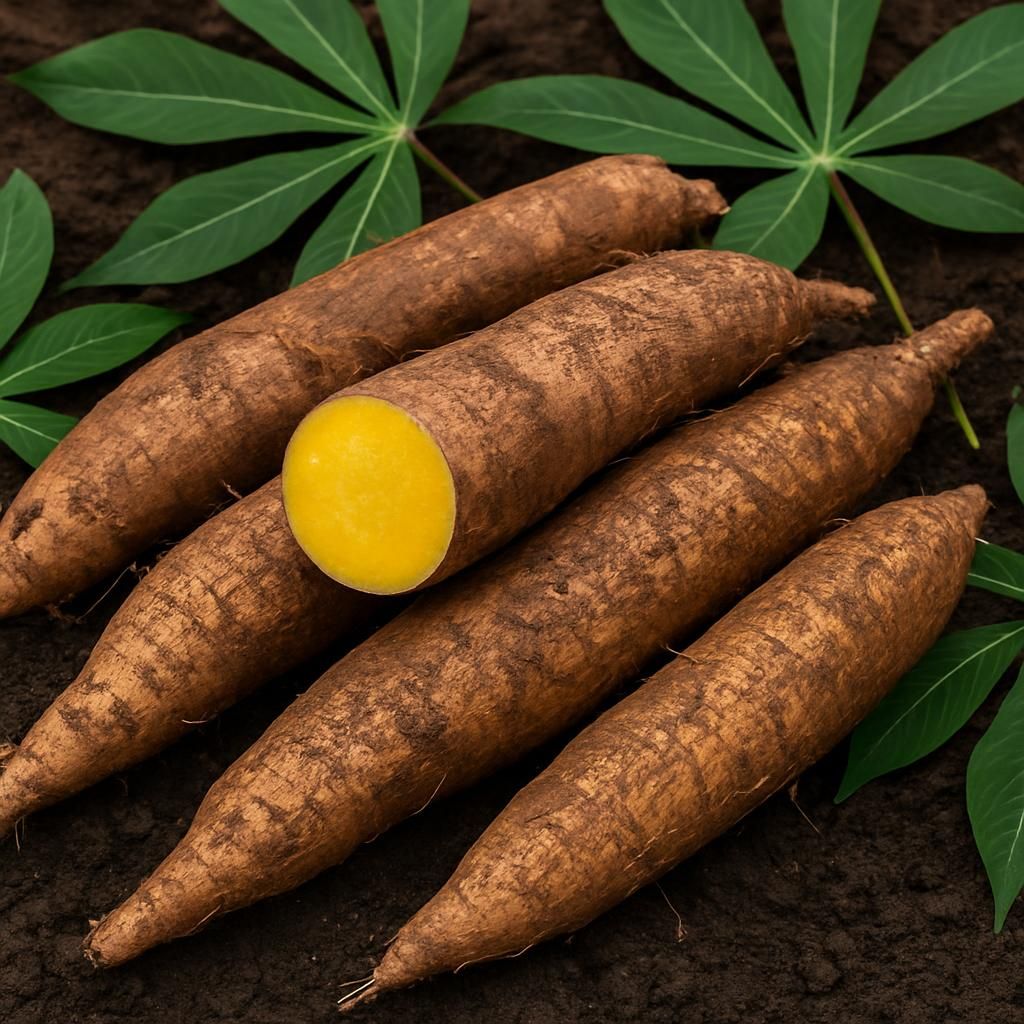
Introduction to Cassava (Manihot esculenta - Yellow)
Cassava (Manihot esculenta - Yellow) is a staple root crop cultivated across tropical and subtropical regions for its carbohydrate-rich tubers and resilience in marginal soils. The yellow-fleshed variety offers elevated beta-carotene content compared to white types, making it valuable for both nutrition and market differentiation. Global production exceeds 300 million tonnes annually, with major contributions from Africa, Asia, and Latin America. Farmers favor cassava for its low input requirements, ability to withstand prolonged dry periods, and multiple end uses ranging from fresh consumption and flour to starch and biofuel feedstock.
Botanical Profile of Cassava (Manihot esculenta - Yellow)
Cassava belongs to the Euphorbiaceae family and is a perennial shrub grown as an annual for its swollen storage roots. Plants reach 1.5–4 m in height with palmate leaves featuring 5–9 lobes and prominent veins. The yellow variety produces tubers with bright yellow-orange flesh due to higher carotenoid levels. Roots vary in length (15–100 cm) and diameter (3–15 cm) and contain 25–35% starch on a fresh-weight basis. Flowering is sporadic; most commercial fields rely on stem cuttings rather than seed. Cassava exhibits strong mycorrhizal associations that enhance phosphorus uptake in low-fertility soils.
Soil, pH, and Climate Requirements for Cassava (Manihot esculenta - Yellow)
Cassava thrives in well-drained, sandy-loam to clay-loam soils with moderate fertility. It tolerates acidic conditions but performs best near neutral pH. The crop requires consistent warmth and cannot tolerate frost.
| Parameter | Ideal Range | Notes |
|---|---|---|
| Soil Type | Sandy loam to clay loam | Excellent drainage essential |
| Soil pH | 5.5–7.0 | Tolerates down to 4.5; liming advised below 5.0 |
| Temperature | 20–32 °C daytime | Minimum 15 °C; frost kills stems |
| Annual Rainfall | 1000–2000 mm | Drought tolerant once established |
| Altitude | 0–1800 m | Best below 1500 m for optimal tuber quality |
| Light | Full sun (≥6 hours) | Shading reduces root bulking |
Step-by-Step Planting & Propagation
- Select healthy, disease-free stems 8–12 months old from high-yielding plants.
- Cut 20–30 cm long sections with 5–7 nodes; treat cut ends with wood ash or fungicide.
- Prepare ridges or mounds 30–40 cm high spaced 1 m apart in well-tilled soil.
- Plant cuttings vertically or at 45° angle with 2–3 nodes buried; maintain 1 m × 1 m spacing (10,000 plants/ha).
- Irrigate lightly after planting to settle soil; mulch with 5–10 cm organic material to conserve moisture.
- Plant at the onset of rains when soil temperature exceeds 18 °C.
Care & Maintenance regimes for Cassava (Manihot esculenta - Yellow)
Weed control during the first 3–4 months is critical. Apply balanced NPK at planting and side-dress nitrogen at 3 months. Prune lower leaves at 6–8 months to improve airflow.
| Growth Stage | Water (mm/week) | Fertilizer (NPK kg/ha) | Pruning Schedule |
|---|---|---|---|
| 0–3 months | 25–35 | 40-20-40 basal + 20 kg N at 8 wks | Remove weeds only |
| 3–6 months | 20–30 | 20-10-30 side-dress | Thin lower leaves at 5 months |
| 6–9 months | 15–25 | Optional K boost if deficient | Prune to 1.2 m height if lodging |
| 9–12 months | 10–15 | None | Remove senescent leaves |
Pests, Diseases & Organic Management
Major insect threats include cassava mealybug, cassava green mite, and whiteflies. Fungal issues such as cassava anthracnose and root rot caused by Phytophthora species can reduce stands. Implement integrated pest management: release predatory mites, rogue infected plants, and rotate with legumes. Neem-based sprays and reflective mulches suppress whitefly populations. Maintain field sanitation by burning crop residues after harvest.
Harvesting, Curing & Optimal Storage
Harvest when leaves yellow and tubers reach physiological maturity (8–18 months depending on variety and climate). Use a digging fork to loosen soil and lift roots carefully to avoid breakage. Cure harvested tubers in shaded, ventilated heaps for 3–5 days to reduce latex and improve peelability. Store fresh roots in moist sawdust or sand at 5–10 °C for up to 4 weeks. For longer storage, process into chips, flour, or starch within 48 hours of harvest.
Companion Planting for Cassava (Manihot esculenta - Yellow)
Intercrop cassava with cowpea, pigeon pea, or maize to improve nitrogen fixation and suppress weeds. Marigold borders deter nematodes while sorghum provides windbreaks. Avoid planting near tomato or sweet potato to minimize shared viral vectors. Rotate cassava with cereals or legumes every 2–3 cycles to break pest cycles and restore soil fertility.