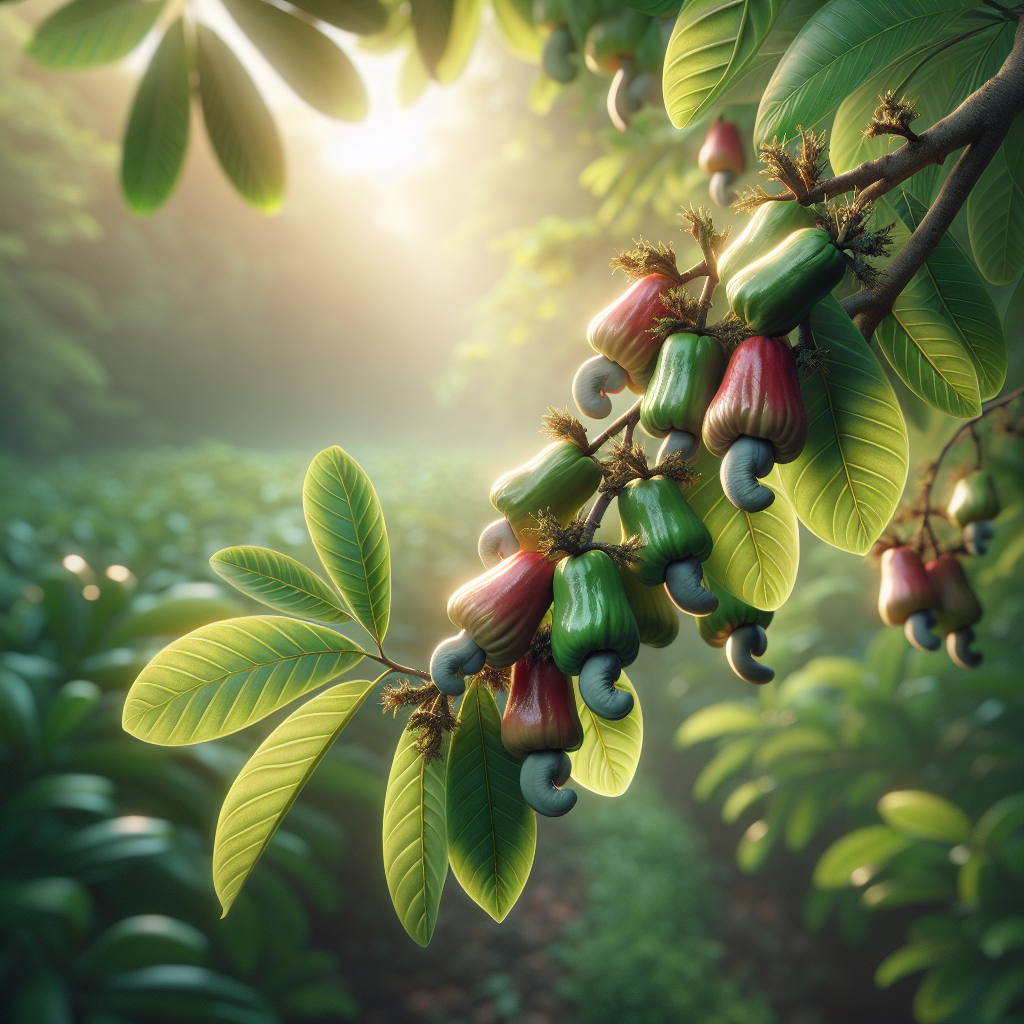
Introduction to Cashew
Native to northeastern Brazil and later spread widely through Portuguese trade routes to India, Africa, and Southeast Asia, cashew became one of the most important tropical tree crops for dry coastal belts and light-textured uplands. It is unusual among orchard crops because the edible kernel develops outside the true fruit, attached beneath the swollen pedicel commonly called the cashew apple. This botanical peculiarity is more than a curiosity: it affects harvest timing, postharvest handling, and labor planning.
Cashew is grown both for export-grade kernels and for local use of the apple in juices, fermented beverages, preserves, and livestock feed. Commercial performance depends heavily on climate rhythm: a pronounced dry period usually supports floral induction, pollinator activity, and cleaner harvests, while prolonged rain during flowering often reduces nut set and increases disease pressure. In well-managed orchards, grafted trees usually begin meaningful bearing earlier than seedling trees, and yield consistency is better.
For growers comparing tree crop systems, cashew is often chosen for its tolerance of lower-fertility soils and intermittent drought relative to more demanding tropical fruit trees. Even so, tolerance should not be confused with indifference. Strong yields, large nut size, and long orchard lifespan still require careful site selection, balanced nutrition, canopy management, and disciplined postharvest handling. For comparison with another tropical perennial orchard crop, see Mango.
Botanical Profile of Cashew
Cashew belongs to the family Anacardiaceae, the same family as mango and pistachio. It is a medium-sized, evergreen to semi-evergreen tree depending on moisture regime, typically reaching 6-14 m in orchard conditions, though unmanaged trees may spread wider than they grow tall. The species naturally develops a low, broad canopy and can produce multiple scaffold branches close to the ground unless trained early.
The root system consists of a prominent taproot in young plants and an expanding network of lateral roots that exploit a large soil volume. This helps explain the crop's resilience in seasonal drought, but also means it responds poorly to prolonged root-zone saturation. Young leaves are often reddish to bronze before maturing to glossy green. Flowers are borne in terminal panicles and may be male or hermaphroditic, with flowering intensity strongly influenced by temperature, dry season duration, and cultivar genetics.
The so-called cashew apple is not the true fruit. Botanically, the true fruit is the kidney-shaped drupe at the end of the apple, containing the seed that becomes the commercial cashew kernel after processing. The shell contains caustic cashew nut shell liquid, rich in phenolic compounds such as anacardic acid and cardol, which can burn skin and must be handled with care. This is why raw cashew “nuts” sold in markets have always been heat-processed to remove toxic shell residues.
Cultivar selection matters. Seedling populations are highly variable in tree vigor, canopy architecture, flowering pattern, nut size, and kernel recovery percentage. Modern orchards generally favor clonal or grafted selections chosen for compact habit, regular bearing, larger nut count, better shelling percentage, and tolerance to local pests or diseases. Dwarf and semi-dwarf types are often preferred in higher-density systems because they simplify pruning, spraying, and harvest collection.
Soil, pH, and Climate Requirements for Cashew
Cashew performs best in deep, well-drained sandy loams, red loams, lateritic soils, and light coastal soils where water does not stand around the root collar. It can survive in relatively poor soils, but commercial productivity is highest where effective soil depth exceeds 1 m and internal drainage is excellent. Heavy clay is risky unless planted on raised mounds or ridges, because anaerobic conditions after rain can suppress feeder roots and predispose trees to decline.
Ideal soil pH is generally 5.0-6.8, though cashew can tolerate moderately acidic conditions better than many orchard species. Below about pH 4.5, aluminum toxicity and phosphorus fixation may limit root growth and nutrient uptake. Above about pH 7.5, micronutrient deficiencies, especially zinc and iron, become more likely, showing as interveinal chlorosis on younger leaves. Before establishing an orchard, conduct a full soil test including pH, organic matter, cation balance, phosphorus, potassium, calcium, magnesium, boron, zinc, and soil texture.
The crop thrives in tropical climates with annual temperatures of 24-32°C. Short exposures above 36°C are tolerated if soil moisture is adequate, but persistent hot dry winds during flushing or flowering can desiccate tender tissues and reduce fruit set. Young trees are vulnerable below 15°C, and frost can be lethal. Reliable cashew regions typically receive 800-2000 mm annual rainfall, but the crucial pattern is not only total rain; it is the presence of a distinct dry season for flowering and harvest.
A 4-6 month dry period often favors synchronized flowering, better pollen viability, lower Anthracnose pressure, and easier nut collection. In contrast, frequent rain or heavy dew during bloom encourages flower blight, poor pollinator activity, and premature fruit drop. Relative humidity that stays excessively high through flowering may reduce nut retention. Wind exposure also matters: moderate air movement improves canopy drying, but strong salt-laden coastal winds or storm gusts can scar leaves, snap panicles, and reduce yields.
Soil moisture management should aim for moist but aerated conditions in the active root zone, especially during establishment, panicle emergence, flowering, and nut fill. In practical terms, the top 15-20 cm should dry slightly between irrigations, while the subsoil at 20-40 cm remains lightly moist, never sour-smelling or sticky for long periods. Signs of overwatering include yellowing leaves without uniform nutrient deficiency patterns, poor flush vigor, blackening fine roots, algae or moss at the trunk base, and increased flower drop. Signs of drought stress include leaf folding, reduced panicle length, small apples, nut shrivel, and premature leaf fall.
Step-by-Step Planting & Propagation
Start with adapted planting material from a reputable nursery or breeding program. Grafted plants are strongly recommended for commercial orchards because they reduce juvenile variability and usually bear earlier than seedlings. Use healthy, disease-free nursery plants 3-6 months old, with a straight graft union, no circling roots, and a hardened canopy. Reject any plant with a cracked graft, swollen collar, chlorotic leaves, or root-bound bags.
Propagation from seed is mainly used for rootstocks or low-input plantings. Select fully mature nuts from high-yielding mother trees with known kernel quality. Fresh seed germinates best; viability drops with poor storage. Sow nuts horizontally or with the stalk end slightly angled upward in polybags or nursery beds filled with a porous medium such as sandy loam mixed with compost. Avoid waterlogging. Germination usually occurs within 1-3 weeks under warm conditions.
For grafting, vigorous seedlings are raised as rootstocks and then softwood grafted, veneer grafted, or epicotyl grafted depending on local practice. Scion wood should come from elite mother trees that are true-to-type, productive, and free from visible pest or disease issues. Use pencil-thick scions with mature buds. Keep graft unions shaded and humid but not wet until callusing is complete. Once the scion flushes consistently, gradually harden plants before field establishment.
Land preparation should begin well before the rainy season. Clear perennial weeds, mark contour lines on sloping land, and provide drainage outlets where needed. Dig planting pits roughly 60 x 60 x 60 cm, larger in poor soils. Refill with topsoil mixed with 10-20 kg well-decomposed farmyard manure or compost. If soil tests indicate deficiency, incorporate rock phosphate or a phosphorus source and agricultural lime or dolomite several weeks before planting rather than putting concentrated fertilizer directly against young roots.
Spacing depends on cultivar vigor, rainfall, pruning style, and mechanization. Traditional orchards may use 8 x 8 m to 10 x 10 m spacing. Semi-dwarf types can be planted more closely, for example 6 x 6 m or 7 x 7 m, especially if annual canopy control is practiced. On very fertile soils or in high-rainfall zones, wider spacing reduces shade buildup and disease pressure. Double-hedgerow or high-density systems can work, but only if thinning or systematic pruning is planned from the outset.
Plant at the onset of reliable rains or under irrigation after the hottest period. Remove the nursery bag carefully without disturbing the root ball. Set the plant at the same depth it grew in the nursery; burying the graft union invites collar problems and scion rooting. Firm soil gently, create a shallow basin for irrigation, mulch lightly but keep mulch 10-15 cm away from the trunk, and stake if wind is an issue. Provide temporary shade in very hot, exposed sites for the first few weeks.
During the first year, maintain a weed-free circle at least 0.75-1 m around each plant. Intercrops can be used while trees are young, but they must not compete aggressively for moisture. Leguminous covers and short-duration crops are usually preferable. Broader orchard floor planning benefits from principles like those discussed in soil health strategies.
Care & Maintenance regimes for Cashew
Young cashew trees need disciplined establishment care even though mature trees are drought tolerant. Irrigate newly planted trees deeply enough to wet the root zone to about 30-40 cm, then wait until the upper soil begins to dry before irrigating again. On sandy soils in hot weather, this may mean watering every 3-5 days; on loams, every 7-10 days may suffice. Mature orchards often rely on rainfall, but supplemental irrigation during pre-flowering, flowering, and nut development can improve nut size and retention if drainage is excellent.
Mulching with dry grass, leaves, husk, or composted material helps buffer soil temperature, reduce evaporation, and suppress weeds. However, thick mulch piled against the trunk creates a humid microclimate that favors stem pests and collar infections. Keep a bare ring immediately around the trunk and replenish mulch as it decomposes.
Nutrition should be guided by soil and leaf analysis, but general principles are consistent. Nitrogen supports vegetative growth and canopy renewal, phosphorus supports rooting and reproductive performance, and potassium is essential for flower retention, nut filling, and stress tolerance. Calcium and magnesium matter for structural and metabolic balance, while sulfur, zinc, boron, and iron are often limiting in low-organic soils or high-pH situations. Apply fertilizers in split doses, usually timed before rains or followed by irrigation. Broadcast in a ring under the canopy dripline rather than close to the trunk, because feeder roots are concentrated outward.
Organic amendments such as compost, farmyard manure, neem cake, or well-decomposed poultry manure can significantly improve sandy or lateritic soils by increasing moisture retention and cation exchange capacity. In very low-organic soils, annual addition of 10-25 kg organic matter per bearing tree, combined with mineral nutrition, often stabilizes yield and improves soil biology. Foliar feeding of zinc and boron is sometimes justified where flowering is poor or tissue tests confirm deficiency.
Training should begin in the first 1-2 years. Select 3-4 well-spaced scaffold branches beginning around 0.5-1 m from the ground, depending on harvest method and desired canopy form. Remove weak, crossing, inward-growing, or very low branches. The aim is a broad but airy canopy that admits light and allows rapid drying after dew or rain. Minimal but regular pruning is generally better than infrequent severe cutting.
In bearing orchards, prune after harvest or before the next flush, depending on local climate. Remove deadwood, diseased shoots, rootstock suckers, and tangled interior growth. If trees become too tall, reduce height gradually over more than one season to avoid shock and excessive unproductive vegetative flushing. Good light penetration improves flowering and reduces pest harborage.
Weed management is especially important in the first 3-4 years. Keep a clean basin near the tree and mow or slash alleys before weeds set seed. Avoid deep hoeing near the trunk because feeder roots are shallow in the upper profile. Living groundcovers can reduce erosion and improve infiltration if they are not excessively competitive.
Cashew is mostly insect-pollinated. Encouraging bee activity and reducing unnecessary pesticide exposure during flowering can improve fruit set. Avoid spraying broad-spectrum materials when panicles are in full bloom unless absolutely necessary, and if treatment is unavoidable, spray late in the day after pollinator activity declines.
Pests, Diseases & Organic Management
The most economically important cashew pests vary by region, but Tea mosquito bug, Stem and root borers, Leaf miners, Thrips, Aphids, and Mealybugs are common concerns. Tea mosquito bug feeding on tender shoots, panicles, and young apples can cause necrotic lesions, Dieback of inflorescences, and severe crop loss. Monitoring should intensify at new flush and flowering. Organic management depends on sanitation, canopy aeration, and early intervention with neem-based products, entomopathogenic fungi where locally effective, and preservation of natural enemies.
Stem and root borers are particularly serious because damage is often advanced before symptoms are obvious. Look for frass at the trunk base, boreholes, gumming, canopy yellowing, and branch decline. Regular trunk inspection is essential. Mechanical removal of larvae with a wire, cleaning boreholes, and sealing wounds with appropriate protective pastes are traditional measures. Severely infested branches should be cut and destroyed.
Mealybugs and Scale insects often flare in dense, dusty, or ant-infested orchards. Their honeydew supports Sooty mold, reducing photosynthesis. Control ants, prune overcrowded canopies, avoid excessive nitrogen, and encourage predators such as ladybird beetles and lacewings. Horticultural soaps or oils can suppress light infestations when coverage is thorough and temperatures are not extreme.
Disease pressure is highest where flowering overlaps with wet, humid weather. Anthracnose can attack leaves, panicles, apples, and young nuts, causing black lesions, blossom blight, and fruit drop. Powdery mildew may appear on tender tissues under certain humidity-temperature combinations, especially in cooler dry seasons with heavy night moisture. Dieback and Gumosis may follow pruning wounds, borer injury, or chronic water stress.
Organic disease management begins with site design rather than sprays. Use well-spaced trees, avoid waterlogging, prune for airflow, remove diseased panicles and fallen debris where practical, and avoid overhead irrigation during flowering. Balanced potassium and micronutrition often improve tissue resilience. Preventive applications of permitted materials such as copper-based products, sulfur, or biological antagonists may help, but timing must be aligned with local regulations and weather windows.
A strong integrated program follows five principles: plant resistant or tolerant cultivars where available, maintain orchard sanitation, monitor frequently, intervene early while populations are low, and avoid practices that create lush, susceptible growth. Healthy trees with moderate vegetative vigor generally suffer less than neglected trees that alternate between stress and excess fertility.
Harvesting, Curing & Optimal Storage
Harvest begins when mature nuts detach naturally along with the fully developed cashew apple. Do not strip immature fruits from the tree, because kernel development and shell hardening may be incomplete. In most systems, nuts are collected daily from the orchard floor during the harvest season. Frequent collection is important because nuts exposed to rain, soil moisture, or fermentation under fallen apples lose quality quickly and become more prone to mold.
Separate the nut from the apple by twisting rather than tearing. The apple is highly perishable and should be processed or consumed quickly. Nuts should be dried immediately after separation. Sun-dry them in a thin layer on clean mats, trays, or drying floors for 2-4 days depending on weather, turning regularly. The target is to reduce moisture to roughly 8-10% for safe short-term storage before shelling. Nuts that are insufficiently dried may produce a dull sound when shaken, feel heavy, and develop internal mold or rancidity in storage.
Do not handle freshly harvested raw nuts with bare wet skin for prolonged periods because shell oils can irritate or burn. Workers should use gloves and avoid crushing shells. Commercial processing involves roasting, steaming, or drum heating to make shelling safer and to inactivate caustic shell liquid. After shelling, kernels are peeled, graded, and dried again to the precise moisture required for packing, usually around 3-5% depending on market standard.
Storage conditions strongly affect kernel quality. Unshelled dried nuts should be kept in breathable sacks or approved containers in a cool, dry, rodent-free store with good ventilation and relative humidity low enough to prevent moisture uptake. Avoid direct contact with concrete floors; use pallets. Kernel storage is more demanding because fats can absorb odors and turn rancid. Use moisture-barrier packaging and keep stock away from heat, sunlight, fuel, spices, and damp walls.
Quality grading is based on nut count, kernel recovery percentage, wholeness, color, and absence of defects such as scorching, mold, insect damage, or rancidity. Good harvest hygiene and prompt drying often make the difference between premium export grade and discounted local grade.
Companion Planting for Cashew
Companion planting in cashew orchards is most useful during the juvenile years before canopy closure. The main goals are weed suppression, nitrogen contribution, erosion control, biodiversity support, and short-term farm income without harming the trees. Suitable companions are low-growing or seasonally managed species that do not aggressively shade the trunks or exhaust soil moisture during the dry season.
Leguminous covers such as cowpea, sunn hemp, pigeon pea managed at a distance, stylosanthes, or mucuna can improve soil structure and add biomass. Their residues can be slashed and used as mulch, helping sandy soils retain moisture. Short-duration food crops may also be intercropped between wide rows in the first 2-4 years if irrigation and fertility are adequate. Avoid tall, permanently competitive crops close to young trees.
In dryland systems, the best companions are usually those with shallow or complementary rooting, manageable canopy size, and modest nutrient demand. Ground-hugging legumes are preferred over vigorous climbers that can invade young cashew canopies. Aromatic flowering plants at orchard edges may support pollinators and beneficial insects, but keep dense vegetation away from trunks where rodents and stem pests may hide.
Do not intercrop with species that host the same serious pests, require frequent broad-spectrum pesticide sprays, or need heavy irrigation that keeps the orchard floor wet for long periods. Likewise, avoid deep tillage intercrops once tree roots spread into the alleys. As the orchard matures and shade increases, companion planting should shift from annual cash intercrops toward managed cover crops, mulch systems, and biodiversity strips.
A well-designed cashew companion system improves infiltration, reduces erosion, moderates soil temperature, and can lower weed pressure substantially. The best result comes from treating intercrops as support species for orchard establishment rather than as dominant crops competing with the main tree.