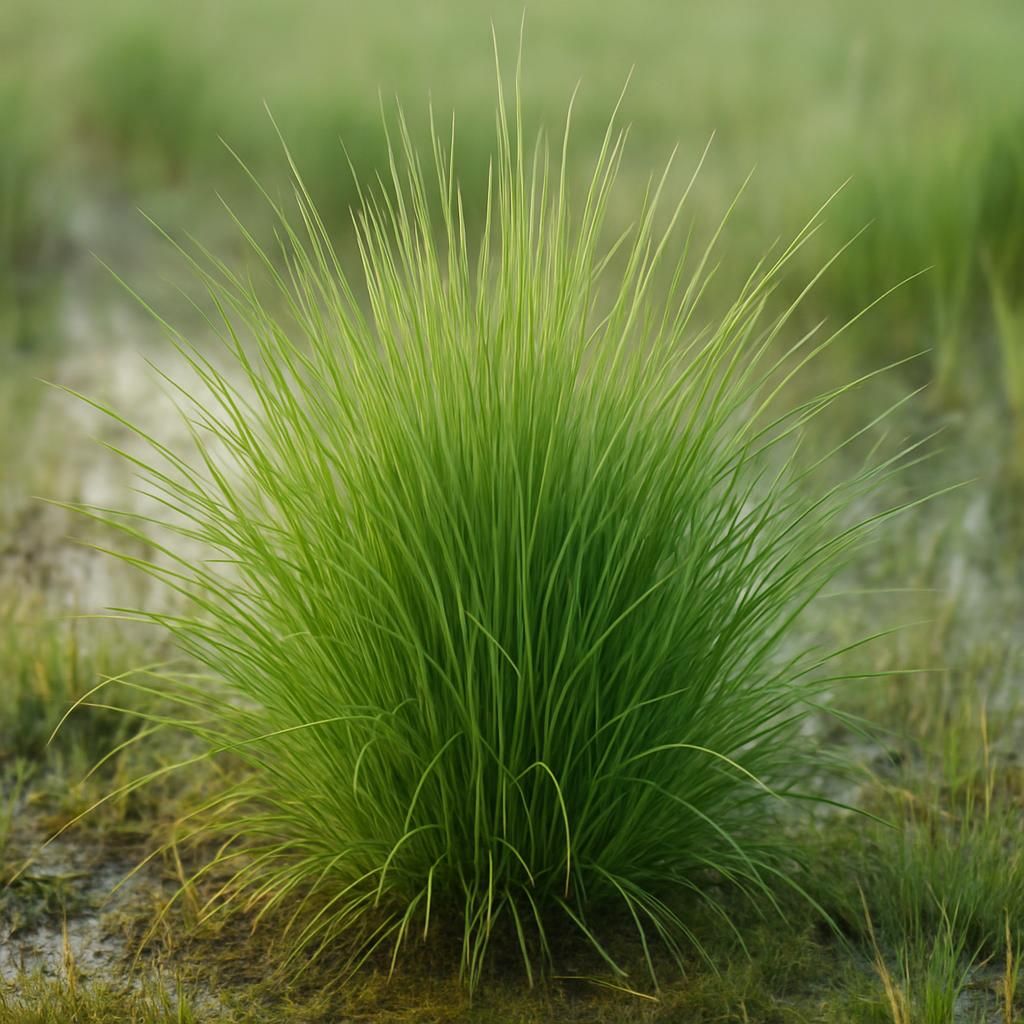
Introduction to Carex stricta
Carex stricta, commonly called tussock sedge or upright sedge, is a clumping, perennial wetland grass-like plant native to North America. It thrives in saturated soils along streams, marshes, and wet meadows, where its dense root system stabilizes banks and filters runoff. Professional growers value it for ecological restoration, rain garden construction, and low-maintenance landscaping in USDA zones 3–8. Unlike many ornamental grasses, Carex stricta remains semi-evergreen in milder climates and provides critical early-season habitat for beneficial insects and amphibians.
Its fine-textured, bright green foliage grows 2–3 feet tall with an equal spread, forming characteristic hummocks or tussocks that rise above standing water. These tussocks improve biodiversity by creating micro-habitats while reducing soil erosion during heavy spring flows. Because it tolerates periodic flooding and drought once established, Carex stricta serves as a resilient choice for climate-adaptive agriculture and conservation plantings.
Botanical Profile of Carex stricta
Carex stricta belongs to the Cyperaceae family and is distinguished by its triangular stems, narrow leaves, and terminal inflorescences of wind-pollinated spikelets. The plant spreads slowly via short rhizomes and produces copious fibrous roots that bind saturated soils. Flowers appear in late spring as erect, brownish spikes that mature into small achenes dispersed by water and gravity. Its evergreen-to-semi-evergreen habit varies by latitude, with northern populations dying back completely while southern stands retain winter color.
Botanically, the species exhibits strong phenotypic plasticity, allowing it to colonize both full-sun open wetlands and partial-shade forest edges. Professional nurseries propagate selected ecotypes for improved uniformity and disease resistance. Understanding these traits helps growers match plant material to site hydrology and light conditions for optimal establishment success.
Soil, pH, and Climate Requirements for Carex stricta (MUST INCLUDE A MARKDOWN TABLE OF IDEAL CONDITIONS)
Successful commercial production of Carex stricta begins with matching site conditions to the species’ native wetland preferences. The plant performs best in heavy loam to clay soils that retain moisture yet drain enough to prevent prolonged anaerobic conditions around the crown. Organic matter content above 4 % supports vigorous root development and nutrient cycling. While tolerant of seasonal inundation, Carex stricta declines in permanently standing water deeper than 6 inches.
| Parameter | Ideal Range | Notes |
|---|---|---|
| Soil Texture | Loam to clay loam | Avoid pure sand unless heavily amended |
| Soil pH | 5.5 – 7.5 | Slightly acidic to neutral; tolerates 5.0 |
| Organic Matter | 4 – 10 % | Incorporate compost or peat for low-OM sites |
| Soil Moisture | Consistently moist to wet | Tolerates 1–6 inches seasonal flooding |
| USDA Hardiness | Zones 3 – 8 | Protect young plants in zone 3 winters |
| Temperature Range | 15 °F – 85 °F | Optimal growth 55–75 °F |
| Light Requirement | Full sun to partial shade | Full sun maximizes density and flowering |
| Salinity Tolerance | Low (< 2 dS/m) | Sensitive to road salt and brackish water |
Site selection should also consider micro-topography; slight elevation within a wetland allows tussocks to form above average water levels, reducing crown rot risk. Pre-plant soil tests for pH, salinity, and nutrient levels guide amendment decisions before installation.
Step-by-Step Planting & Propagation
Propagation of Carex stricta is achieved primarily through division of established clumps or from seed. Division is preferred for commercial uniformity. In early spring or fall, lift mature plants, separate into 4–6 inch sections with at least three growing points, and replant immediately at the same depth. Spacing of 12–18 inches on center allows rapid canopy closure while minimizing competition.
Seed propagation requires cold-moist stratification for 60–90 days at 35–40 °F to break dormancy. Sow stratified seed in flats of moist seed-starting mix under 60–70 °F with high humidity. Germination occurs in 14–28 days. Seedlings are transplanted to 4-inch pots once they reach 3 inches tall and hardened off for 7–10 days before field planting. Direct seeding into prepared wetland beds is possible but demands excellent weed control during the first season.
Care & Maintenance regimes for Carex stricta (MUST INCLUDE A MARKDOWN TABLE OF WATER, FERTILIZER, AND PRUNING SCHEDULES)
Once established, Carex stricta requires minimal intervention. Supplemental irrigation is necessary only during the first growing season or prolonged summer drought. Fertilization is rarely needed in fertile wetland soils; however, light applications support container production or nutrient-poor restoration sites.
| Season | Watering Schedule | Fertilizer Schedule | Pruning / Maintenance Schedule |
|---|---|---|---|
| Spring | Keep evenly moist; 1 inch/week if dry | Apply ½ lb N/1000 ft² slow-release 10-10-10 in March if growth is pale | Cut back previous season’s foliage to 4–6 inches before new growth emerges |
| Summer | Maintain consistent moisture; avoid drying | None required unless container-grown | Remove spent inflorescences only if aesthetic control desired |
| Fall | Reduce watering as temperatures drop | None | Optional light trim to tidy appearance; leave 6 inches for winter interest |
| Winter | Natural precipitation sufficient | None | Remove debris only if it impedes spring emergence or harbors rodents |
Mulching with 2–3 inches of coarse wood chips or pine straw suppresses weeds and conserves moisture during establishment. Avoid high-nitrogen fertilizers that promote lush foliage at the expense of root development and winter hardiness.
Pests, Diseases & Organic Management
Carex stricta is generally resistant to serious pests, yet aphids and spider mites may appear during hot, dry spells. Monitor leaf undersides weekly and apply insecticidal soap or neem oil at first detection. Slugs can damage young foliage in overly moist micro-sites; iron-phosphate baits provide effective organic control.
Fungal leaf spots occasionally develop under prolonged high humidity. Improve air circulation by proper spacing and remove infected leaves. Root and crown rots caused by Pythium or Phytophthora are rare when soil is not waterlogged year-round. Preventive drenches of beneficial Bacillus subtilis or Trichoderma spp. strengthen root health in high-risk plantings.
Harvesting, Curing & Optimal Storage
Commercial harvest of Carex stricta focuses on seed collection or division stock rather than foliage. Mature seed heads are collected in late summer when achenes turn tan and detach easily. Dry seed heads in paper bags at 70 °F for 7–10 days, then clean with screens or air-column separators. Store cleaned seed in sealed containers at 35–40 °F with 5–8 % moisture content for up to three years with 70 % viability retention.
Division stock is lifted in early spring or fall, washed free of soil, and stored in moist sphagnum moss or cedar shavings at 35–40 °F. Divisions remain viable for 4–6 weeks if kept cool and moist. Label all lots with collection date and source ecotype for traceability in restoration projects.
Companion Planting for Carex stricta
Carex stricta pairs well with other wetland species that share similar hydrology. Recommended companions include Joe-Pye Weed, Blue Flag Iris, and Cardinal Flower for pollinator support and visual contrast. In rain garden designs, interplant with Switchgrass and Soft Rush to create layered structure and extended bloom periods.
Avoid aggressive competitors such as Common Reed or Purple Loosestrife that can outcompete sedge colonies. Strategic placement near Cattail stands provides additional erosion protection while maintaining biodiversity. These pairings enhance both ecological function and market appeal for native plant nurseries and landscape contractors.