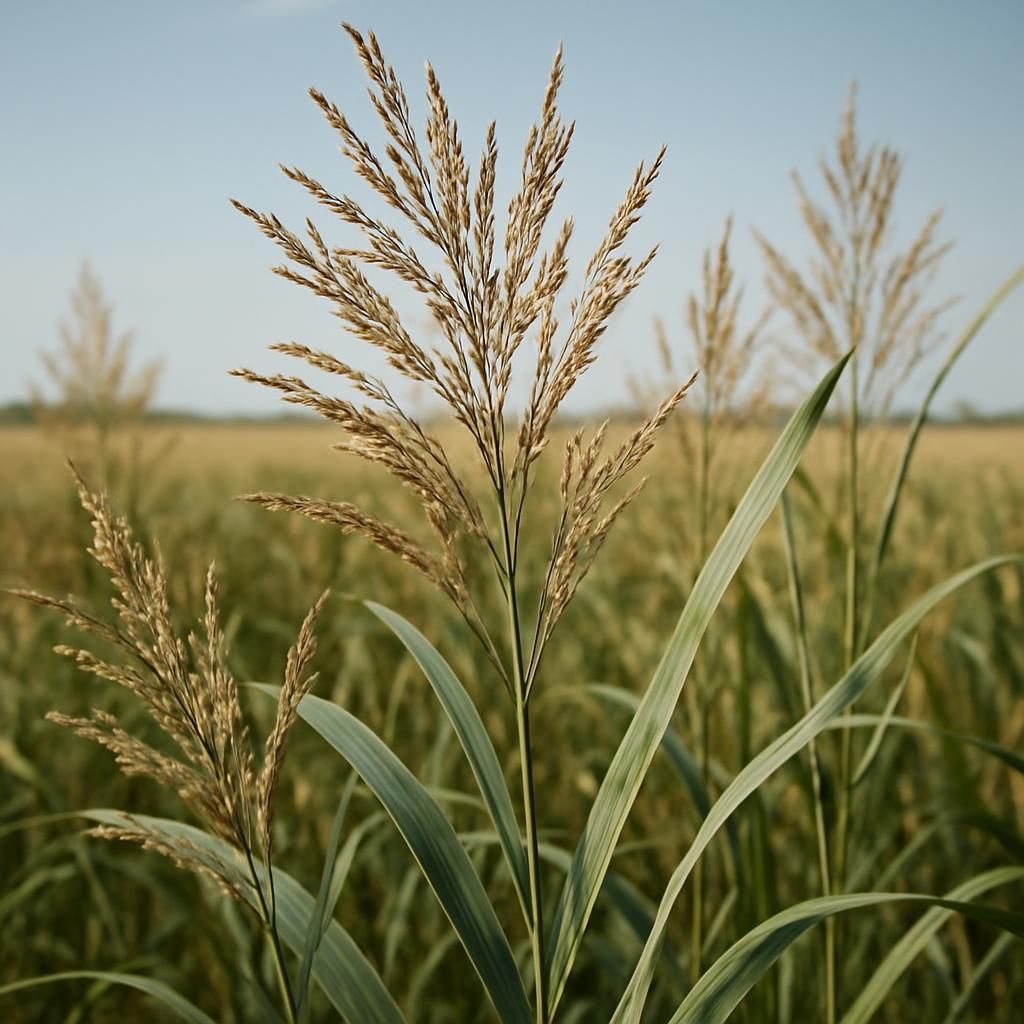
Introduction to switchgrass
Switchgrass (Panicum virgatum) is a native North American warm-season perennial bunchgrass that has become a cornerstone species for sustainable agriculture, bioenergy feedstock production, and ecological restoration. Originally adapted to prairies, it now serves commercial farms seeking low-input, high-biomass crops that improve soil health while delivering long-term economic returns. Its deep fibrous root system stabilizes slopes, sequesters carbon, and filters runoff, making it ideal for marginal lands unsuitable for row crops.
Growers appreciate switchgrass for its resilience: once established, stands persist 10–20 years with minimal annual inputs. It produces high-quality biomass for pellet fuel, cellulosic ethanol, and animal bedding while supporting pollinators and grassland birds. This guide delivers professional-grade agronomic recommendations for commercial and conservation plantings.
Botanical Profile of switchgrass
Switchgrass belongs to the Poaceae family and exhibits two primary ecotypes: upland and lowland. Upland varieties (e.g., Cave-in-Rock, Blackwell) are shorter (1.2–1.8 m), more cold-tolerant, and suited to well-drained sites. Lowland ecotypes (e.g., Alamo, Kanlow) reach 2.5–3 m, prefer wetter soils, and deliver higher biomass yields in southern regions.
The plant forms dense clumps with erect stems, long linear leaves, and an open, airy panicle that disperses seed in late summer. Rhizomatous spread is minimal; most propagation occurs via seed. Flowering occurs July–September depending on latitude, with seed maturity typically 4–6 weeks after anthesis.
Soil, pH, and Climate Requirements for switchgrass
Switchgrass performs across a wide range of soils but achieves peak productivity on moderately fertile, well-drained sites. It tolerates pH 5.0–8.0 but yields best between 6.0–7.5. Lowland types tolerate periodic flooding; upland types require good drainage.
| Parameter | Ideal Range | Notes |
|---|---|---|
| Soil Texture | Loam to sandy loam | Avoid heavy compacted clays |
| Soil pH | 6.0–7.5 | Tolerates 5.0–8.0 |
| Organic Matter | 2–5% | Higher OM improves establishment |
| Drainage | Moderate to good | Lowland types handle seasonal wetness |
| Minimum Temperature | −20 °C (−4 °F) | Dormant plants survive winter freezes |
| Optimum Growing Temp | 25–35 °C (77–95 °F) | Peak growth occurs mid-summer |
| Annual Rainfall | 500–1,200 mm | Supplemental irrigation rarely needed |
| USDA Hardiness Zones | 3–9 | Select ecotype matched to zone |
Step-by-Step Planting & Propagation
- Site preparation: Eliminate existing vegetation with glyphosate or tillage; conduct soil test and correct pH and nutrients.
- Seedbed: Create firm, weed-free seedbed; avoid excessive tillage that promotes erosion.
- Seeding rate: 8–12 kg/ha pure live seed (PLS) for drilled stands; increase to 12–16 kg/ha for broadcast or marginal sites.
- Depth and timing: Drill seed 6–12 mm deep. Plant in late spring when soil temperature reaches 18 °C (65 °F) or later for weed control.
- Inoculation: No rhizobial inoculant required; native mycorrhizae assist nutrient uptake.
- First-year management: Mow weeds at 15–20 cm height; avoid harvesting until year two to allow root development.
Care & Maintenance regimes for switchgrass
Established stands require minimal intervention. Fertility programs focus on phosphorus and potassium replacement based on soil tests; nitrogen is applied sparingly after year two.
| Operation | Timing | Rate / Method | Frequency |
|---|---|---|---|
| Water | Establishment only | 25 mm/week if rainfall <50 mm | First 8–12 weeks |
| Fertilizer N | Post-harvest or spring | 50–80 kg N/ha (year 2+); soil test P & K | Annual |
| Fertilizer P/K | Pre-plant or fall | Per soil test (maintain 30–50 ppm P) | Every 2–3 years |
| Pruning/Mowing | Early spring | Mow to 10–15 cm to remove residue | Annual |
| Weed Control | Year 1–2 | Mowing at 15 cm; spot herbicide if needed | As required |
Pests, Diseases & Organic Management
Switchgrass is relatively pest-resistant, yet young stands may suffer from grasshoppers and armyworms. Fungal issues such as rusts or leaf spot diseases appear under prolonged humidity. Cultural controls—proper spacing, residue removal, and resistant cultivars—form the first line of defense. Organic options include neem oil, Bacillus thuringiensis for caterpillars, and beneficial nematodes for soil pests. Regular scouting during establishment prevents outbreaks.
Harvesting, Curing & Optimal Storage
Harvest once after frost when moisture drops below 18%. Cut at 10–15 cm stubble height using a mower-conditioner or swather. Field-dry to 12–15% moisture before baling. Store bales under cover or plastic wrap to prevent weathering losses. For pellet production, grind and pellet within 30 days of harvest to preserve quality.
Companion Planting for switchgrass
Switchgrass integrates well with native forbs and legumes such as clover or sunflower to boost biodiversity and pollinator habitat. Interseeding with sorghum or millet can provide first-year nurse crops that suppress weeds while the perennial stand develops. Avoid aggressive cool-season grasses that compete during establishment.