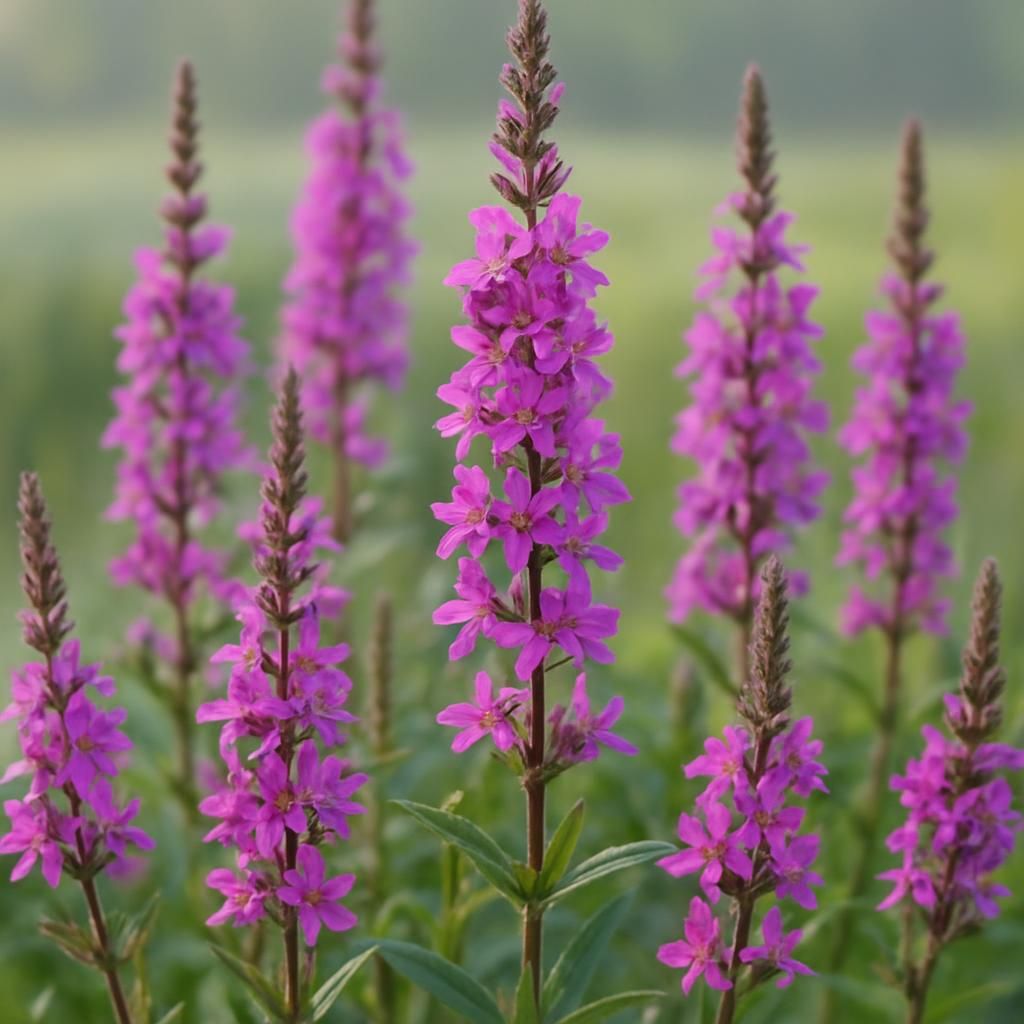
Introduction to Purple Loosestrife
Purple loosestrife (Lythrum salicaria) is a tall, clump-forming perennial that produces dense stands of vibrant magenta flower spikes from mid-summer into early autumn. Originally introduced from Europe and Asia as an ornamental and medicinal herb, it has become one of the most problematic invasive wetland plants across temperate North America. Professional agricultural and land-management experts treat this species with extreme caution because a single mature plant can produce over two million seeds annually and spread vegetatively through root fragments. While some regions still permit controlled cultivation in contained water gardens, most jurisdictions classify it as a noxious weed requiring eradication or strict isolation.
Botanical Profile of Purple Loosestrife
Lythrum salicaria belongs to the family Lythraceae and grows 0.5–2 meters tall with square stems and opposite or whorled, lance-shaped leaves. The showy terminal spikes consist of numerous small, six-petaled flowers that attract bees, butterflies, and hoverflies. Below ground, the plant develops a woody caudex and extensive rhizomes capable of producing new shoots from fragments as small as 1 cm. Because of its aggressive rhizomatous spread, many experts recommend treating it similarly to other regulated invasives such as Japanese Knotweed in containment protocols.
Soil, pH, and Climate Requirements for Purple Loosestrife (MUST INCLUDE A MARKDOWN TABLE OF IDEAL CONDITIONS)
Purple loosestrife thrives in saturated or seasonally flooded soils with high organic content. It tolerates a wide pH range but grows most vigorously in slightly acidic to neutral conditions. The species is fully hardy in USDA zones 3–9 and performs best with consistent moisture and full sun exposure.
| Parameter | Ideal Range | Notes |
|---|---|---|
| Soil Type | Loamy to silty clay | High organic matter preferred |
| Soil pH | 5.5 – 7.5 | Tolerates 4.5–8.0 but vigor declines outside ideal |
| Moisture | Saturated to 15 cm standing water | Tolerates periodic drought once established |
| Temperature Range | 15–30 °C daytime | Frost tolerant to –30 °C |
| Light | Full sun (6+ hours) | Partial shade reduces flowering |
| Salinity | Low (<4 dS/m) | Sensitive to brackish conditions |
Step-by-Step Planting & Propagation
- Site Selection: Choose a location with permanent containment such as lined ponds, raised wetland beds, or sealed containers. Verify local noxious-weed regulations before planting.
- Soil Preparation: Amend native soil with 30–50 % composted organic matter to improve water-holding capacity while maintaining drainage within the containment structure.
- Propagation Methods: The most reliable professional technique is division of established clumps in early spring. Seed propagation is discouraged because of extreme fecundity; if seed is used, cold-stratify for 60 days at 4 °C and sow under controlled greenhouse conditions.
- Planting Depth: Rhizomes should be placed 5–10 cm deep with crowns at soil level. Space plants 30–45 cm apart within containment to allow monitoring.
- Containment Barriers: Install 45–60 cm deep root barriers or use above-ground planters with sealed bottoms to prevent escape into natural waterways.
Care & Maintenance regimes for Purple Loosestrife (MUST INCLUDE A MARKDOWN TABLE OF WATER, FERTILIZER, AND PRUNING SCHEDULES)
Because the species is managed primarily for containment rather than production, maintenance focuses on preventing seed set and rhizome escape.
| Season | Watering Schedule | Fertilizer (N-P-K) | Pruning / Deadheading Schedule |
|---|---|---|---|
| Spring | Maintain 5–10 cm standing water | 10-10-10 at 50 g/m² once new growth appears | Remove winter debris; divide if containment is crowded |
| Summer | Keep soil saturated; top up weekly if rainfall <2.5 cm | Avoid high-nitrogen to limit vegetative spread | Deadhead spent spikes weekly before seed capsules form |
| Autumn | Reduce to field capacity as plants senesce | None | Cut stems to 10 cm after first hard frost |
| Winter | Minimal; prevent complete freezing of root zone in containers | None | Monitor containment barriers for damage |
Pests, Diseases & Organic Management
Purple loosestrife has few serious pests in its introduced range, but the introduced biological control agents Galerucella beetles have proven effective in reducing populations where permitted. Monitor for Aphids and Spider Mites on stressed plants. Root and crown rots caused by Pythium and Phytophthora can occur in poorly drained artificial containers. Organic management emphasizes mechanical removal of seedlings, solarization of contaminated soil, and strict sanitation of tools and footwear.
Harvesting, Curing & Optimal Storage
Professional growers rarely harvest loosestrife biomass because of regulatory restrictions. If biomass must be removed for control purposes, cut stems at ground level in late summer before seed set, bag immediately, and dispose of as regulated invasive waste. Do not compost. Dried stems can be stored in sealed containers for up to 12 months if needed for research or dye extraction, but seed heads must be removed first.
Companion Planting for Purple Loosestrife
Because of its invasive potential, companion planting is generally discouraged. In permitted research or educational wetland displays, pair with native sedges such as Carex stricta and Juncus effusus inside sealed liners to demonstrate competitive exclusion studies. Always maintain a 3-meter buffer zone from natural waterways and label all plantings clearly.